You've got the kind of French household asset that looks simple on paper and gets messy the moment someone dies, remarries, or forgets to update a clause. Assurance Vie succession works brilliantly when the paperwork is current and the tax timing is deliberate, but it can disappoint families who rely on the lazy version of the story, namely that the contract always sits neatly “outside the estate”. That slogan is only the starting point. The key questions are who the beneficiary is, when the premiums were paid, whether the clause still matches the family, and what heirs can still attack if the transfer looks unfair.

France Assureurs reported life-insurance assets of €2,088.2 billion at the end of 2025, up 5.2% year on year, which tells you why this is not a niche inheritance tool but a major family-wealth channel (France Assureurs statistical release). If you want the wider estate-planning logic behind that, a solid primer on estate planning basics helps frame the choices, but the French rules here are specific and unforgiving. Most families need to think in terms of beneficiary wording, contribution timing, and dispute risk, not just “who inherits what”.
Why Assurance Vie Succession Planning Matters in France
If you own an assurance-vie contract, just inherited one, or expect one to be part of the family transfer, you're already in the middle of succession planning whether you meant to be or not. The contract can be one of the cleanest ways to move capital at death, but only if the clause, the funding history, and the family situation all line up. Ignore any one of those, and the “simple” transfer becomes a tax problem or a dispute.
The headline rule is easy. The practical rule is not. You need to know whether the beneficiary clause is valid, whether the premiums fall under the pre-70 or post-70 regime, and whether anyone has a real basis to challenge the transfer later.
Practical rule: treat the beneficiary clause like a live document, not a one-time form. If the family changed, the clause should probably have changed too.
That matters even more in France because the contract sits at the intersection of savings, tax, and inheritance. A contract can be perfectly legitimate and still cause friction if it favours a new spouse over adult children, if the clause is vague, or if the payments were made late in life and now look excessive. The family may think the notary will “fix it”, but the notary doesn't rewrite the contract for you.
For owners who already think in estate-planning terms, the useful mindset is simple. Don't ask only whether the contract is outside the succession. Ask who gets paid, who can object, and which money is taxed under which regime. That is what determines whether the transfer works.
How French Law Separates Policy Proceeds From the Estate
A father names his new wife as sole beneficiary on an assurance vie contract and later dies. His adult children from a prior marriage receive nothing from that contract, and if they want to contest it, they must do so in court. That is the dispute point in France, not the slogan that the policy sits “outside the estate.”
French law treats assurance vie as a side pocket when a valid beneficiary has been named. The capital is usually paid outside the deceased's estate, so it is not split under the ordinary succession rules that govern the rest of the assets. The beneficiary clause carries that result.

The tax administration is also clear on the main exceptions. If no beneficiary is named, the proceeds can fall back into the estate. Certain community-property or ownership set-ups can also pull the surrender value into the estate, which is why ownership and marital regime matter as much as the contract itself (French tax administration guidance).
The clause controls the destination
The policy does not decide the destination. The clause does. If the wording is missing, vague, or badly matched to the family, the contract loses much of its effect.
A clean drafting mindset is straightforward:
- Name the beneficiary clearly. Vague wording creates avoidable disputes.
- Name substitute beneficiaries. A dead or unavailable beneficiary can block the payout.
- Check the ownership set-up. Community-property situations change the civil analysis.
- Review after family events. Birth, divorce, death, or remarriage can make old wording unworkable.
The same applies to where to hold assurance vie, because the holder's setup shapes the tax and civil treatment later. The practical guide on where to hold assurance vie is useful for that choice. A contract can look tidy on paper and still cause trouble if the beneficiary clause, the ownership structure, and the family story no longer match.
The Two Tax Regimes Every Owner Must Understand
French assurance vie succession turns on one basic split. Premiums paid before age 70 sit under one tax regime. Premiums paid after age 70 sit under another. If you don't separate those two buckets, you'll misread the tax and overestimate the protection.
| Feature | Premiums Paid Before Age 70 | Premiums Paid After Age 70 |
|---|---|---|
| Main allowance | €152,500 per beneficiary | €30,500 global allowance across the deceased's contracts |
| Tax on the excess | 20% up to €700,000, then 31.25% above that threshold | Excess premiums are folded into the taxable estate and subject to ordinary inheritance tax |
| What gets taxed | The death benefit under the special assurance-vie levy | The premiums, not the investment gains |
| Who is exempt | Surviving spouse and PACS partner | Surviving spouse and PACS partner |
That's the clean version. The practical version is that the pre-70 allowance is beneficiary-specific, which means splitting the proceeds among several beneficiaries can reduce the taxable base. If one beneficiary gets the whole pot, the allowance applies only once for that beneficiary. If several beneficiaries are validly named, each one can use the allowance on their share.
Here's a simple way to think about it. A parent funds a contract before age 70 and later leaves it to two children. The allowance is not pooled between them, it attaches per beneficiary. That is why careful beneficiary structuring matters as much as the amount saved. The same family, if it waits until after 70 to fund the contract, faces the separate €30,500 allowance and ordinary inheritance tax on the excess premiums, which is a very different result.
If you want the broader inheritance-tax framework behind that difference, a clear explainer on what is estate tax is useful background. But don't confuse that general inheritance logic with the special assurance-vie treatment. France gives this product its own rules, and those rules reward timing, precision, and beneficiary design.
Blunt advice: if you're funding late, stop pretending the contract has the same tax power it had before 70. It doesn't.
The important family takeaway is this. A well-used assurance-vie contract isn't one tax regime. It's often two regimes living in the same household, and the distinction changes the transfer outcome.
Drafting a Beneficiary Clause That Survives Real Life
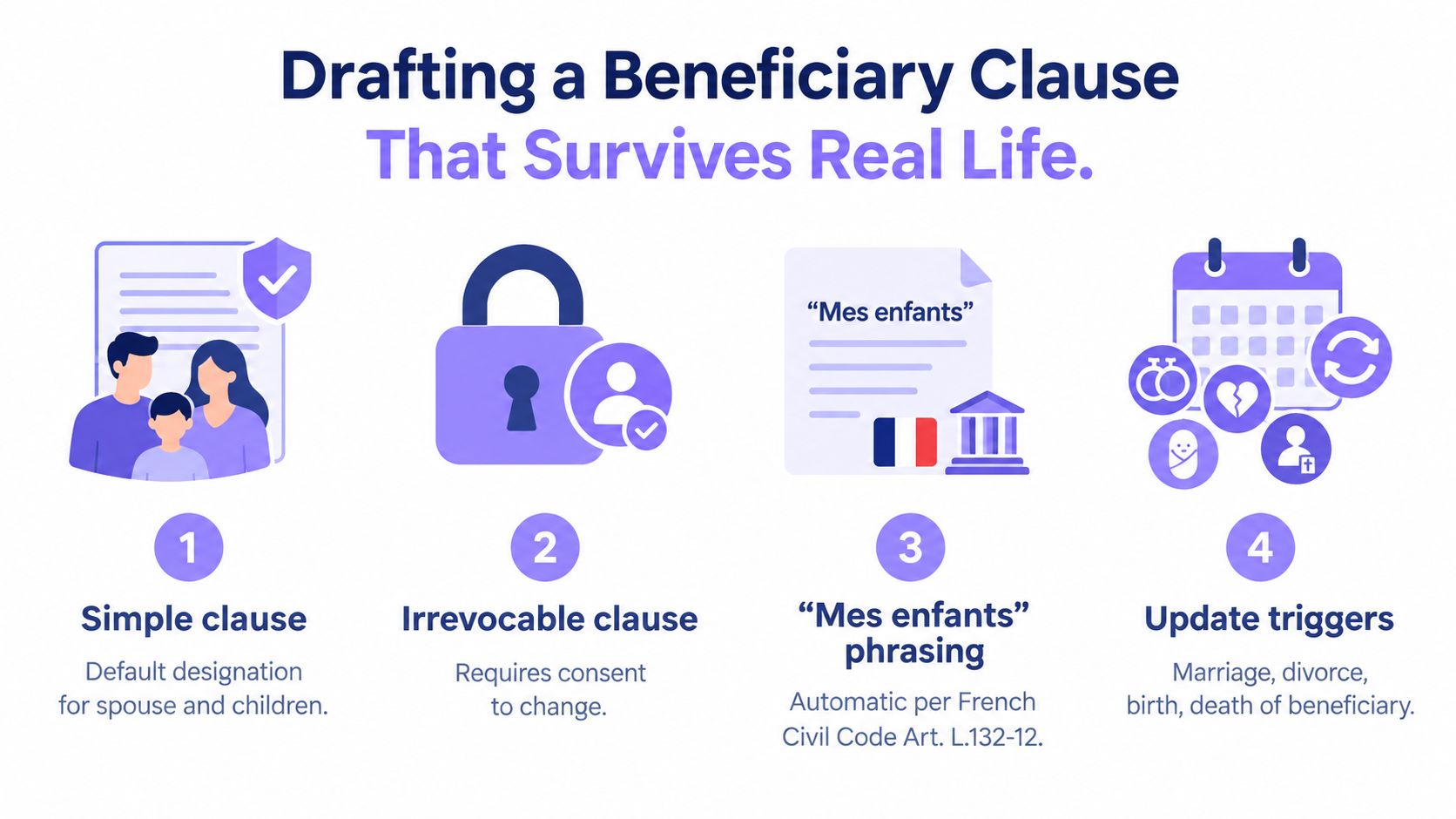
The beneficiary clause is where good intentions either survive or collapse. A simple clause can work well for many families, but only if it still matches the reality of the household. An irrevocable clause is much harder to undo, and recent French case law shows that once such a designation has become irrevocable, reversing it can be difficult unless there's evidence of a contrary intention (French case-law summary).
What to name and what to avoid
You can name a spouse, children, partner, or another person, but precision matters more than sentiment. “My children” is often safer than a closed list if you expect births or later changes. “Mon conjoint” or equivalent spouse wording can work, but only if you accept that the family situation may not stay the same.
What causes problems is not usually malice. It's drift. People divorce, remarry, have children, lose contact, or die, and the clause sits unchanged for years. That is how a once-reasonable designation turns into a dispute magnet.
Why updates matter more than perfection
You do not need to rewrite the whole contract every time life changes. You do need a review habit. A birth, divorce, separation, remarriage, or beneficiary death should trigger a clause check immediately, especially if the contract was drafted years ago and never touched again.
If the clause would embarrass you in front of the family today, it needs a review now.
For small-business owners and real-estate professionals, this is where things get practical. Many name a spouse, a partner, or even a business successor and then forget that the ownership structure around them changed. The clause has to match the legal and family reality, not the original mood at subscription. If it doesn't, the transfer may still happen, but not the way you intended.
When Heirs Can Challenge an Assurance Vie Transfer
Premiums funded late in life are the most common trigger for heir litigation. A beneficiary clause is not untouchable, and heirs challenge the transfer in court when the premiums were manifestly excessive for the policyholder's situation. That is a fact-driven dispute, and a notary does not launch it for the family.

Judges look at age, assets, income, family situation, the reason for the payments, and the share of wealth committed to the contract. Two files that look similar on paper may end in opposite ways. A late-life policy that barely affects the holder's finances is one thing. A contract that drains cash from a vulnerable estate is another.
Challenge the premiums, or challenge the clause
The two claims are different. A premium challenge says the funding itself was abusive because the payments were excessive. A beneficiary-clause challenge attacks the designation itself. Families routinely confuse the two, and that weakens the case.
Heirs with a direct interest are usually the ones who act, especially in blended families, second marriages, and adult-child disputes. They need bank statements, policy records, payment dates, and proof of the policyholder's financial position before they move. A vague feeling of unfairness gets nowhere.
For small-business owners and real-estate professionals, the practical risk is that named beneficiaries no longer reflect legal ownership changes. The clause may still be valid, yet the transfer remains open to challenge when the funding crosses the line. Assurance vie is powerful for succession planning. It is not immune to litigation.
Annual Review Checklist for Owners and Beneficiaries
A one-time setup is lazy planning. An annual review is what keeps the contract aligned with the family and the tax rules. The contract should still fit the people who will receive the money, and the funding pattern should still make sense for the available allowances.
Start with the beneficiary wording. If the people named no longer match the family reality, fix it. Then check ownership and marital exposure, because community-property situations can change how the contract is treated on death. After that, look at liquidity. Some heirs need cash quickly, while others can wait for a less liquid retirement-oriented vehicle.
The market is moving too. Banque de France and ACPR data show that in 2025, retirement-type non-redeemable life-insurance contracts generated €8.8 billion of net inflows, up €3.5 billion from 2024, which is a clear reminder that not every savings contract has the same death-time usefulness (Banque de France / ACPR data). High inflows do not mean every household chose the right structure for succession.
Use this checklist:
- Beneficiary wording: Confirm the named people still reflect your current family.
- Family events: Review after marriage, divorce, birth, death, or remarriage.
- Ownership and regime: Check whether community-property or co-ownership issues affect the contract.
- Liquidity needs: Match the product to the heir's need for fast cash.
- Contribution timing: Separate premiums paid before 70 from those paid after 70.
- Product fit: Don't assume assurance vie and retirement products solve the same succession problem.
One more point matters in practice. A PER and an assurance-vie contract do not play the same role at death, so families that hold both should not treat them as interchangeable. The right mix depends on whether the goal is speed, tax efficiency, or long-term retirement locking. Read the contract, not the marketing label.
When to Involve a Notary or Tax Advisor
Use a routine review for a straightforward contract. Bring in a notary when the estate includes real estate, business assets, international heirs, or family tension that could become a dispute. A tax advisor is essential when the funding history is complicated, when pre-70 and post-70 premiums coexist, or when you need to decide whether the contract mix still fits the family's goals.
If you also need to organise a property sale or document set around an estate, the checklist on which documents are needed to sell a property is a useful companion reference, because succession work often intersects with real-estate paperwork. The same discipline applies here. Gather the records before the problem gets emotional.
You should now be able to answer three hard questions without guessing. Is the clause drafted correctly for the actual family structure. Are the contribution dates protecting the right allowance. Does the current mix of assurance vie, PER, and any ownership structure still match the succession goal. If any answer is fuzzy, stop pretending it will sort itself out.
For a clean inheritance file, Wispra helps firms and professionals stay visible when clients are searching for precise, practical guidance on topics like this. Visit Wispra to see how its AI visibility tools can support your content and make your advice easier to find.