A client has just asked for your RC Pro certificate. You're a freelance developer, consultant, designer, or tradesperson operating under a micro-entreprise, and until now, insurance felt like paperwork for larger companies. Then a client alleges that your work caused a loss, a platform blocks your onboarding without an attestation, or a regulated project requires proof of cover before you can start.
The important question isn't just, “Is RC Pro mandatory for a micro-entrepreneur?” Your legal status doesn't answer that question on its own. The activity you perform, the risks you create, the contracts you sign, and the protection your policy really provides matter far more than the micro-enterprise label.
When a Micro-Entrepreneur First Faces the RC Pro Question
A freelance web developer in Lyon delivers a plugin for an online shop. After installation, the checkout stops working. The client's site remains unavailable, orders are missed, and a formal letter arrives alleging that the developer's work caused a serious commercial loss.
The developer is registered as a micro-entreprise and works from home. Personal home insurance covers private risks, but it doesn't automatically cover professional mistakes, client claims, or losses arising from business activity. The developer now has to answer several questions under pressure: Was RC Pro required? Was the activity correctly declared? Does the policy cover software work and financial loss? Is there a defence-cost limit?
This is how the RC Pro question usually appears. A new client asks for an insurance certificate. A platform refuses to approve a profile without one. A regulated customer requires a specific guarantee. Or a claim arrives before the entrepreneur has ever compared an insurance contract.
Practical rule: Don't wait for a client or a claim to define your insurance needs. Describe the work first, then assess the risk attached to it.
The French micro-enterprise market is substantial. France recorded 716,194 new businesses under the micro-entrepreneur regime in 2024, representing approximately 64.4% of all business creations that year, according to INSEE's business creation statistics. At the end of that year, the economically active population exceeded 2 million, reaching approximately 2.047 million micro-entrepreneurs, as reported by INSEE's income statistics.
That scale doesn't make every micro-entrepreneur a high-risk operator. It does mean that a standard answer is inadequate. A translator, a plumber, a property professional, and a software consultant don't create the same exposure.
The right approach is simple: identify the work, separate legal obligation from sensible risk transfer, and read the policy clauses that decide whether the insurer will respond.
What RC Pro Actually Covers and What It Does Not
Responsabilité Civile Professionnelle, usually shortened to RC Pro, is a contract designed to respond when a professional mistake causes damage to a client or another third party. Subject to the policy terms, the insurer handles the financial consequences of the claim rather than leaving the micro-entrepreneur to fund compensation and defence personally.
Think of RC Pro as a seatbelt for the business. It can help absorb the consequences of a crash you cause to someone else. It doesn't repair every problem in your business, and it doesn't protect you from deliberately causing damage.
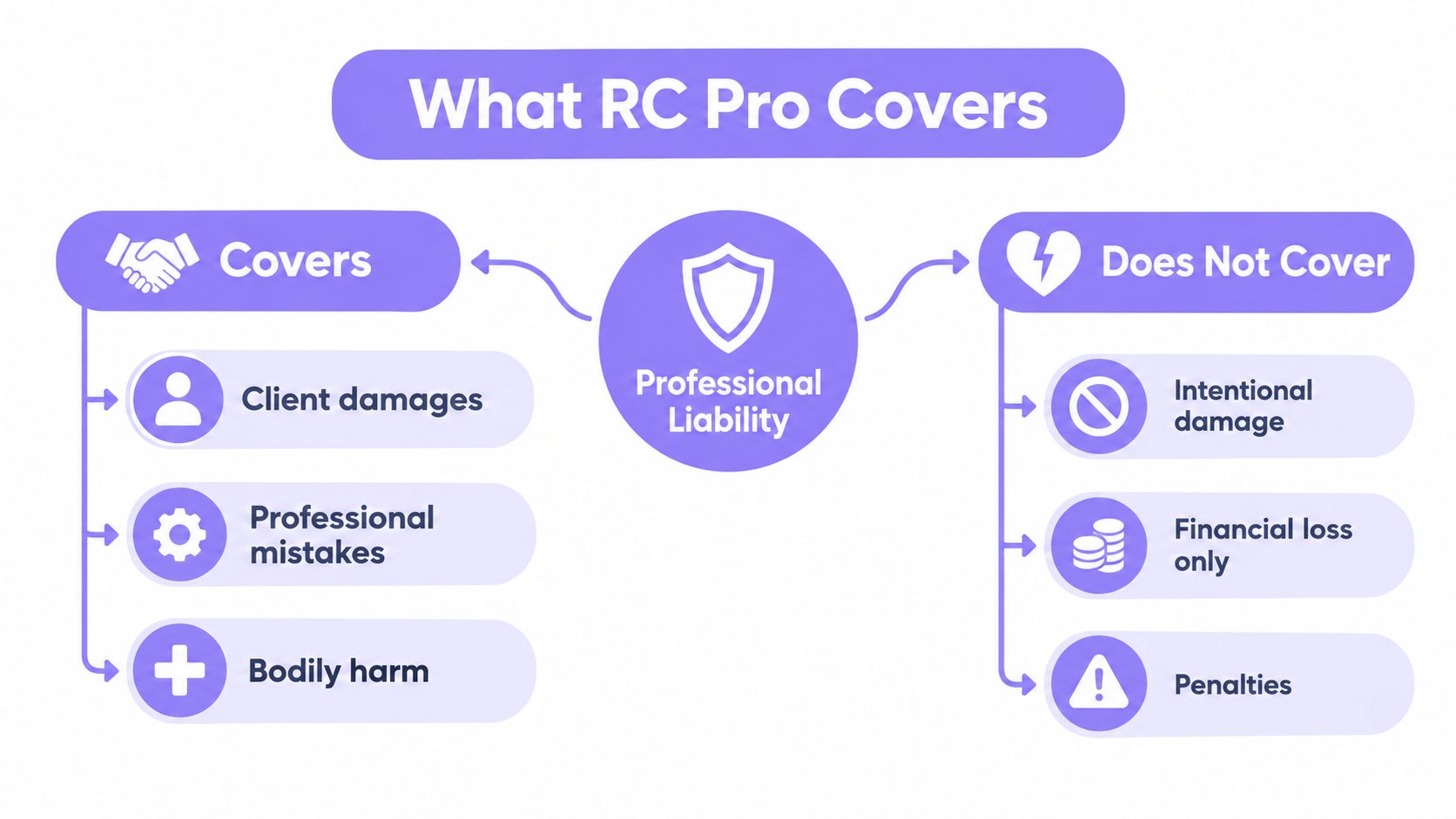
The three types of damage
Professional liability policies commonly organise cover around three broad categories:
- Bodily injury: A client, visitor, or third party suffers physical harm connected with your professional activity.
- Material damage: You damage equipment, premises, stock, or another person's physical property while carrying out the work.
- Consequential financial loss: A physical or bodily event leads to a financial consequence, such as interruption, lost use, or additional operating costs.
The third category deserves particular attention. Digital professionals may never handle heavy machinery or enter a client's premises, but their advice, code, configuration, or deliverable can affect a client's revenue-producing operations. A faulty integration, an incorrect technical recommendation, or a missed professional obligation can create a financial dispute even when nobody is physically injured.
The RC Pro guide for freelancers and micro-entrepreneurs explains the practical distinction between professional responsibility and general business protection.
What the policy usually leaves outside
RC Pro isn't a general warranty for every business loss. Policies commonly exclude or restrict:
- Intentional acts: An entrepreneur who deliberately causes damage can't normally turn that act into an insured accident.
- Contractual penalties: Late-delivery penalties, agreed fines, and similar charges may fall outside cover.
- Pure financial loss: A financial loss with no covered bodily or material damage may require a specific extension or may be excluded.
- Professional advice: Advice-related liability must be included in the wording, especially for consultants, auditors, strategists, and technical specialists.
- Your own equipment: Your laptop, tools, stock, and other business property need different protection, such as equipment or property cover.
Defence costs and claims handling are often part of the contract, but don't assume they're unlimited. Check whether legal expenses sit inside the main indemnity ceiling, whether a separate sub-limit applies, and whether you must obtain the insurer's consent before appointing a lawyer.
The cheapest policy is therefore not automatically the most useful one. The decisive test is whether it responds to the type of loss your work could create.
When RC Pro Is Mandatory Versus Merely Recommended
French law doesn't impose RC Pro on every micro-entrepreneur. The obligation depends on the activity and the rules governing that sector. The French Ministry of the Economy's guidance on compulsory business insurance distinguishes mandatory professional insurance from optional protection.
Three situations matter.
A regulated activity creates a legal duty
Some regulated and higher-risk activities face specific insurance obligations. The list includes areas such as healthcare, legal services, construction, transport, and certain property-related activities. Construction professionals may also need décennale cover, while healthcare professionals can face specific medical-liability requirements.
The obligation may concern more than RC Pro. Professional vehicle use, premises, equipment, and sector-specific guarantees can create separate requirements. The fact that you operate as a micro-entrepreneur doesn't remove those rules.
A client can make insurance a contract condition
A business client, public body, agency, marketplace, or platform may ask for an attestation RC Pro before signing a contract or approving your account. In that situation, the policy may not be legally compulsory for your activity, but it becomes commercially necessary if you want the work.
Read the requested certificate carefully. The client may require a particular activity description, coverage period, territorial scope, or indemnity limit. A certificate with the wrong activity wording won't solve the problem.
Some activities leave the decision to you
Consultants, developers, designers, copywriters, photographers, and many other service providers may operate without a statutory RC Pro obligation, depending on the precise activity. That doesn't mean the risk is negligible. A professional error can still lead to a demand for compensation, legal defence costs, or a dispute over a deliverable.
Use this quick classification:
| Situation | RC Pro status | Typical trigger | Example activities |
|---|---|---|---|
| Regulated or higher-risk activity | Often mandatory, with additional sector rules possible | Law or professional regulation | Healthcare, legal services, construction, transport |
| Client or platform requirement | Contractually required | Tender, onboarding, client contract | Consulting, property services, agency work |
| Unregulated service activity | Usually discretionary | Exposure and commercial expectations | Development, design, copywriting, coaching |
The guide to RC Pro for liberal professions is useful when your activity combines advisory work with another service or when your registered description no longer matches what you deliver.
The decisive question isn't “Am I a micro-entrepreneur?” It is “What damage could my work cause, and who would pay if it happened?”
If your activity is regulated, the answer is clear. If clients demand a certificate, you need one to access the work. If neither applies, compare the potential financial shock of one serious claim with the annual cost of transferring that risk.
Typical Cost Ranges and What Drives the Premium
Price guides can give you an initial benchmark, but a headline premium tells you very little without the wording behind it. For a low-risk service activity in France, publicly reported pricing can begin at roughly €13 per month, or about €156 per year, while broader indications for service-based micro-enterprises often sit around €100 to €300 annually, according to LegalPlace's RC Pro pricing guide.
Those figures are not a quote for your business. Insurers price the exposure, not the tax regime.
Five factors change the premium
Declared activity comes first. “Consulting” is too vague if you also configure software, handle customer data, supervise subcontractors, or provide implementation work. The insurer needs the actual activity, because the same client-facing title can conceal very different risks.
Turnover also affects pricing. Insurers use declared revenue as one indicator of the scale of work and potential exposure. Understating turnover or softening the activity description to obtain a lower premium is a poor strategy. If the claim relates to work outside the declared scope, the saving can become the reason the policy fails.
Coverage limits determine how much the insurer may pay. A higher ceiling can increase the premium, but a low ceiling may be commercially useless if a client contract demands broader protection.
The deductible shifts part of the loss back to you. A higher deductible can reduce the premium, but only choose it if you could pay it immediately after a claim. A low monthly price is not a saving if the deductible would disrupt your cash flow.
Claims history and risk profile influence underwriting. Insurers may ask about previous disputes, the type of clients served, geographical exposure, subcontractors, and the services delivered.
A useful comparison looks like this:
| Activity profile | Typical annual premium | Main cost drivers | Watch out for |
|---|---|---|---|
| Low-risk digital or consulting service | From roughly €156 in publicly reported examples | Activity, turnover, limits, deductible | Advice, pure financial loss, data-related exclusions |
| General service micro-enterprise | Often around €100 to €300 | Scope of work and claims exposure | A broad label that doesn't match the real service |
| Higher-risk or regulated activity | Can be materially higher | Sector rules, severity of potential claims, additional guarantees | RC Pro may not replace décennale, medical, vehicle, or other required cover |
The micro-enterprise insurance pricing comparison from Legalstart reinforces the central point: price ranges vary substantially by activity and risk. Compare equivalent limits, deductibles, exclusions, and extensions. Otherwise, you're comparing different products with similar monthly prices.
How to Read a Policy Before You Sign
The policy wording is the product. The sales page is only a summary.
Start with the exclusions. Standard RC Pro contracts may exclude intentional misconduct, certain contractual liabilities, war and nuclear risks, and pollution unless specific cover has been added. These exclusions don't automatically make a contract poor, but you need to know whether one removes the risk you bought insurance to transfer.
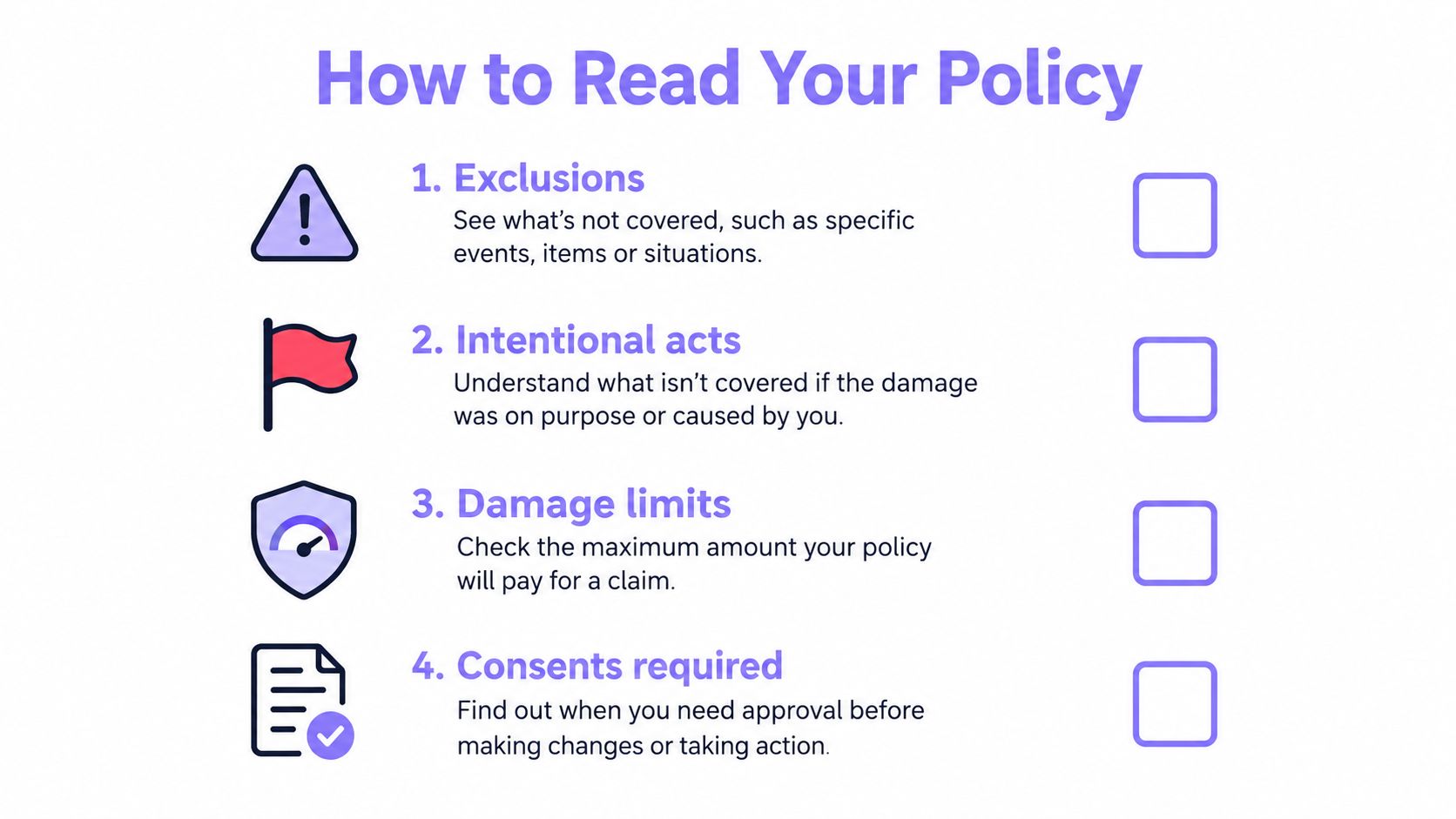
Find the limits inside the limit
A policy may advertise a generous overall indemnity ceiling while applying much smaller sub-limits to specific claims. Data loss, advice, intellectual-property allegations, legal defence, and damage involving property in your custody may each have their own cap.
Ask the insurer to show every sub-limit in writing. A broad general ceiling is not enough if the clause most relevant to your business has a narrow internal limit.
The deductible deserves the same attention. Read whether it applies per claim, per incident, or to particular types of loss. Check whether defence costs reduce the amount available for compensation.
Identify the trigger and territory
A claims-made policy generally focuses on when the claim is made and whether the relevant retroactive date has been preserved. An occurrence-based policy generally focuses on when the harmful event occurred. The distinction becomes important when you change insurers, stop trading, or receive a complaint about earlier work.
Don't cancel an old policy before checking how prior work remains protected. Ask about the retroactive date, continuity, notification requirements, and any post-termination reporting period.
Territorial scope matters too. Remote work can involve clients, servers, suppliers, and subcontractors in different countries. A policy that covers professional activity in France may not respond to work performed for a client in Switzerland or the United States without the right territorial wording.
Ask these questions before signing
- Pure financial loss: Is financial loss without preceding physical damage covered?
- Professional advice: Does the policy cover recommendations, audits, strategy, configuration, and technical guidance?
- Subcontractors: Are subcontractor acts covered, and must you obtain their own certificates?
- Data and intellectual property: Are data loss, confidentiality breaches, copyright disputes, and similar allegations included or excluded?
- Consent requirements: Must the insurer approve settlements, lawyers, subcontractors, or specific contractual commitments?
- Certificate wording: Does the certificate name the exact activity, policy period, and relevant limits?
A deductible is only one part of the cost. The guide to insurance deductibles helps clarify how much of a claim remains your responsibility.
Read the exclusions before the guarantees. That single habit eliminates many bad purchasing decisions.
Documents Needed and the Path to a Real Quote
A first quote should be based on your actual work, not a vague description copied from a registration form. Gather the information before opening an insurer's questionnaire.
- Prepare your identity documents. Have your pièce d'identité available, along with your business registration information.
- Confirm your registration. Keep your avis de situation SIREN or other proof that your micro-entrepreneur activity is registered.
- Provide turnover information. Your latest URSSAF turnover declaration helps the insurer assess the scale of the activity.
- Write one accurate activity sentence. For example, describe whether you build and maintain websites, provide strategic consulting, manage paid campaigns, install equipment, or perform repairs. Don't hide the operational detail behind a generic label.
- Add professional qualifications. If the activity is regulated, include the relevant diploma, licence, certification, or professional evidence.
The activity sentence is the most important part of the questionnaire. It should match invoices, contracts, marketing materials, and the work you perform. If you begin offering a new service later, notify the insurer before relying on the original policy.
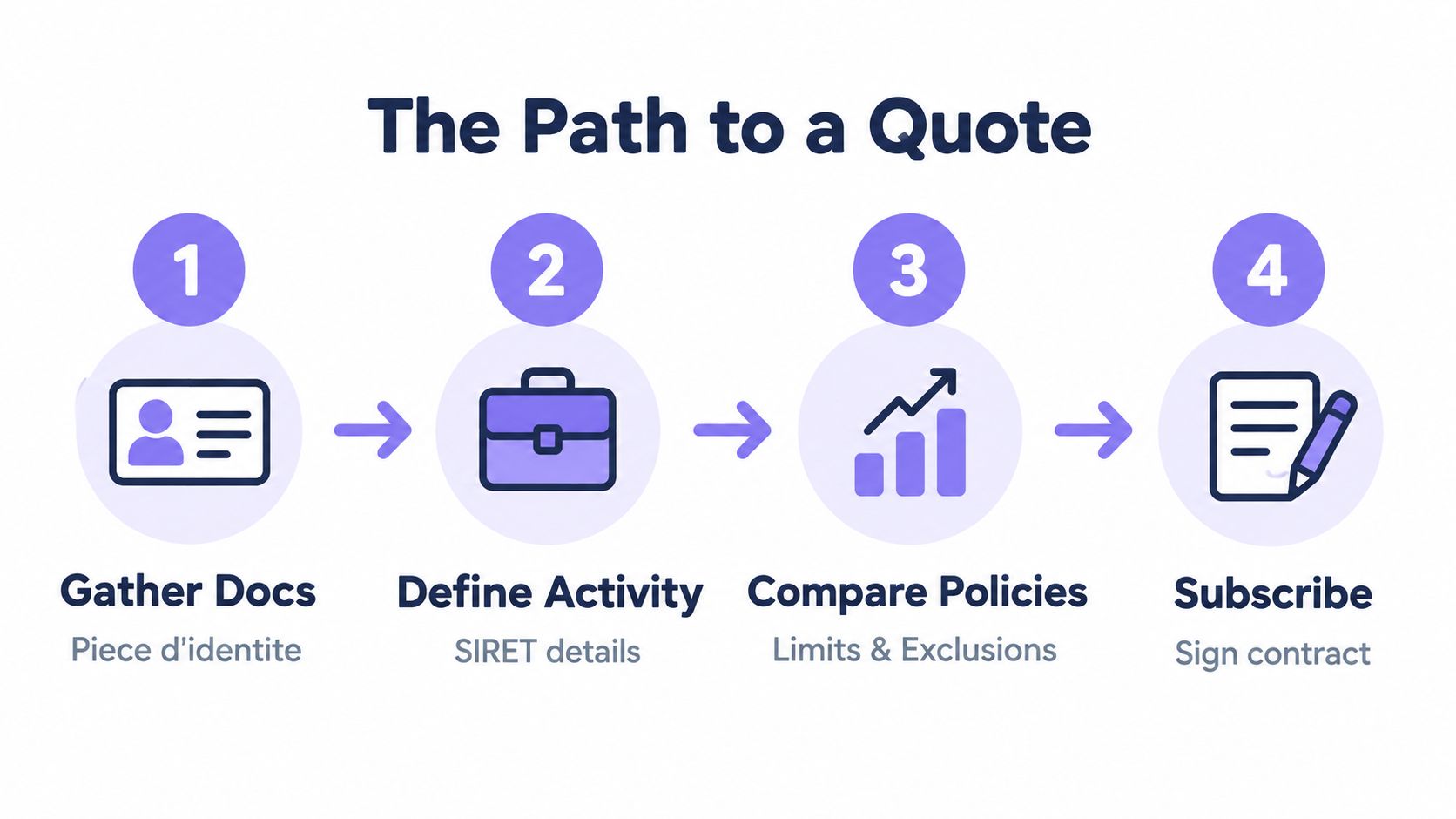
Compare like with like
Request quotes from specialist insurers or brokers familiar with micro-entrepreneurs. Obtain at least three offers where possible, but set the same comparison basis for each:
- the same activity description;
- the same indemnity limits;
- the same deductible;
- the same territorial scope;
- the same extensions for advice, pure financial loss, data, and subcontracting.
Request the IPID, the insurance product information document, as well as the full terms and conditions. The IPID makes the main exclusions and characteristics easier to compare, but it doesn't replace the policy wording.
Once you subscribe, request a named certificate of insurance. It should identify the policy number, insured activity, coverage period, and relevant guarantees. Save the certificate as a PDF in the shared drive or client-onboarding folder you already use.
Clients often ask for proof at the point of signature, not during an insurance planning session. Having the document ready keeps administration from delaying the start of a mission.
Smart Choices and Common Pitfalls for Micro-Entrepreneurs
Use three questions to make the decision.
First, is the activity legally regulated? If it is, identify every required guarantee, not just RC Pro. Construction, healthcare, transport, and other regulated sectors may have additional insurance rules.
Second, does a client, public body, agency, or platform require an attestation? If the answer is yes, obtain a policy that matches the requested activity and wording.
Third, could one serious claim threaten the business? A digital consultant may have limited physical exposure but still face a dispute involving advice, a failed implementation, confidential data, or a client's commercial loss. A tradesperson may face physical and material damage. Assess the consequence, not the appearance of the work.
The right policy transfers a risk you can't comfortably keep. It isn't simply the policy with the lowest monthly payment.
Several mistakes appear repeatedly:
- Choosing the cheapest quote: A low premium may hide a narrow pure-financial-loss clause, a restrictive sub-limit, or a high deductible.
- Using the wrong activity description: Declaring “consulting” while performing implementation, software configuration, or project supervision can create a coverage dispute.
- Forgetting subcontractors: If another professional delivers part of the work, confirm whether their acts are covered and whether their own insurance is required.
- Ignoring continuity when changing insurers: Check the retroactive date and claims-made provisions before cancelling an existing policy.
- Waiting for the certificate request: Buying cover after a client asks for proof can delay a contract and leave earlier work unprotected.
- Failing to update the contract: Tell the insurer when your services, turnover, client geography, subcontracting, or risk profile changes.
Keep the certificate accessible, review the policy when the business changes, and ask for written clarification where the wording is unclear. A broker or insurer should be able to explain exactly how the contract responds to the claim scenarios your business could realistically face.
Wispra offers informational guides for freelancers and micro-entrepreneurs on RC Pro obligations, coverage, exclusions, quotation preparation, and policy documents. Use Wispra to review the relevant guidance before comparing policies and asking an insurer for a quote.