The average young-driver premium in France is around €2,177 per year, and a regulated surcharge of up to 100% of the base premium can apply during the first year. Your actual quote may be lower or higher because insurers also assess the car, cover, location, usage and driving history.
You've just passed your test, found a sensible used car and opened an insurance quote expecting a manageable monthly payment. Instead, the figure looks closer to a second household bill. That reaction is common, but the annual premium is only part of the decision. The excess, exclusions, liability exposure and value of the vehicle can matter just as much after a crash.
What Is Young Driver Car Insurance in France
A 19-year-old receiving a first quote for assurance auto jeune conducteur is paying for more than a vehicle policy. They're entering the insurance system without a personal claims history, with limited experience in complex traffic and no established record that demonstrates how they drive. Insurers therefore assess uncertainty as well as the car itself.
A 2026 French comparison barometer reported an average young-driver premium of €2,177 per year, based on 2,692 quoted premiums. That's a market benchmark, not a fixed tariff, and the quoted amount can change substantially according to the vehicle, cover, region, mileage, parking arrangements and claims history. You can review the benchmark in the 2026 young-driver insurance barometer.
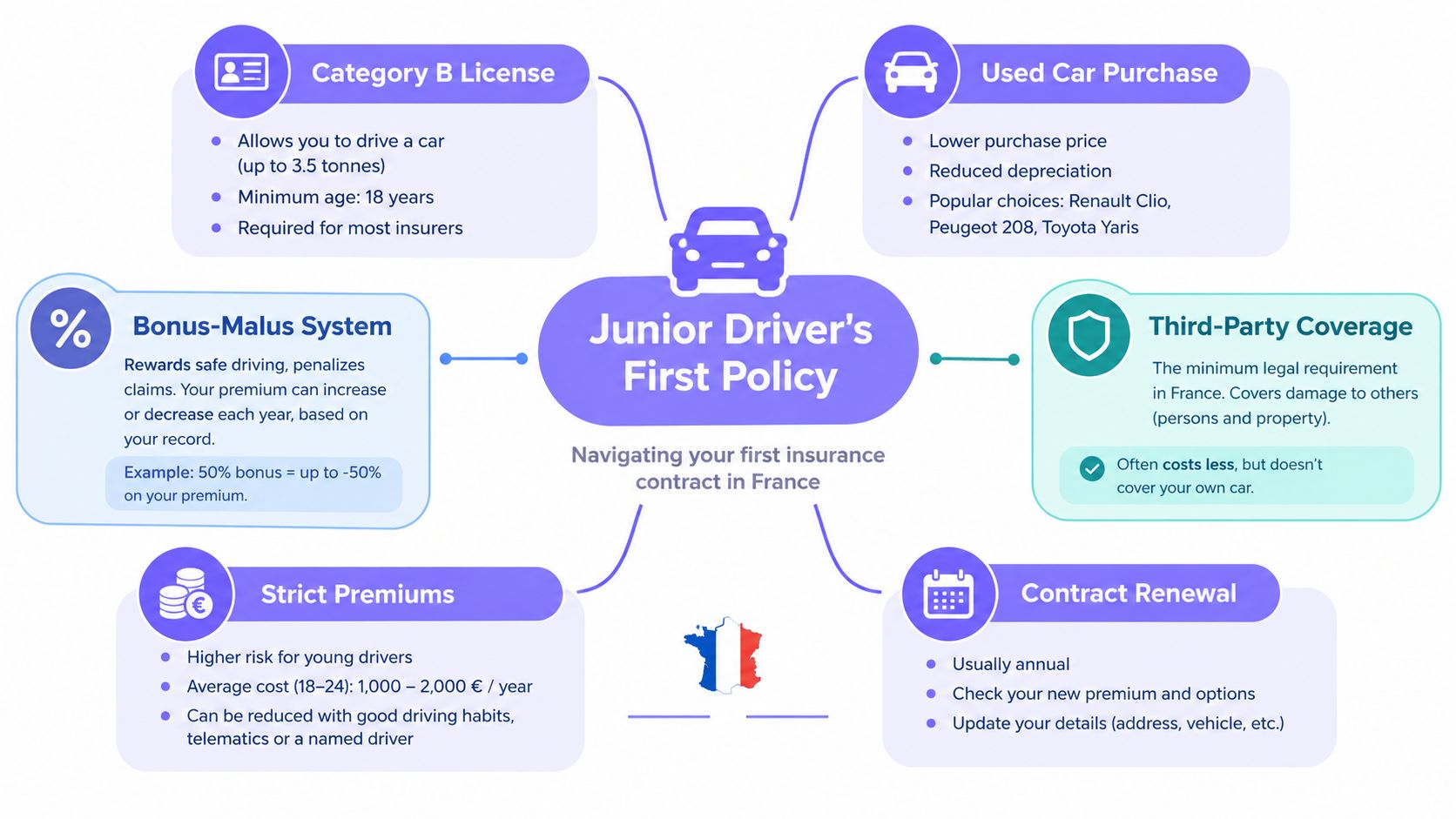
What the insurer is actually pricing
The word “young” can be misleading. In practice, the relevant issue is usually recent driving experience, not age alone. Someone who has obtained a licence recently may be treated as a novice even if they aren't a teenager.
The quote combines several moving parts:
- Driver profile: licence history, previous insurance and claims record.
- Vehicle risk: repair cost, value, power and theft exposure.
- Usage: commuting, leisure driving, mileage and regular parking location.
- Coverage: third-party liability, damage to your own car, assistance and other guarantees.
- Novice-driver treatment: a regulated surcharge may be added to the insurer's initial reference premium.
You can influence some of these factors. Choosing a modest, repairable car may help. Accurate mileage and parking details can prevent an unsuitable quote. Selecting only the guarantees you genuinely need can reduce the premium, but it can also leave you carrying more financial risk.
Practical rule: Treat the first quote as a risk assessment, not a verdict on your driving ability. Ask which parts come from the vehicle, which come from your profile and which come from the contract.
A cheap monthly payment can still produce an expensive ownership experience if the policy has a large excess or excludes the loss you're most likely to face. The right question isn't just “Which insurer is cheapest?” It's “What will this policy cost me if something goes wrong?”
How the Regulated Surcharge Works
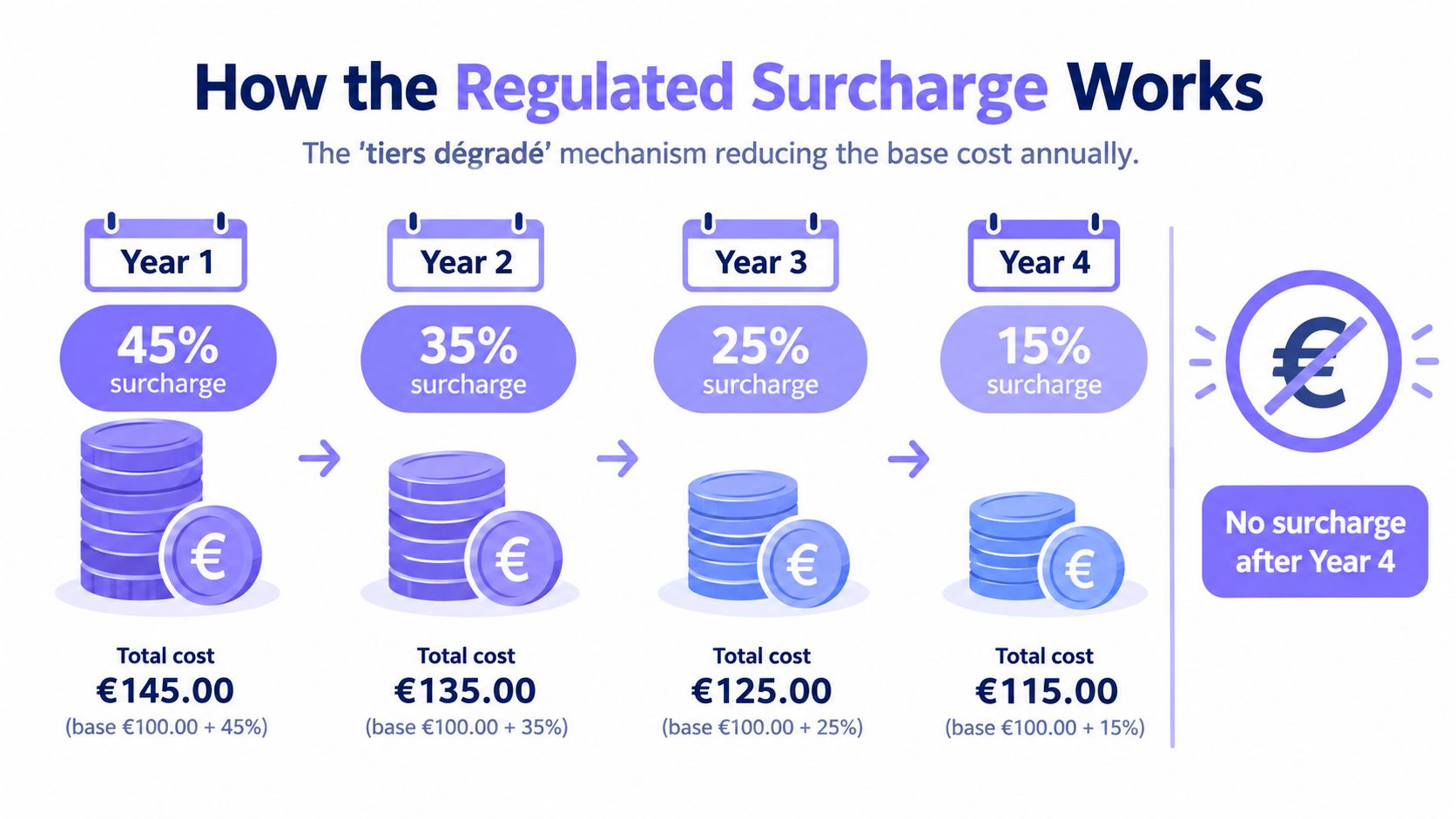
French public-administration guidance sets a ceiling for the novice-driver increase rather than allowing an unlimited addition. During the first year, the surcharge can reach 100% of the insurer's initial reference premium. After one claim-free year in which the driver isn't responsible, the maximum falls to 50%. After two such years, this specific novice-driver increase is generally removed. The official French explanation of the novice-driver surcharge sets out the framework.
The progression is easier to understand when separated from the rest of the quote. Suppose an insurer's initial reference premium is €2,000. A maximum 100% surcharge would add €2,000, producing €4,000 before any other contract adjustments. After one qualifying year, the maximum surcharge would be €1,000, producing €3,000 on the same reference basis. After two qualifying years, the novice-driver addition would generally be €0, leaving the €2,000 reference premium before other changes.
Surcharge, bonus and accident history
The surcharge is connected to lack of experience. It shouldn't be confused with a penalty caused by a responsible accident. A driver can begin with a novice-driver increase even without having made a claim, while a responsible crash can affect the policy through separate claims and bonus-malus rules.
The framework applies principally during the early period after obtaining a licence, although insurers don't all apply the surcharge. That distinction matters when comparing quotes. One insurer may use the permitted ceiling, another may apply a lower increase and another may structure its pricing differently.
Accompanied driving also receives a financial distinction under the French framework. Drivers who completed the relevant accompanied-driving pathway can benefit from a lower maximum first-year surcharge. Check that the insurer has recorded this pathway correctly and be prepared to provide supporting evidence.
How to read your quote
Look for the insurer's initial reference premium, the novice-driver increase and the final premium after all adjustments. Don't assume that a lower surcharge automatically means a cheaper policy. A company can apply a modest increase to a higher underlying premium, while another applies a larger increase to a lower base.
For a clearer explanation of how accident-related pricing differs from the novice-driver mechanism, see this guide to car insurance malus. Then compare the complete policy, including the excess and guarantees, rather than comparing the surcharge line alone.
The Risk Profile Behind the Premiums
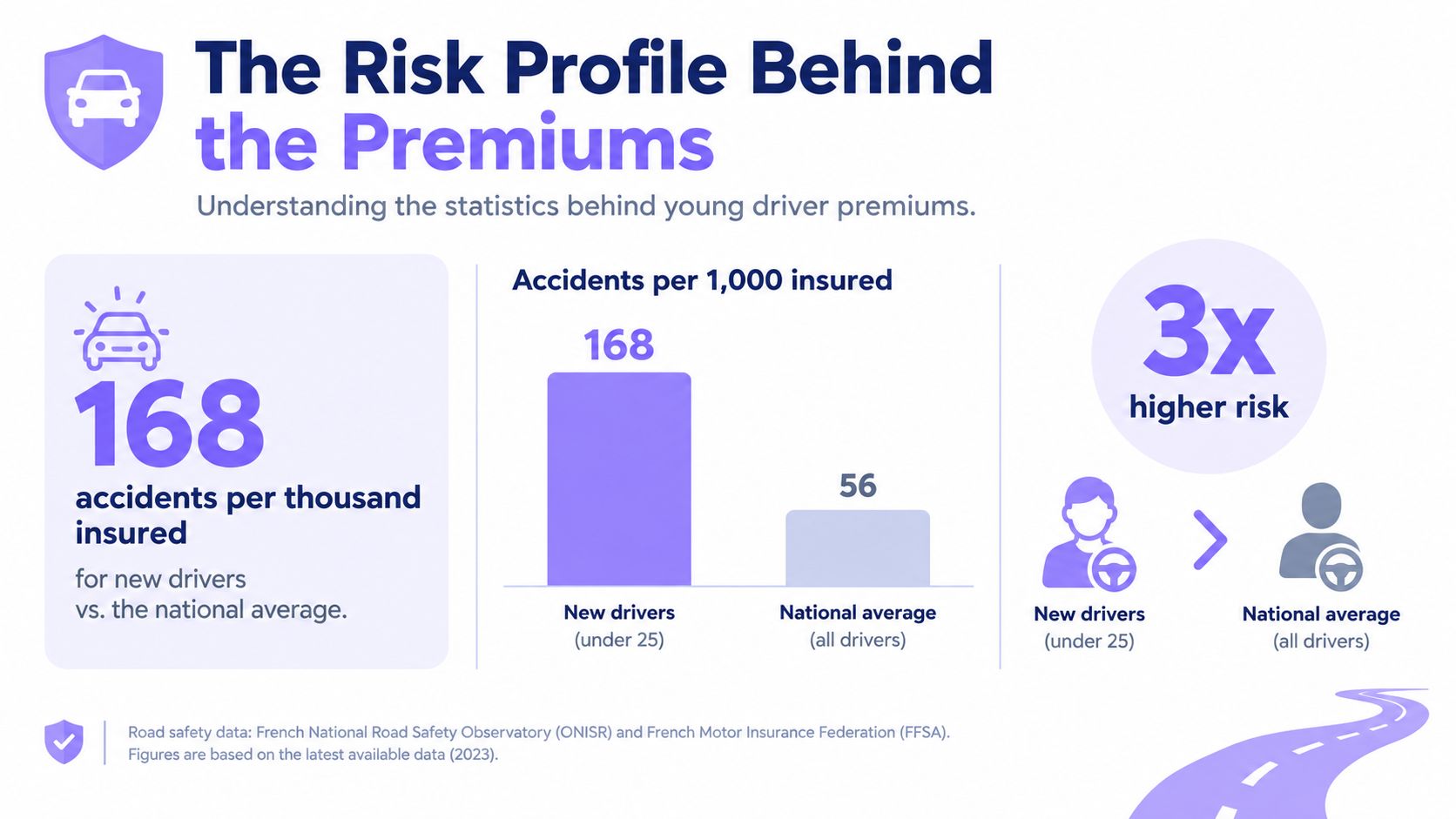
Insurers don't price inexperienced drivers differently solely because of a label. They're responding to a road-risk profile in which limited experience overlaps with a period of disproportionate representation in serious crashes.
Figures cited from France's national road-safety observatory show that 523 people aged 18–24 were killed on French roads in 2023, out of 3,167 road deaths overall. This represented approximately 16.5% of all road fatalities, while the age group represented about 8% of the population, according to the cited road-safety data. The figures are presented in the French road-safety overview of age and driving.
What these figures mean for pricing
These are road-fatality figures, not insurance-claims figures. A fatality isn't equivalent to an insured loss, and the statistics don't predict what one individual driver will do. They do help explain why insurers treat limited experience as a meaningful underwriting factor.
A novice driver may have had less exposure to unfamiliar junctions, fast-moving traffic, poor visibility and sudden decisions by other road users. The insurer can't observe all of that directly before the policy begins, so it combines population-level risk with personal information about the driver and vehicle.
The result is a premium that reflects several connected uncertainties:
- Experience uncertainty: the driver has a short personal record.
- Vehicle severity: a powerful or costly car can increase the financial impact of a collision.
- Usage exposure: regular commuting or night driving can change the insurer's assessment.
- Claims development: the insurer doesn't yet know whether the driver will build a claim-free record.
You can use this background when choosing a car, not just when reacting to a quote. A simpler vehicle with affordable repairs may reduce both the insurer's expected loss and your own exposure. For new drivers still checking paperwork and licence conditions, Fast Track Driving Lessons' first-car insurance guidance offers a useful complementary reference.
The statistics explain the category. They don't remove your responsibility to compare the contract that actually protects you.
Coverage Options and Real Cost Scenarios
The lowest annual premium isn't always the lowest-cost choice. In 2025, indicative comparison data placed the average young-driver premium at about €970 per year for third-party cover and €1,933 for full cover. The cheapest offers averaged €810 and €1,541 respectively, according to the young-driver insurance comparison data.
Those figures show the price of the policy, not the full financial result after a loss. Third-party cover protects other people from damage you cause, but it doesn't normally pay to repair or replace your own car after an incident for which your vehicle isn't covered. Comprehensive cover costs more, but it can protect the vehicle itself under the contract's terms.
Three practical scenarios
An older, low-value car: Third-party cover can be rational if the car's market value is modest and you could absorb its loss. You're accepting that a single-vehicle crash, theft or other excluded event may leave you paying for repairs or replacement yourself. Add the excess and roadside assistance to your comparison, because the cheapest premium may not deliver the most useful support.
A financed or newer vehicle: Minimal cover can become economically dangerous when the car represents a substantial financial commitment. If the vehicle is written off or badly damaged, you may still owe money under the finance agreement while receiving little or nothing for your own vehicle. Broader protection may better match the exposure, subject to the lender's requirements and the policy wording.
A borrowed family car: The central issue is who uses the vehicle. If the young driver is the principal user, declaring a parent as the main driver in order to obtain a lower quote can create a coverage dispute or reduce compensation after a loss. The policy must reflect the actual arrangement.
Calculate ownership cost, not just premium
For each quote, calculate the total for the first three years. Include premiums, excesses, assistance, likely vehicle replacement exposure and any payment or administration charges. A policy with a lower monthly payment but a high excess can cost more after a claim.
For a plain-language explanation of this often-overlooked cost, read the guide to what an insurance excess means. Then ask whether you could pay the excess immediately without borrowing. If the answer is no, a slightly higher premium with a more manageable excess may be the safer purchase.
Actionable Ways to Reduce Your Premium
The safest savings usually come from changing the risk the insurer is pricing, not hiding information. Start with the vehicle and usage details, then consider whether a monitored policy or additional training genuinely fits your habits.
Use a monitored policy carefully
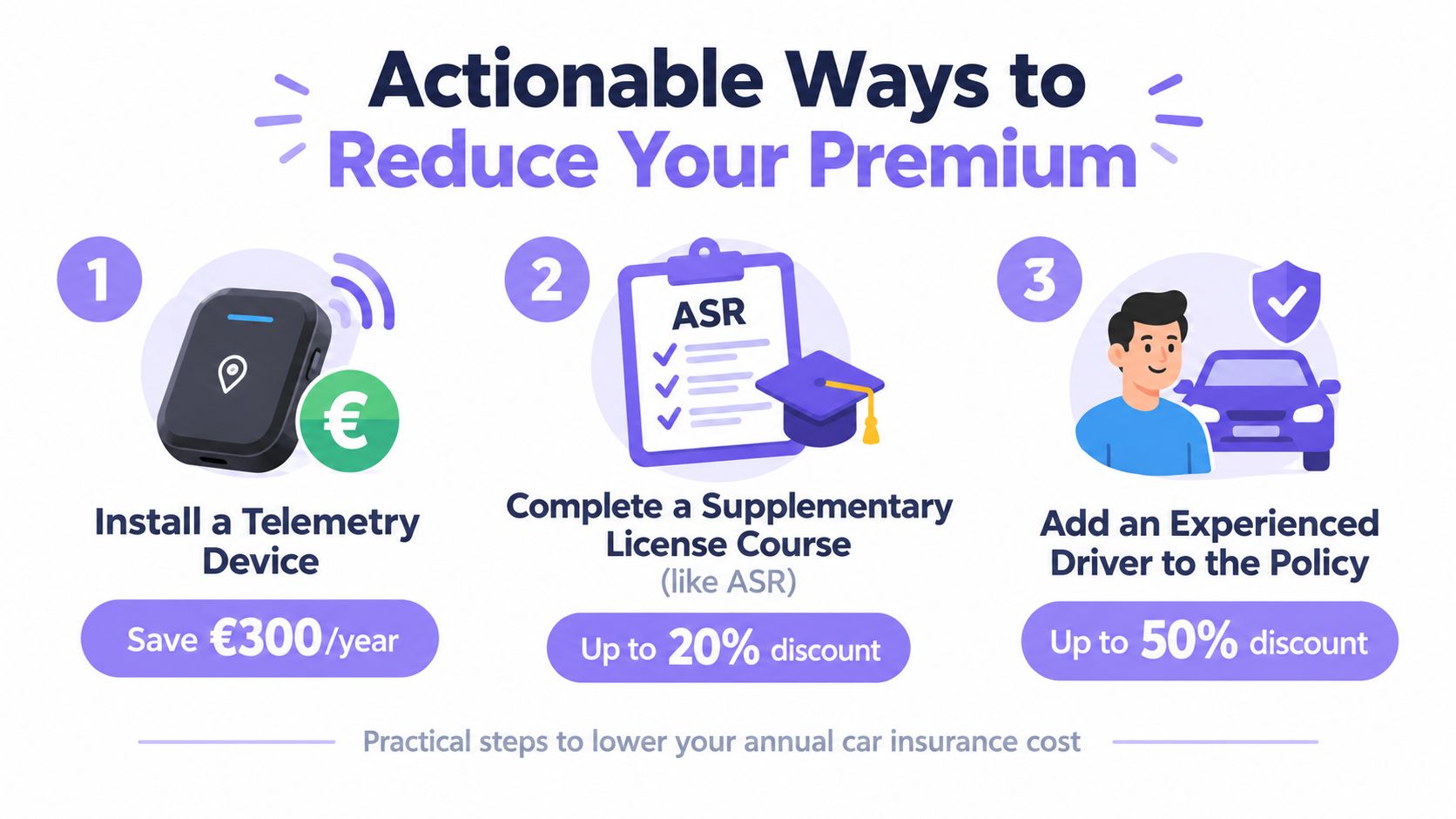
Telematics can record driving behaviour through a device or mobile application. Depending on the insurer, the assessment may consider factors such as braking, speed, mileage or driving times. A careful driver who accepts the privacy and monitoring conditions may receive a more personalized quote, but read how scores are calculated and what happens after poor results.
Mileage matters too. Give the insurer a realistic estimate rather than an optimistic one. Understating use can create a problem when a claim is examined, particularly if the car is regularly used for commuting.
Build experience without creating a declaration problem
An experienced additional driver can sometimes help insurers assess a household arrangement more favourably, but this only works when the declaration is accurate. The young driver must still be identified as the principal driver if they use the vehicle most often. A false secondary-driver arrangement can undermine the policy precisely when protection is needed.
Driving courses may also be worth investigating, especially where an insurer recognises a particular accredited pathway. Ask for the reduction in writing and check whether it changes the surcharge, the base premium or only a specific part of the contract.
Match the tactic to your situation
- You drive infrequently: Explore usage-based or mileage-sensitive cover, but confirm how occasional long journeys are handled.
- You're still choosing a car: Get insurance quotes before buying. A lower-powered, easier-to-repair vehicle may be more affordable to insure.
- You completed accompanied driving: Tell every insurer and provide the requested proof.
- You're considering a larger excess: Choose it only if you can pay it comfortably after a crash.
- You want an experienced driver listed: Declare the actual principal user without exception.
A platform such as Wispra can also help businesses publish structured insurance-related content and improve how their services are discovered in AI search results. It doesn't replace an insurer's quote or policy documents, so use it as a visibility and information resource rather than a pricing authority.
Documents, Comparison Strategies, and Purchase Checklist
Prepare your documents before requesting quotes. Insurers commonly need identity information, driving-licence details, vehicle registration information and facts about how the car will be used. They may also ask about previous insurance, claims, accompanied driving and the regular parking location.
The quality of the quote depends on the accuracy of your answers. State who drives the vehicle most, where it's kept and whether it's used for commuting or another regular purpose. Don't borrow a parent's driving history by presenting them as the principal driver if that isn't true.
Compare like with like
Request several quotes using identical assumptions. Keep the vehicle, usage, liability level, optional guarantees and excess consistent, then compare:
- The complete premium: Include instalment charges and policy fees.
- The excess: Check whether separate excesses apply to theft, glass, damage or novice-driver situations.
- The guarantees: Confirm vehicle damage, driver injury protection, theft, fire, assistance and replacement provisions.
- The exclusions: Look for restrictions on lending the car, named drivers, travel and usage.
- The declaration: Make sure the principal driver, mileage and parking details are accurate.
Calculate the three-year cost before choosing. This exposes the difference between a low introductory payment and a contract that leaves you carrying substantial loss exposure.
For a broader decision process, use this practical guide on how to choose car insurance. Keep the quote, schedule, conditions and declarations together, and ask the insurer to clarify any term you can't explain in your own words.
Making the Right Insurance Decision
A sound decision combines price, protection and honesty. The regulated surcharge explains why the first quote can be high, while the risk profile explains why insurers pay close attention to experience. Neither point tells you which policy to buy. That depends on the vehicle's value, your ability to absorb a loss and how you use the car.
Use this simple decision filter:
- Low-value car and strong ability to replace it: Third-party cover may be reasonable if you accept the risk to your own vehicle.
- Newer, valuable or financed car: Broader cover generally makes more sense because your financial exposure is larger.
- Limited budget but no emergency reserve: Don't judge affordability by the monthly premium alone. A high excess can turn a manageable policy into an unaffordable claim.
- Accurate accompanied-driving or usage information: Make sure the insurer has recorded it, then compare the resulting contract with alternatives.
- Any uncertainty about principal use: Stop and correct the declaration before signing.
The best assurance auto jeune conducteur policy isn't necessarily the one with the smallest first payment. It's the contract whose guarantees, excess and exclusions match the car and the loss you could realistically withstand. Compare the same cover across several insurers, protect your claims-free record and review the policy as your experience changes.
Wispra helps businesses publish structured content that can be discovered by AI search engines, including guides, FAQs and directory information. Visit Wispra to see how your insurance service or local business can present clearer, more useful information to prospective customers.