The popular advice sounds sensible. Buy the smallest house you can find, borrow less, and keep every other cost small too. In France, that logic often fails at the first spreadsheet.
A compact house still needs a roof, heating, drainage, sound electrics, and legal transfer. Those costs don't shrink in neat proportion to floor area. If you're researching buy a small house, treat the asking price as one line in the budget, not as the budget itself, and check the paperwork that a very small home may not legally have to provide.
The Real Budget Before You View
A compact house can have a full-sized monthly burden. The asking price is only one part of the cost: repairs, heating, taxes and other fixed expenses still need room in your budget. Set a monthly ceiling before booking viewings, and test whether it holds if the rate or repair bill is higher than expected.
The Banque de France statistics on credit to individuals put the average interest rate on new housing loans excluding renegotiations at 3.10% in August 2025, after 3.09% in July and 3.10% in June. By December 2025, that average had eased to 3.08%, down 109 basis points from its January 2024 peak. Even a small rate change affects the amount you can borrow, so use a current simulation rather than treating an old one as a firm limit.
Many first-time buyers are looking in the same price bands, so a low asking price does not guarantee an easy negotiation. Base your offer on the full cost of owning the house, not on the assumption that few other buyers will be interested.
Build Three Numbers Before Any Viewing
First, calculate cash to buy. Add the price, transfer and notary costs, any buyer-paid agency fee, loan guarantee, diagnostics, moving expenses and work needed before you can live there. If the agency fee falls to the buyer under the mandate, include it once. This guide to who pays estate agency fees in France can help you identify which side pays.
Second, calculate monthly stress: the loan payment, borrower insurance, taxe foncière, utilities, buildings insurance and a maintenance allowance. Third, set aside a reserve that you will not use for the deposit. A compact house can still need a new boiler or roof repair, and that bill will not be smaller just because the floor area is.
Screening rule: Don't view a house whose all-in monthly cost only works in the cheapest rate case. If it fails after you add half a point to the simulation, it isn't affordable yet.
Use the table to list your own planning figures. For an existing home, you might test notary costs at a high single-digit percentage, buyer-paid agency fees at a mid single-digit percentage when the mandate assigns them to you, and the guarantee at a low percentage of the loan. Replace those allowances with written quotes before making an offer.
| Line | Planning figure | When it hits |
|---|---|---|
| Purchase price | Offer after deducting works | Signing and loan |
| Notary and transfer costs | Your notary's estimate for an existing home | At the deed |
| Buyer-paid agency fee | Amount stated in the mandate, if charged to you | At the deed |
| Loan guarantee | Bank quote for caution or hypothèque | Loan set-up |
| Diagnostics and moving | Quotes plus removals and connections | Before and after completion |
| Immediate works | Contractor quotes for safety and habitability | At completion |
| Monthly payment | Simulation including borrower insurance | Every month |
Set your ceiling at the lower of the amount the bank will lend and the monthly amount your household can sustain without using its reserve. A house priced €20,000 less may still cost more in the first year if it needs urgent heating work. Compare the two homes' fixed costs and immediate repairs alongside their prices.
Financing Routes Compared
For a compact house, a lower monthly payment can hide a higher total cost. Compare each borrowing route using the same loan term, borrower insurance, guarantee and fees, then check the total against the cash you need to keep available for the property.
- Your own bank: It can provide a convenient first simulation, but shows only that lender's offer. Ask for the payment including assurance emprunteur, plus guarantee and file fees.
- Mortgage broker: A broker can compare several lenders and arrange insurance separately. Ask who pays the broker and whether the fee is included in your cash-to-buy total.
- Longer versus shorter term: A longer loan lowers monthly payments but increases total interest. Compare both terms with the same insurance and fees, then see which leaves room for taxes and maintenance.
- Guarantee route: A guarantor company, called a caution, and a mortgage, called a hypothèque, have different set-up and resale-release costs. Compare both costs, not just how quickly each route may secure approval.
Set a limit for your personal contribution before negotiating. Keep your chosen reserve separate, and treat only the remaining cash as available for the deposit and fees. If your credit file needs attention, tidy existing debts and organise the documents French lenders require. A guide to mortgage readiness for credit-challenged renters may offer general preparation ideas, but French lenders set their own criteria and document requirements.
A joint application brings together income and joint liability. Agree in writing on each person's ownership share, contribution to payments and what happens if one wants to sell. Extending the loan term can make a payment appear manageable while increasing total interest, so compare the overall cost as well as the monthly figure.
Choose the route with the lowest total cost that still works in your higher-rate case, not the one with the lowest headline rate.
How the Purchase Runs from Credit to Deed
A French purchase rewards sequence. Each step below ends with a document, a deadline, or a decision you can point to, so you don't confuse enthusiasm with progress.
The infographic below compresses the route into its three public milestones. The detailed steps after it show what must happen between those milestones.
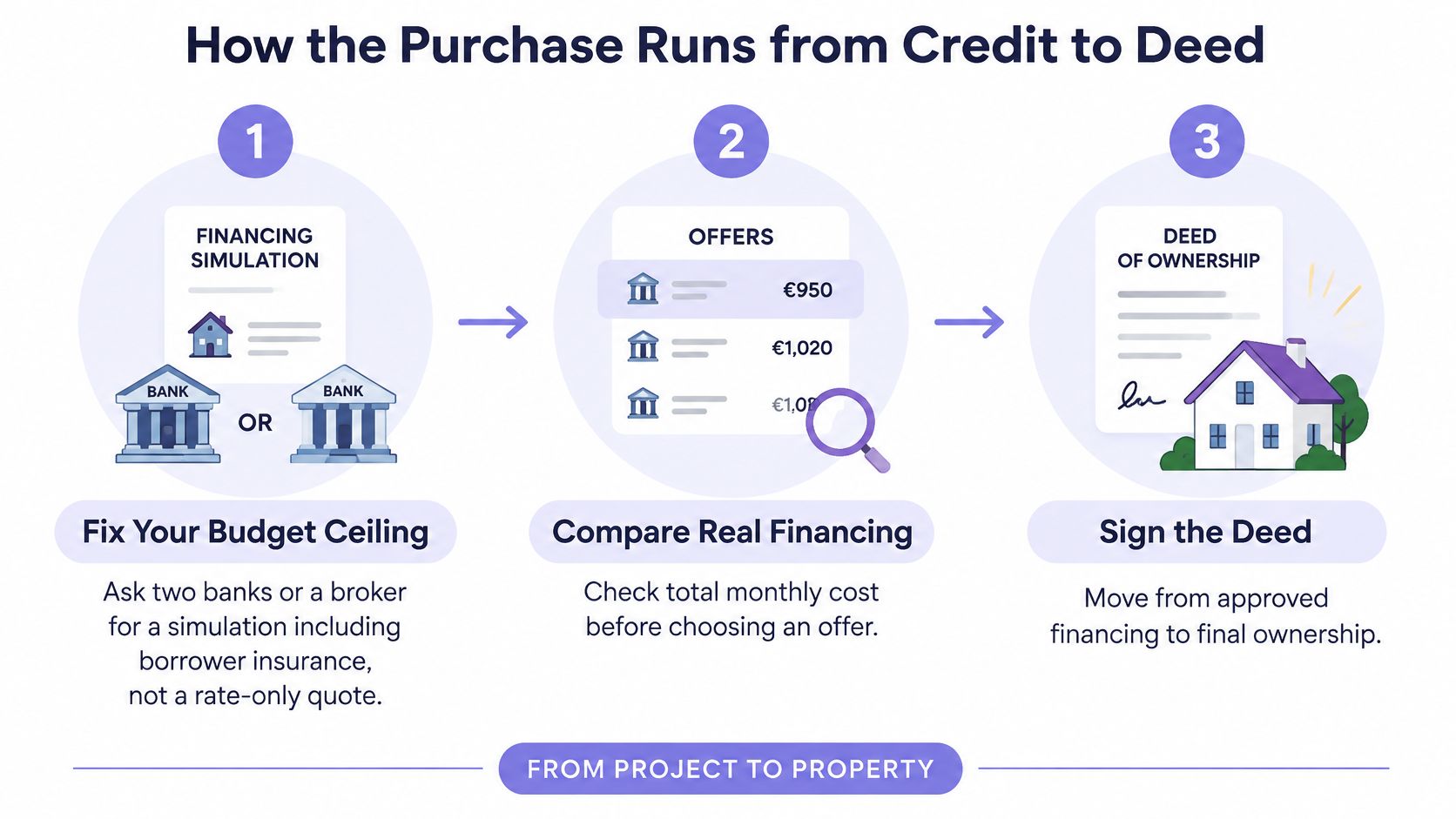
- Fix your ceiling. Take the financing route you've chosen and ask two banks or one broker for simulations that include borrower insurance. The step is finished when you have written monthly totals, not verbal rate quotes.
- Stress the household budget. Test a higher-rate case and, for a couple, a single-income case. The Banque de France and ACPR housing finance statistics put the average household effort rate at 30.4% in 2025, while average household indebtedness rose marginally to 4.5 years of income. Use those figures as a national benchmark, not as permission to borrow up to them.
- Get a financing capacity letter. Ask the lender or broker to state the amount your file supports and the conditions attached. Sellers and agents take you more seriously when that letter exists before a second visit.
- Search by micro-area. Filter by commune, hamlet, or a few streets, not by a whole département. Note whether each house is above or below the floor-area threshold that can affect energy paperwork, and treat land, outbuildings, and access as potential costs rather than free bonuses.
From Visit to Signed Deed
- Visit with evidence. Take a works list covering roof, heating, electrics, drainage, sanitation, damp, and access. Bring recent sold comparables for the same micro-area, because asking prices only tell you what other sellers hope to get.
- Make a written offer. State the price, the quantified works you've deducted, the financing condition, and a short validity date. A vague verbal offer lets the seller renegotiate every assumption later.
- Sign the compromis de vente. Pay the agreed deposit into the notary's account as the contract directs, and diarise every condition deadline. This guide to the compromis de vente timetable helps you map the cooling-off period and financing deadline onto actual calendar dates.
- File the full mortgage application immediately. Send identity, income, tax, bank, and property documents in one organised bundle. The financing condition has a deadline, and slow paperwork can turn an approvable file into a failed condition.
- Respect the loan reflection period, then sign. Once the formal loan offer arrives, follow the required waiting and acceptance process your lender sets out. You sign the acte authentique at the notary only when funds, insurance, and final checks are ready.
You're ready to complete when three things are true at once. The approved loan covers the all-in figure, your reserve remains intact after fees, and every urgent work item is either funded or explicitly excluded from the plan. If one of those fails, you don't have a purchase yet, you have a gap to price or walk away from.
Checks When the DPE Does Not Apply
A smaller house can mean less energy paperwork, not less energy risk. Buyers may assume every French sale file contains the same certificate, but some independent dwellings are exempt from a mandatory DPE.
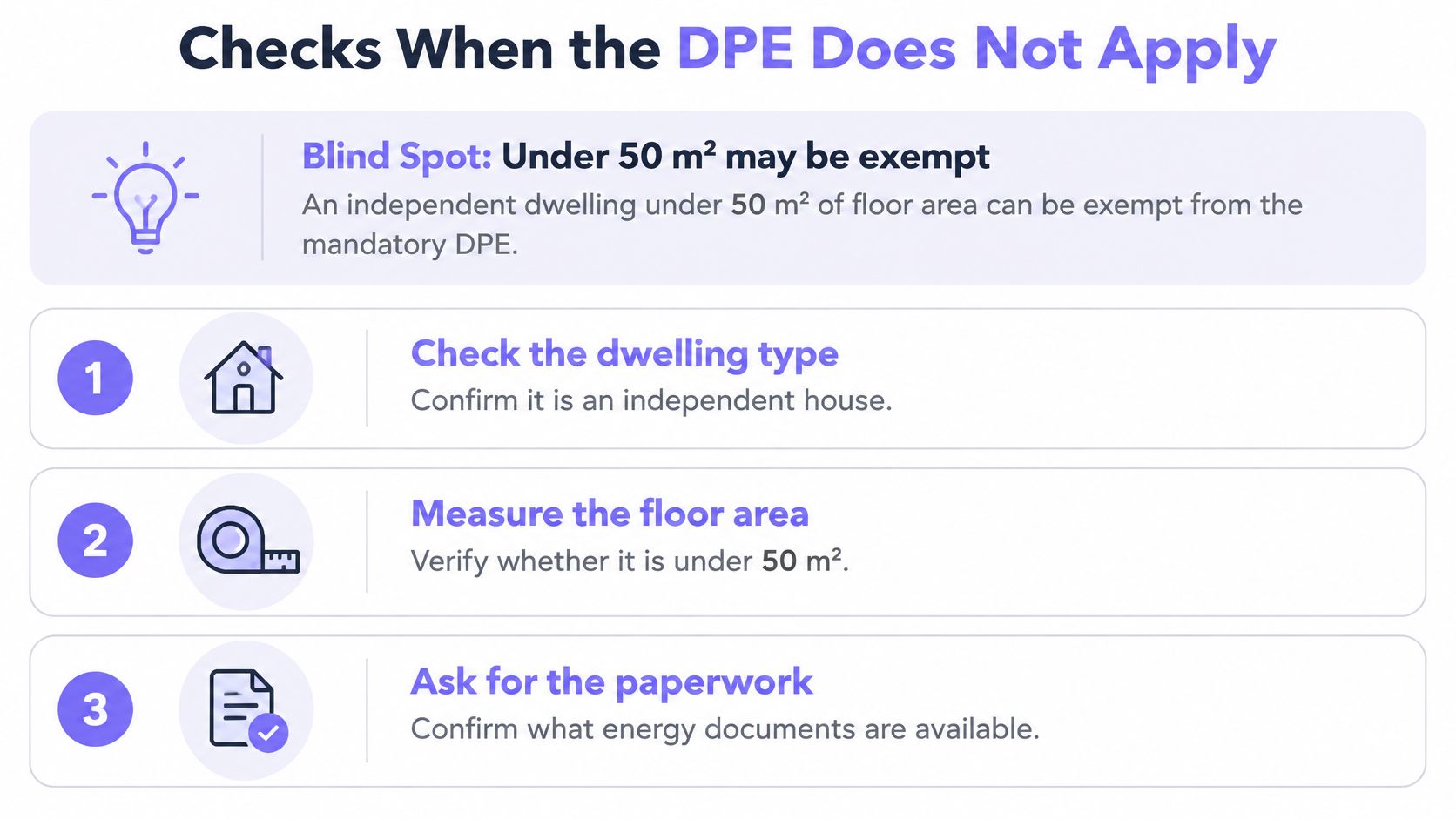
The service-public.fr guide to the DPE explains that an independent dwelling with less than 50 m² of floor area can be exempt from the mandatory DPE. Exemption says nothing about efficiency. The file may leave you without answers about heating, insulation, damp, or the questions a future buyer will ask.
Use the checklist to separate what the sale file may legally omit from what you still need to assess the house.
Electric heating adds another reason to look beyond an older label. The primary-energy conversion factor for electricity was revised in 2026, so an older certificate for an electrically heated home may no longer reflect how it scores today. A revised score does not mean the walls, windows, or heater have changed.
| Check | Legal DPE under 50 m² | Demand anyway |
|---|---|---|
| Energy performance certificate | Often exempt for an independent dwelling | Voluntary DPE if you will renovate or resell soon |
| Recent consumption | Not in the exemption file | 12 months of bills by fuel |
| Heating system | Not proven by an old label | Age, type and service record |
| Insulation and ventilation | Not covered by the exemption | Roof, walls, moisture and airflow notes |
| Older certificate for electric heating | May not reflect the current scoring method | Ask whether it was updated and check bills |
| Structure and damp | Outside the DPE | Independent inspection of roof, drainage and damp |
A voluntary DPE can help if you plan to resell within a few years, seek support for an energy renovation, or cannot verify electric heating costs from bills. It gives you a baseline for renovation quotes and resale discussions. Ask the diagnostician which inputs shape the result: in a small house, one assumption can have a noticeable effect on the label.
Diagnostics and Plot Checks Still Matter
The DPE is only one part of the sale file. Depending on the house's age, location, and installations, check the relevant information on lead, asbestos, termites, gas, electricity, natural risks, and private sanitation where there is no mains sewer. On a compact plot, verify boundaries, shared access, parking rights, and whether an extension or external insulation would breach a limit.
Ask the seller and diagnostician five direct questions. What fuel heated the house last winter, and what did it cost? When was the heating system installed and last serviced? What evidence exists for roof and wall insulation? Has there been damp, a leak, or drainage work, and are there invoices? Which documents are absent because the house is exempt, and which were never obtained?
Missing answers become price, not hope. If nobody can prove the heating cost or roof condition, deduct the credible worst case or pay for an inspection before you commit.
Funding Works After the Keys
A smaller house can carry a larger financial risk. Fixed project costs do not shrink with the floor area, and renovation grants may arrive only after you have paid contractors. Budget for the work as carefully as for the purchase.
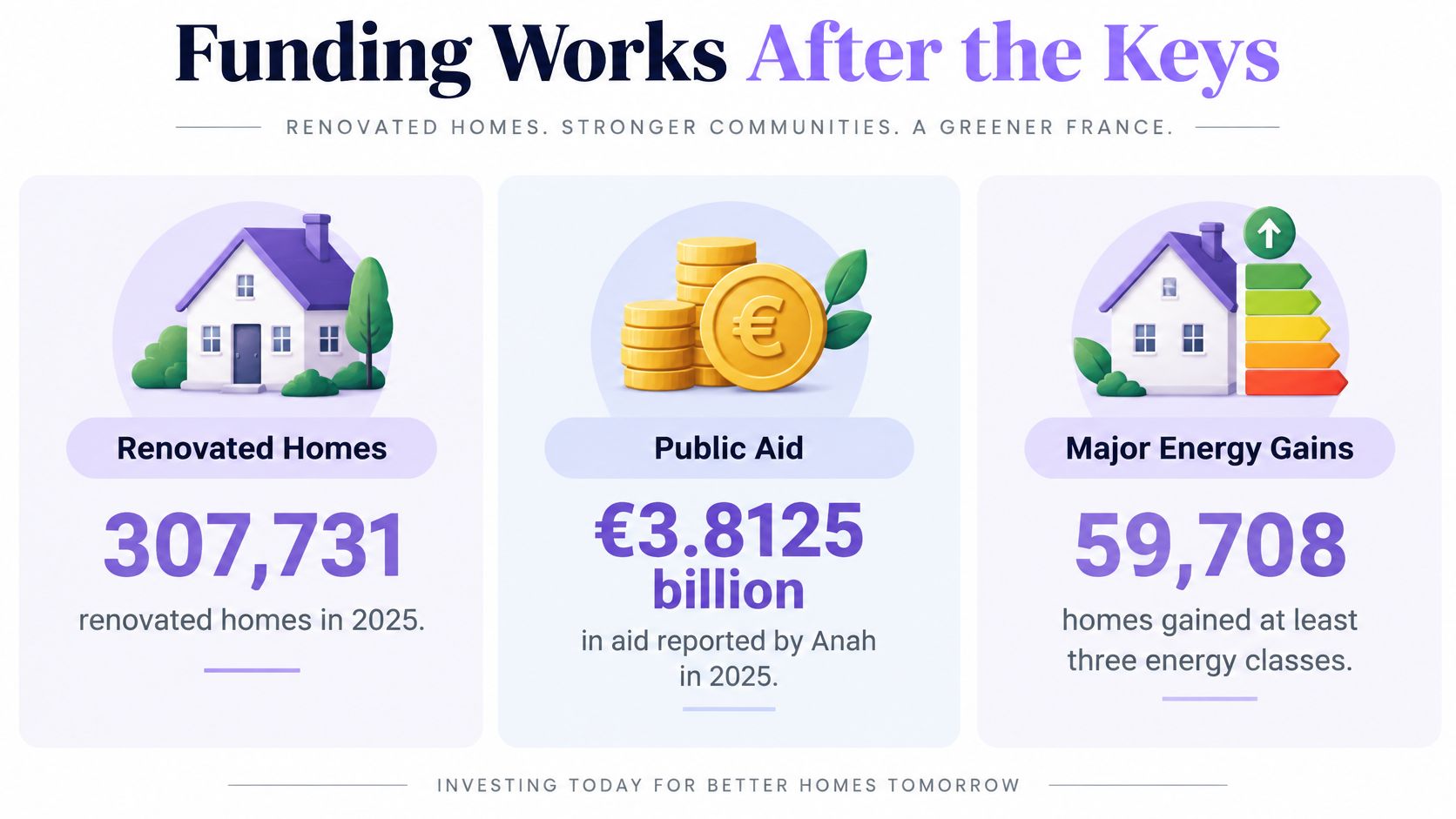
The Anah key figures for 2025 reported 307,731 renovated homes and €3.8125 billion in aid. It also reported that 59,708 homes gained at least three energy classes after works. These national results show the scale of renovation support, not money available automatically to an individual buyer. Your project still needs to meet eligibility conditions, use compliant quotes, and cover costs in the right order.
Large-scale renovation aid may depend on achieving a minimum improvement in energy class, alongside other eligibility conditions. Before relying on a grant in your budget, confirm the current criteria with a France Rénov' adviser. The process may also involve Mon Accompagnateur Rénov' and professionals with RGE certification. A cheaper informal quote may not qualify for support.
Keep Three Cash Pots Apart
| Pot | Typical contents | Cash timing |
|---|---|---|
| Acquisition | Price, notary, guarantee, agency, diagnostics, moving | Before and at the deed |
| Habitability | Leaks, electrics, heat, sanitation, urgent damp | Cash or loan at completion |
| Subsidised energy works | Insulation package, energy-class improvement, RGE quotes, adviser | Advance the cost; aid comes later |
Some renovation costs are partly fixed. An energy audit, scaffolding, project management, contractor mobilisation, skips, and compliance visits may cost nearly as much for a small house as for a larger one. Spread across fewer square metres, they raise the cost per square metre. A grant can reduce the final bill while still leaving a substantial sum to pay upfront.
Use a worked sketch before committing to a low-priced house. Say the purchase price is €160,000, transaction costs are €12,000, urgent habitability work is €15,000, and a later energy package costs €25,000 before aid. The first-stage commitment is €187,000 before the energy project begins. Gross spending reaches €212,000 before reimbursement arrives.
That cash sequence affects both borrowing and the reserve you keep. If every euro goes into the purchase, a failed heater may force expensive consumer borrowing or leave the work unfinished. If you also need to phase furniture and removals, moving advice from Suburban Furniture can help you decide what must move on day one and what can wait until the renovation dust settles.
Treat an unfunded roof, unsafe electrics, failed sanitation, or a house without working heat as part of the purchase cost. Cover it with the loan and reserve, negotiate a reduction based on a credible quote, or reconsider the deal. A grant can improve a funded project; it cannot fund the gap before the money arrives.
Pricing the Offer Against Real Sales
Don't negotiate from the feeling that a small house should be inexpensive. Negotiate from completed sales on nearby streets, then deduct the work you can quantify.
Bring the evidence into the conversation early, as in the meeting shown below, rather than arguing from adverts the agent already knows are optimistic.

The INSEE housing data note that only about 20% of French households were still repaying a mortgage on their principal residence at the beginning of 2024, while 37% owned without outstanding repayment. That distinction matters when a neighbour says houses here always sell. Their purchase year and lack of a loan don't establish your borrowing power or today's achievable price.
Use at least three comparable recent transactions in the same micro-area. Compare price per usable square metre, then adjust for plot, condition, heating, sanitation, access, and any legal paperwork gap. A method for building that comparison is set out in this guide to estimating a property price from comparables, and the same discipline applies when the property is a detached house rather than a flat.
A Street Level Example
Say a 70 m² village house is marketed at €180,000. Three signed sales of similar houses nearby cluster around €2,200 per m², which points to €154,000 before condition adjustments. If a roofer quotes €12,000 for urgent work, your evidence-based offer starts near €142,000, subject to the rest of the file, not at an arbitrary round discount from €180,000.
That example also shows why tiny houses can look expensive per metre. Roof structure, heating, drainage, access improvements, and energy upgrades contain fixed elements, so dividing them by a small area produces a high unit cost. A seller who has already funded those items may deserve a higher price per metre than a larger house that still needs them.
Your levers should be specific and documentable. Use a missing or exempt energy file, non-compliant private sanitation, unclear shared access, a short seller timeline, or dated electrics with a written quote. Don't use national market mood as your main argument, because the seller only has to sell one house on one street.
Put four items in the written offer. State the price, the works deduction and quote behind it, the financing condition, and a short validity date. If the seller rejects the arithmetic, ask which comparable or quote they dispute, and make them answer the evidence rather than your budget.
Decide Whether the Deal Survives
Start with the shortfall that can hurt you most, not with the feature you liked on the visit. National context can support patience, since the Batinfo report on INSEE house prices records that prices of existing houses in France fell 3.9% year over year in Q3 2024, but that figure doesn't price the house in front of you. Your decision rests on four pass or fail tests.
- All-in fit. The approved loan plus available cash covers price, fees, and funded urgent works without using the reserve. If approval lands below the simulated amount, cut the offer or works scope. That's a one-week fix only if the seller accepts quickly.
- Monthly fit. The payment including borrower insurance and a monthly provision for taxe foncière stays within your chosen ceiling in the higher-rate case. If it only works on the best quote, treat it as a walk-away signal.
- Habitability fit. Leaks, electrics, heat, sanitation, and urgent damp are either sound or funded from cash or the loan. A roof or drainage quote that exceeds the habitability pot means reopen the price before the compromis, a one-week fix with a written quote in hand.
- Paperwork fit. Any very small dwelling without the usual energy evidence has bills plus an independent inspection or a voluntary DPE. A seller who refuses both inspection and basic bills gives you a walk-away signal, not a mystery to finance.
Some gaps can't be solved by optimism. Remove grant brochures from the deposit story, because aid isn't cash at signing. If your only comparables are adverts, pause until an agent or notary can show signed sales. If bills or the sanitation report are missing while a cooling-off period is running, obtain them inside that window or be prepared to withdraw.
Over the next seven days, book two full simulations, pull three sold comparables, and price the urgent works on your strongest candidate. Don't visit a fifth house until those numbers exist. You'll either produce a written offer that survives its own arithmetic, or you'll learn cheaply that the search needs a lower price band, a different micro-area, or a house whose expensive fixed items are already done.
If you're an estate agent helping buyers find a small house like this, Wispra helps your listings and advice get recommended in AI-assisted searches by neighbourhood, budget, property type, and features. Use it to turn clear guides, property pages, and FAQs into citable answers for buyers who start with a question rather than a portal filter. Visit Wispra to make your next well-priced small house easier for the right buyer to discover.