A store owner can lose non-brand search traffic, pay for weak product discovery, write repetitive descriptions, answer the same support questions, and still struggle to tell which customer behaviours lead to profitable purchases. The popular advice is to buy the most advanced AI platform available. That's the wrong starting point. The best AI tool is the one that fixes a costly bottleneck without adding an integration burden your team can't sustain.
AI creates commercial value when it's tied to a defined workflow, reliable data, and an outcome you can measure. A search tool needs accurate product attributes and availability. A support assistant needs trustworthy order and policy information. A lifecycle platform needs clean customer events. Without those foundations, automation can amplify errors instead of removing work. Start by implementing AI with data integrity.
France's e-commerce market reached €175.3 billion in 2024, with 41.6 million online shoppers, making online commerce a major channel for merchants adopting these tools (Fevad's 2024 market review). Yet adoption isn't the same as a sound implementation: France Num reported that 13% of French SMEs used at least one AI solution in 2024, while noting that survey wording changed from the previous edition (France Num's 2024 barometer). This guide compares ten tools by the job they perform, the data and setup they require, their limitations, and whether they're proportionate for an SMB.
1. Algolia
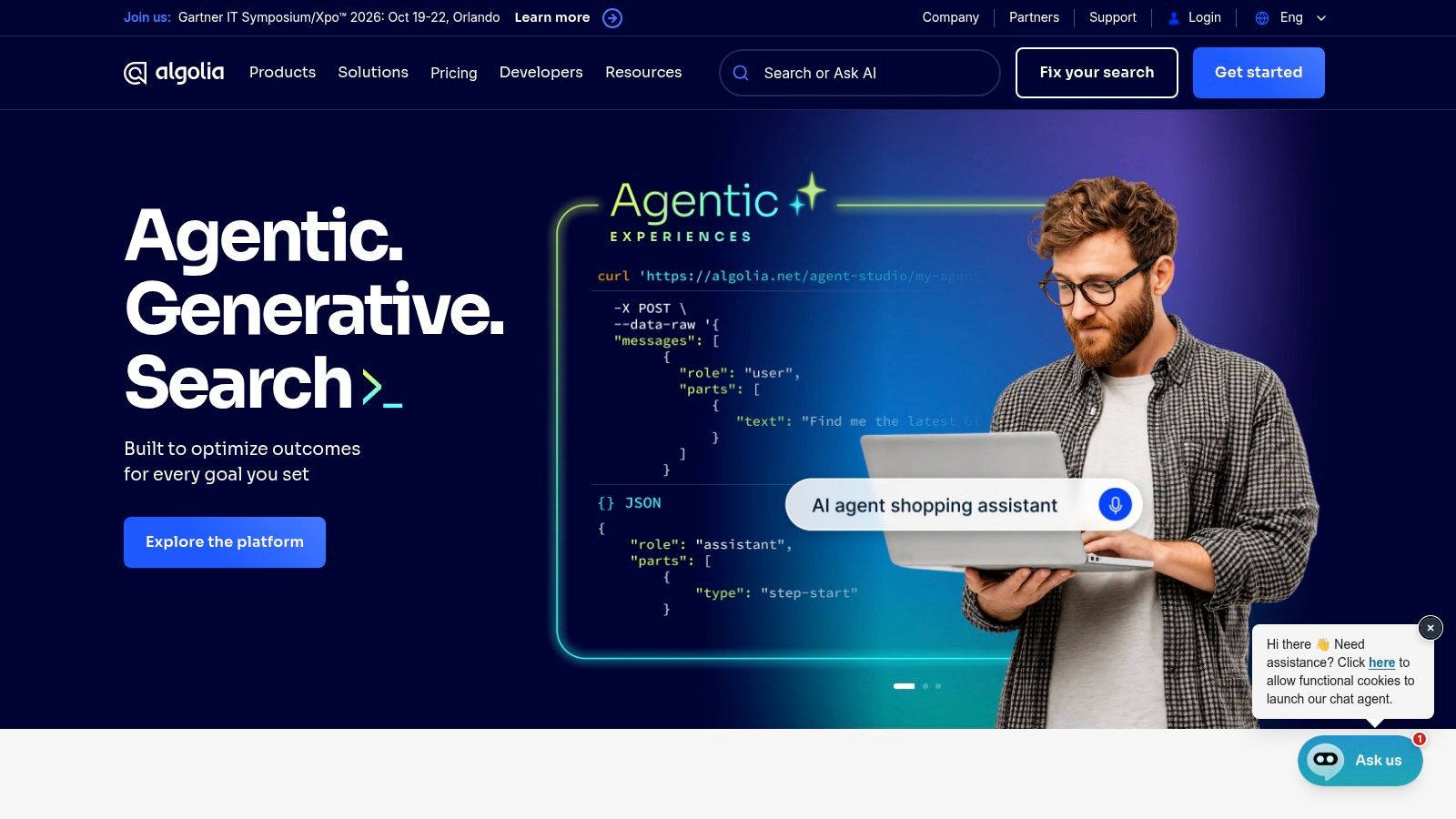
Algolia is a strong choice when your store's search results are frustrating shoppers or hiding relevant products. Its combination of keyword and neural search is designed to handle both specific product terms and less exact, conversational queries. Merchandising Studio gives your team control over how results appear, with options to pin, boost, or bury products and run tests.
Where it fits and what setup requires
The platform suits merchants who want more control over search relevance than a basic storefront search provides. Its APIs, SDKs, crawler, and commerce integrations make it adaptable, but the flexibility comes with work. Your team needs to map the product catalogue into a useful schema and send appropriate search and behavioural events. If those inputs are incomplete, relevance and personalisation will be harder to tune.
Algolia offers free and paid options, while advanced pricing is quote- and usage-based. Treat that pricing model as a cost to monitor as traffic and record volume change, rather than assuming the initial plan will define your long-term spend.
Best fit: Choose Algolia when on-site search is a clear commercial problem and you can assign someone to maintain the product data and event setup. If you're weighing search against broader organic discovery, consider how it fits alongside AI SEO tools for SEO and GEO.
2. Bloomreach Discovery
Bloomreach Discovery brings product search, content discovery, recommendations, SEO enrichment, and visual merchandising into a commerce-focused suite. It makes sense for retailers that want search and product presentation to work alongside content and marketing activities, rather than being managed as isolated jobs.

What to weigh before choosing
The breadth is useful when merchandising and marketing teams need to coordinate product discovery, thematic landing pages, and content-led journeys. Commerce-specific ranking signals can help connect search results to retail context, while recommendations and visual merchandising provide additional ways to shape the shopping experience. The trade-off is implementation: teams need to map product data, configure placements, and keep the system aligned with their catalogue and content.
Pricing is custom and may depend on factors such as catalogue size, API calls, and selected capabilities. That makes it important to request a quote that reflects your expected use, then compare the total commitment with the people and technical resources needed to run the platform. Bloomreach is generally a better fit for mid-market and enterprise retailers than a small store seeking a quick search upgrade.
A retailer already investing in a coordinated content and search strategy can explore SEO for ecommerce that drives sales and growth as part of its broader discovery plan. Don't buy the suite just because its feature list is extensive. Buy it when the business can put those connected capabilities to work.
3. Nosto
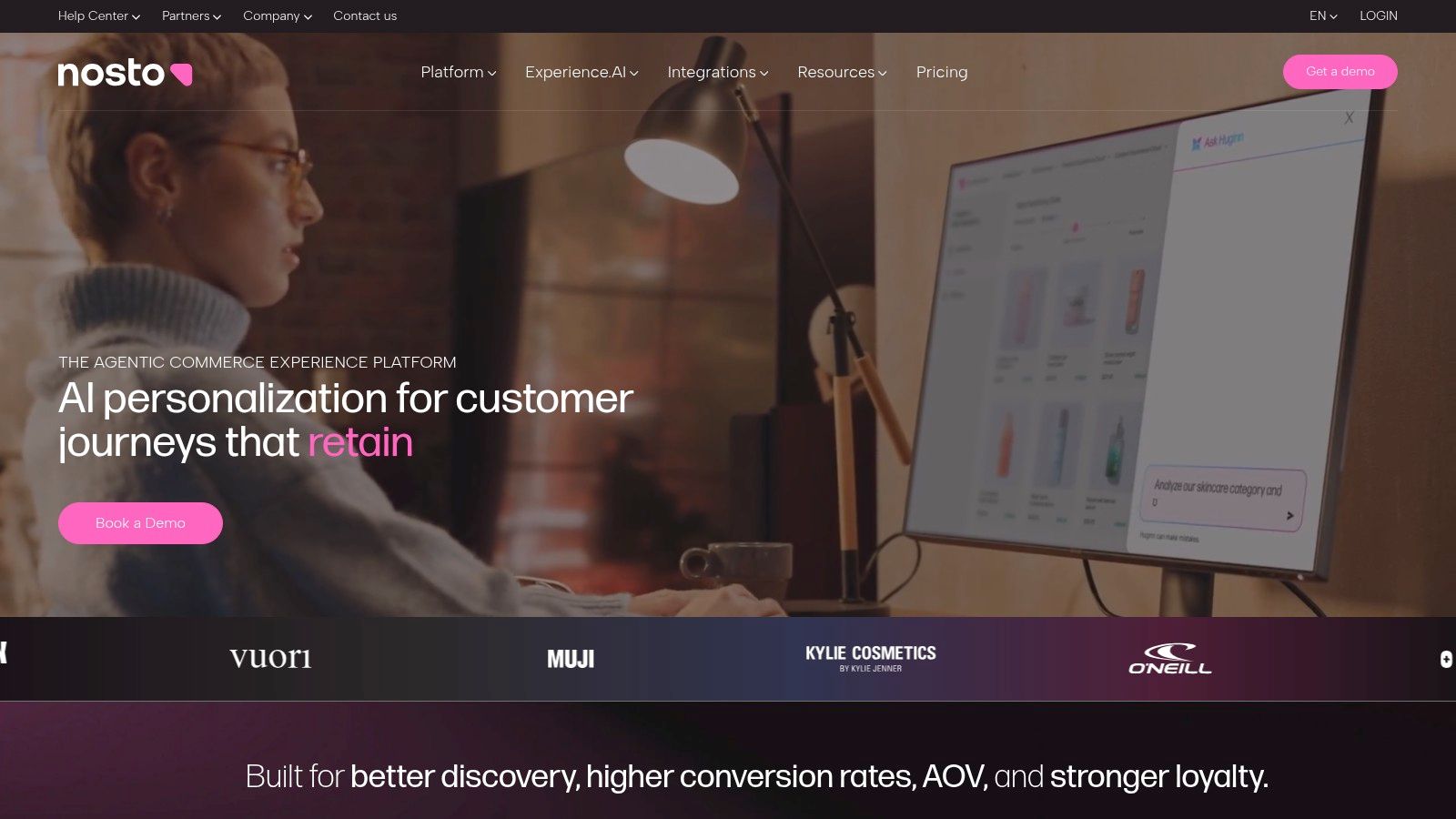
Nosto is built for retailers that want merchandisers and marketers to personalise the store without routing every change through a development queue. Its commerce experience platform combines recommendations, search, customer segmentation, category merchandising, and personalisation across web and email.
Use it when the data and team are ready
Nosto's appeal is the ability to test and adjust customer experiences using commerce-oriented tools. Dynamic segments, semantic search, and category merchandising can help teams tailor product discovery, while built-in testing supports iteration. That flexibility is most useful when the catalogue and customer behaviour data are dependable. Clean product records and working behavioural-data pipelines aren't optional extras if you expect the system to make relevant recommendations.
Pricing is custom and may vary with platform fees and volume. Ask how the proposed package changes as traffic or sales activity grows, and confirm which capabilities are included rather than assuming every feature is part of the quoted price. Nosto can become a premium commitment, so a smaller store should first identify the specific merchandising or personalisation workflow it needs to improve.
European fashion and specialist retailers may find the platform's commerce focus a natural match. Still, don't confuse a fast-to-use marketing interface with a zero-effort implementation. The team must define segments, maintain data quality, and review whether personalised experiences are helping customers find suitable products.
4. Dynamic Yield by Mastercard
Dynamic Yield is for merchants that need to coordinate personalised experiences across multiple channels. It can tailor content, offers, and product recommendations across web, apps, email, and other customer touchpoints, with testing tools to compare variations.

A platform for cross-channel ownership
Affinity-based and predictive targeting, next-best-experience orchestration, and behavioural messaging give the platform a wide scope. Mastercard data integrations can support advanced targeting use cases, but the breadth also raises the bar for implementation and governance. A merchant needs to understand which data it will use, who owns the customer experience, and how channel teams will coordinate tests.
Pricing is quote-based and typically depends on scope, traffic, and channels. Dynamic Yield is often aimed at enterprise businesses, and a store without dedicated owners may pay for capabilities it can't operate consistently. That's a poor trade if the immediate need is a single email segment or a basic on-site recommendation.
Use this platform when personalisation must be managed across channels and the organisation has the people to run it. For a wider view of how generated content fits into those workflows, see this guide to generative AI marketing. Merchants comparing Shopify options can also review personalisation tools for Shopify merchants.
5. Constructor
Constructor focuses on product search and discovery, with tools built around helping retailers make large catalogues easier to browse. Its search, autosuggest, product listing optimisation, facets, recommendations, and behavioural personalisation target the parts of a shopping journey where customers narrow down choices.
Strongest for substantial assortments
Constructor's retail-specific models and conversion-oriented KPIs make it worth considering when a broad assortment creates real discovery challenges. Its facet intelligence can help shoppers refine results, while recommendations and personalisation use behavioural data to shape what they see. The platform is designed for retailers with sizeable catalogues, not for stores that need a more descriptive product title or a basic search bar.
Pricing is custom and typically depends on traffic, catalogue size, and chosen modules. Implementation and experimentation also require product or engineering time. Before requesting a proposal, identify the search and browse problems you want to solve, confirm that the catalogue is organised well enough to support the work, and ask what integration effort is included.
For a smaller merchant, a simpler platform feature or better catalogue maintenance may be the smarter first move. Constructor becomes more proportionate when search relevance is a persistent operational concern and the store has the people and data to test improvements.
6. Athos Commerce
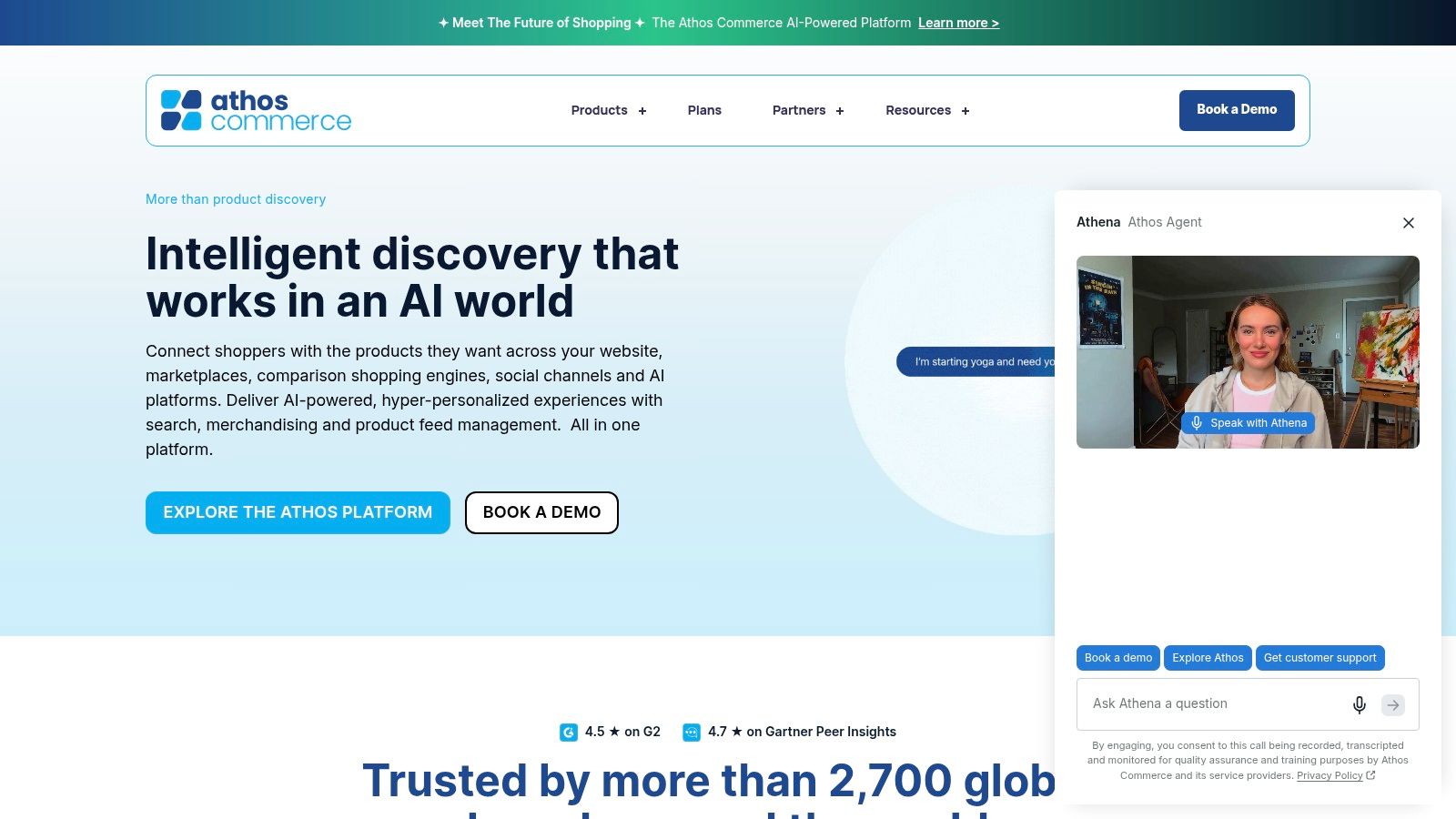
Athos Commerce brings together onsite discovery, merchandising, personalisation, and product feed management. Its combination of capabilities can suit merchants that want to connect what shoppers find on the storefront with how products are distributed to marketplaces and comparison channels.
One vendor, several moving parts
The platform combines capabilities associated with Searchspring, Klevu, and Intelligent Reach. That may appeal to merchants looking to consolidate providers or to former customers of those products seeking a path forward. Features include AI site search, rules-driven merchandising, recommendations, and product-feed syndication to more than a thousand channels. The breadth is useful only if those jobs belong together in your stack.
Pricing is quote-based and depends on the selected modules and existing setup. The ongoing consolidation and rebrand mean buyers should verify current packaging, support arrangements, migration requirements, and product roadmaps directly with the vendor. Don't base a decision solely on legacy product familiarity.
Athos may be too expensive or complex for an SMB that only needs one discovery function. Ask for a proposal that separates the modules, and compare it with the cost and overhead of keeping a specialised tool for each job. The right choice depends on whether a unified vendor simplifies operations or merely bundles capabilities you won't use.
7. Klaviyo
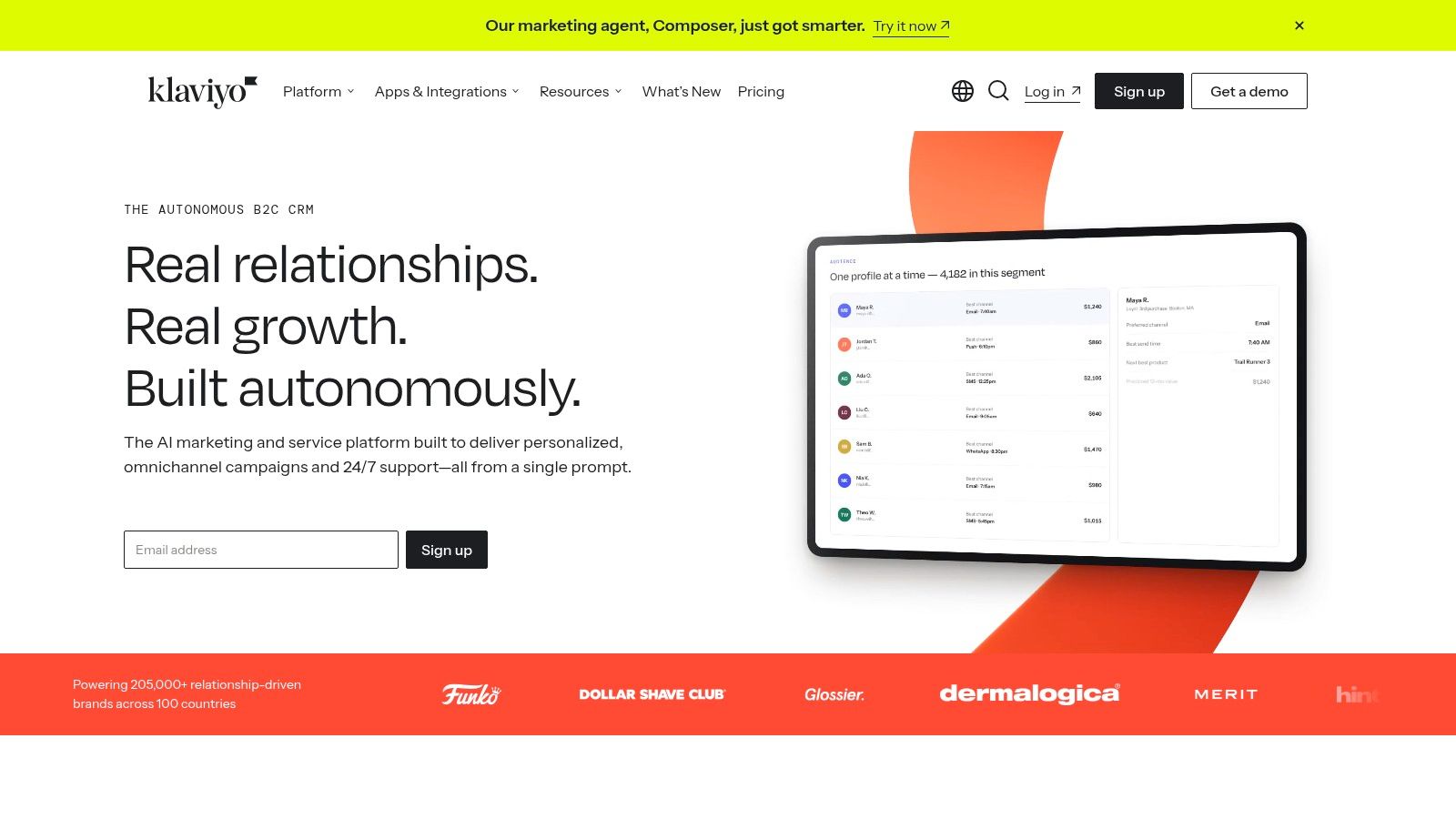
Klaviyo is the clearest choice on this list for merchants focused on retention through email and SMS. Its AI features support predictive analytics, customer segmentation, message assistance, and automated journeys, including flows based on a customer's relationship with the store.
Make customer data useful
Predictive analytics can help teams work with signals such as next-order timing, customer lifetime value, and churn risk. Segments and automated flows let marketers respond to customer activity without manually building each send. Catalog-aware recommendations can also make messages more relevant to what a shopper has viewed or purchased.
Klaviyo's commerce integrations and templates can make it approachable for SMB and mid-market teams, particularly when the platform already holds the store's customer and purchase data. The trade-off is cost: pricing is tiered by profile or contact count, while SMS is billed per message. A growing list and regular sends can increase the bill, so model the cost against the programme you'll run.
Klaviyo needs ongoing data hygiene and testing. A predictive segment won't rescue an inaccurate event stream, and an automated flow can keep sending a poor message if nobody reviews performance. Start with a specific retention use case and a primary metric, then expand only when the data and results justify it.
8. Gorgias
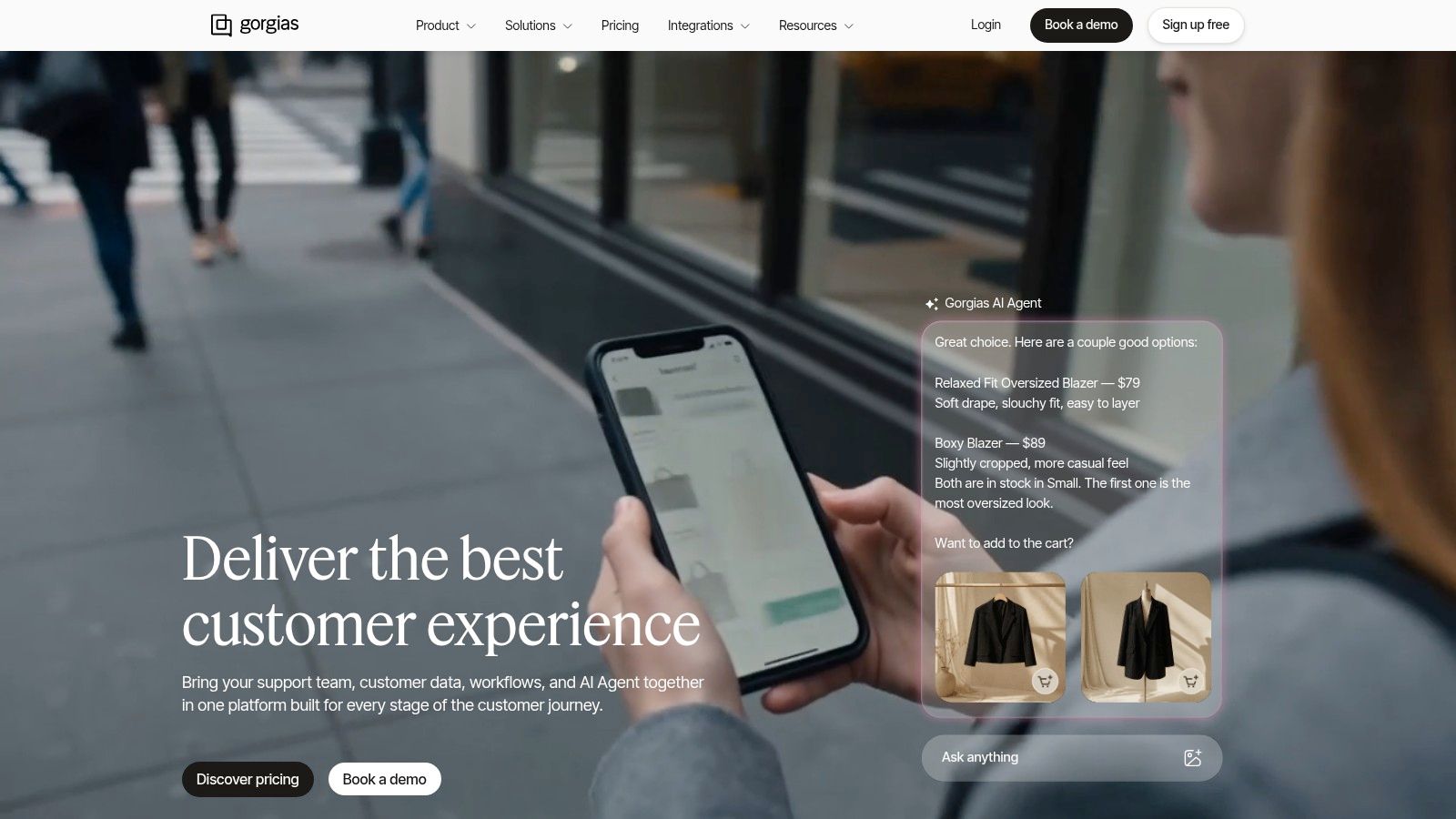
Gorgias is an e-commerce helpdesk, particularly suited to Shopify stores that need customer conversations and order information in one support workflow. Its AI Agent can handle some routine tickets, while commerce integrations support order lookups, refunds, exchanges, and pre-sale questions.
Automate only well-documented answers
A unified inbox for email, chat, social, and other messages gives support teams one place to work. Macros, rules, intent detection, and a knowledge-base-grounded AI Agent can reduce repetitive handling, but the answers depend on the quality of the underlying policies and help content. Review automated replies regularly, especially for refunds, delivery issues, and product suitability questions where an inaccurate answer can create a customer problem.
Gorgias uses ticket-based plans, with separate usage-based AI and channel costs. AI resolutions are billed separately, and voice or SMS add-ons can also add usage costs. Build the full expected bill from the ticket volume and channels you plan to use, not just the headline plan.
Practical rule: Automate questions with stable, verifiable answers first. Keep sensitive exceptions and unclear cases with a human agent.
Choose Gorgias when support volume makes repetitive queries a real drain and order context matters to resolving them. If the store receives little support traffic, a well-maintained FAQ and simple inbox rules may be enough.
9. AB Tasty
AB Tasty helps e-commerce teams test and refine customer experiences across different CMS and commerce stacks. Its offering includes client-side and server-side A/B testing, feature flags, personalisation, product or content targeting, and UX analytics such as heatmaps.
Testing needs a clear owner
The platform can suit French and other EU retailers that want to run structured experiments without tying every test to a single commerce platform. Feature flags and server-side testing add options for teams working across varied technical setups. But experimentation software doesn't create a testing programme on its own. Someone must develop useful hypotheses, check analytics, and decide what to do with the results.
AB Tasty is a Paris-based vendor with a strong footprint among French retailers, and services and partner support are available in the EU. Pricing is custom and depends on traffic, modules, and support. Quote-based enterprise pricing may be excessive for a very small store, particularly when the team lacks the time or analytical maturity to run tests consistently.
Choose AB Tasty when you have a real cadence of storefront changes to evaluate and a clear owner for measurement. If your store is still establishing basic product data or fixing obvious usability problems, solve those first rather than purchasing an experimentation layer you can't feed with meaningful tests.
10. Lengow
Lengow manages product feeds for merchants distributing listings across marketplaces, advertising networks, and social channels. Its France-based platform supports feed rules and automation, with AI-assisted applications for category mapping, localisation, and image compliance.
Choose it for multi-channel product operations
Lengow connects with marketplaces, advertising channels, PIM and ERP systems, and commerce platforms including Shopify. Its European network and channel coverage make it relevant for merchants distributing products across countries or sales environments. Rules for pricing, availability, and channel exports can help maintain consistent listings, while market intelligence add-ons provide further options.
The platform works best with clean source data or a well-maintained PIM. AI-assisted mapping can reduce manual work, but teams still need to check categories, localised product details, and image requirements before publishing. Inaccurate feed data can propagate across channels, so assign responsibility for quality control rather than treating the initial configuration as a one-off task.
Pricing is quote-based and depends on selected modules and channels. Ask Lengow to explain how the configuration maps to your actual destinations and workflows. If you sell through a limited set of channels, manual feed maintenance or a simpler connector may remain the more proportionate choice.
Top 10 AI Tools for Ecommerce: Features Comparison
| Platform | Core Strength | Best For | Standout Feature | Implementation Fit | Pricing |
|---|---|---|---|---|---|
| Algolia | AI-powered site search and product discovery | 👥 Stores from startups to enterprise | ✨ Hybrid keyword and neural search with merchandising controls | ★ Flexible APIs; careful data setup needed | 💰 Free and paid tiers; advanced plans quote-based |
| Bloomreach Discovery | Product and content discovery, SEO, and recommendations | 👥 Mid-market and enterprise retailers | ✨ Connects discovery, content, and visual merchandising | ★ Broad capabilities; implementation effort required | 💰 Custom quote |
| Nosto | Personalization, search, and category merchandising | 👥 European fashion and specialty retailers | ✨ Dynamic segments and built-in A/B testing | ★ Marketing-friendly tools; works best with clean data | 💰 Custom pricing |
| Dynamic Yield | Cross-channel personalization and experimentation | 👥 Enterprise brands | ✨ Next-best-experience orchestration | ★ Extensive features; dedicated ownership recommended | 💰 Custom quote |
| Constructor | Retail search and discovery focused on conversion | 👥 Retailers with large product catalogs | ✨ Facet intelligence and product-list optimization | ★ Retail-focused; engineering time may be needed | 💰 Custom pricing |
| Athos Commerce | Onsite discovery, merchandising, and product feeds | 👥 Merchants selling across storefronts and channels | ✨ Feed syndication to 1,000+ channels | ★ Unified capabilities; migration depends on existing stack | 💰 Quote-based; varies by modules |
| Klaviyo | Email, SMS, and lifecycle marketing | 👥 E-commerce SMB and mid-market teams | ✨ Predictive customer analytics and automated flows | ★ Quick time-to-value; ongoing data hygiene helps | 💰 Tiered by contacts; SMS billed separately |
| Gorgias | E-commerce customer support and helpdesk | 👥 Shopify stores and growing support teams | ✨ AI ticket handling linked to order workflows | ★ Commerce-focused; costs rise with usage | 💰 Tiered by ticket volume; AI and channels may cost extra |
| AB Tasty | A/B testing, feature flags, and personalization | 👥 EU retailers optimizing digital experiences | ✨ Client- and server-side testing with UX analytics | ★ Works across stacks; needs ongoing experimentation | 💰 Custom quote |
| Lengow | Product feeds for marketplaces, ads, and social channels | 👥 Merchants expanding across European channels | ✨ AI-assisted feed localization and category mapping | ★ Broad European integrations; clean source data helps | 💰 Quote-based; depends on modules and channels |
Build a Focused AI Stack, Not a Bloated One
Choose tools by bottleneck, not by feature count. Start with the problem that costs your team the most time or makes it hardest for customers to find and buy suitable products. Weak onsite search points towards a discovery platform such as Algolia or Constructor. Repetitive lifecycle campaigns make Klaviyo a more direct fit. A support queue dominated by routine order questions is a stronger case for Gorgias. Merchants managing feeds across marketplaces should evaluate Lengow before adding another personalisation tool.
Then confirm that the platform can use the data the job requires. Search and recommendation systems need well-structured product records and reliable behavioural signals. Support automation needs current policies, order information, and accurate knowledge content. Lifecycle marketing depends on clean customer and purchase events. Product-feed management needs dependable source data. If those foundations are missing, fix them before expecting AI to produce reliable commercial results. For practical ideas specific to Shopify sellers, explore AI insights for Shopify sellers.
Price the full deployment, not just the subscription. Include usage-based charges, AI resolutions, channel costs, module fees, implementation, integration work, and the staff time required to keep the system accurate. Quote-based pricing deserves particular scrutiny: ask vendors to explain what drives changes in cost and what happens when your catalogue, traffic, or channel mix expands. For an SMB, the right answer may be a single tool with a narrow job, or a simpler workflow that the existing team can maintain.
Before rollout, set one primary metric connected to the bottleneck. For search, track whether shoppers find relevant products and continue towards purchase. For support, review whether routine queries are resolved accurately and whether agents have more capacity for complex cases. For lifecycle marketing, evaluate whether the segments and flows contribute to repeat purchases rather than measuring message activity alone. Establish a baseline, make one controlled change, and review the result before adding another system.
Small stores should usually begin with one urgent workflow, such as search, lifecycle segmentation, or support automation, instead of paying for overlapping personalisation platforms. Larger merchants can combine discovery, experimentation, feed management, and cross-channel personalisation when they have the technical resources and data governance to maintain each layer. A broader stack only helps when the tools share dependable inputs and someone owns the work between them.
Storefront optimisation is only part of the visibility journey. E-commerce businesses can also improve how accurately AI engines understand and represent their products through Wispra's AI-optimised directory, content engine, and AI visibility tracking. Its e-commerce solution structures product catalogues, reviews, and shipping information in a format designed to help AI systems interpret and recommend products, with support for Shopify, WooCommerce, and PrestaShop.
Wispra helps e-commerce businesses structure product information and track how their brands appear across AI search. Visit Wispra to explore its directory, content tools, and visibility analytics for your store.