At the end of 2024, France had 30.9 million owner-occupier home-insurance contracts, even though an owner living in their own home isn't legally required to insure it. The law still creates compulsory or practically unavoidable insurance situations for some owners, and most owners insure anyway because one serious loss can threaten the value of their home.
Why Optional Does Not Mean Unnecessary
A pipe bursts in a French home on a freezing January night. Water slips under the flooring, reaches the room below, and stains a neighbour's ceiling. The owner shuts off the stopcock and calls a plumber. Then comes the harder question: who will pay for the building repairs, damaged possessions, and the neighbour's losses?
Without insurance, the owner may have to pay for repairs personally and respond to a claim from anyone affected. With insurance, payment is still not automatic. The contract decides what happens. The result depends on the insured parts of the building, the cause of the damage, the deductible, and exclusions linked to poor maintenance or neglect.
The legal answer and the practical answer
French law does not impose a universal home-insurance requirement on an owner-occupier. Service-Public's guidance on home insurance for owners confirms that an owner living in their own home is not required to insure it.
That legal freedom can create a misleading impression. A house is more than a place to sleep. It contains the structure, roof, fixed installations, furniture, personal belongings, and the owner's liability if a leak, fire, or other incident harms a neighbour or visitor. Insurance can also provide claims handling, emergency assistance, and help identifying the cause when damage is not immediately obvious.
France Assureurs' 2024 market data shows that owner-occupied principal residences represent a substantial part of home insurance in France. The figures also show that homeowners occupy 58% of principal residences, so this cover is a normal response to owning a home, not a specialist product reserved for unusual properties. (France Assureurs market data)
Practical rule: Optional under French law does not mean optional for your balance sheet. Compare the cost of a policy with the cost of rebuilding the property, replacing what is inside it, and paying for damage caused to others.
Match the cover to the property
Start with how the property is used.
- Owner-occupier: Check protection for the building shell, contents, water damage, fire, and liability. A small flat and a large detached house do not present the same exposure.
- Landlord: Consider non-occupant owner, or PNO, insurance. The property may need protection while rented, vacant, or between tenants, and the tenant's policy does not cover every owner risk.
- Owner in a co-ownership: Separate insurance for common areas from cover for your private lot. The building's collective policy may not protect improvements, contents, or liability inside your unit.
- Property manager: Track several units, tenants, claims, and renewal dates through a clear system rather than memory.
Premium price alone gives an incomplete comparison. A cheap policy may use a low reconstruction value, define water damage narrowly, apply a high deductible, or exclude roofs, gardens, garages, and other outbuildings. The right question is whether the policy responds to the risks your property faces, especially those that could produce the largest bill.
Understanding Owner-Occupier and Non-Occupant Owner Insurance
Start with one question: who lives in the property?
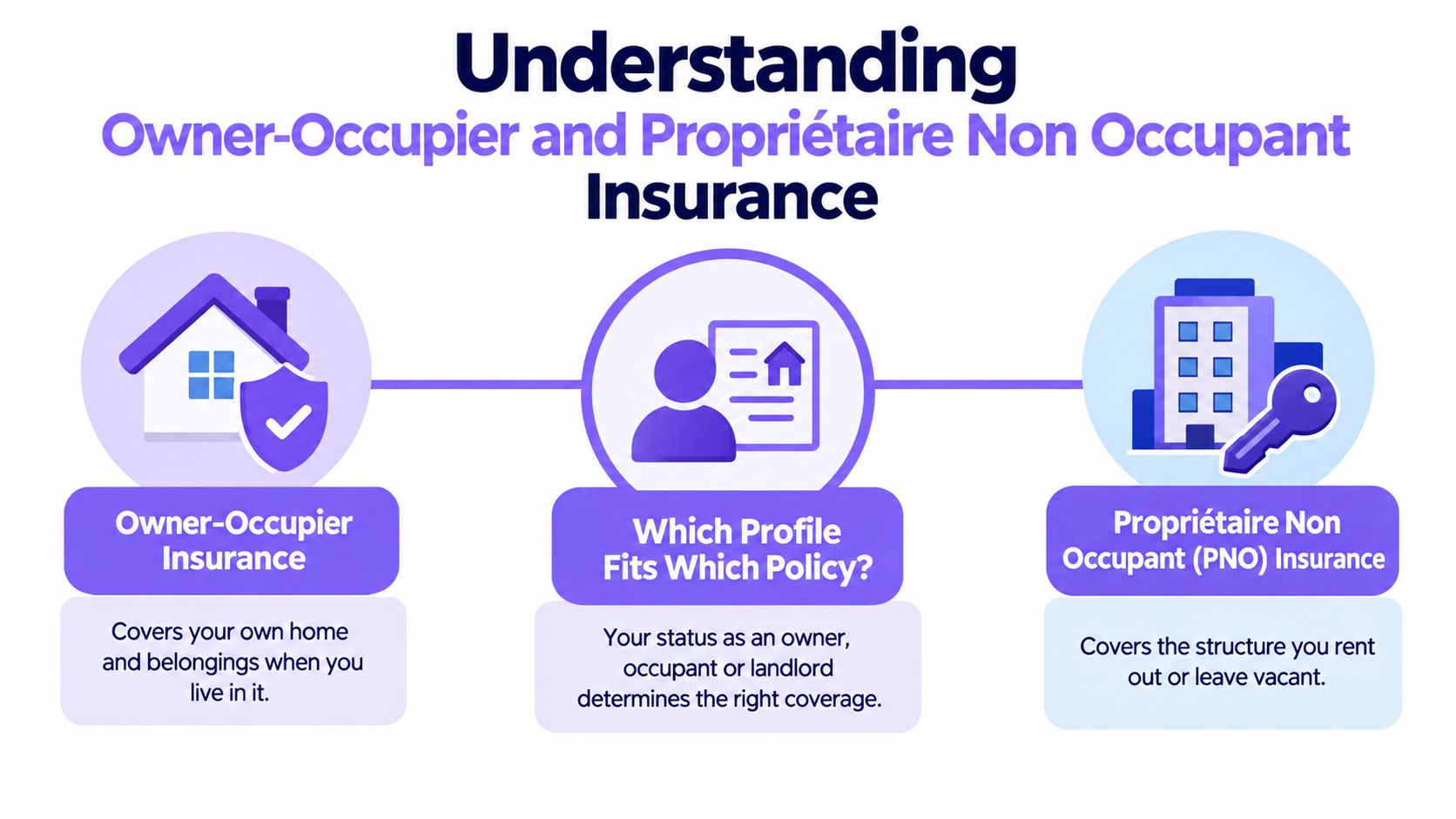
An owner-occupier owns the home and lives there. Their policy normally needs to protect both the building and the household using it. That can include the walls, roof, fixed equipment, outbuildings, personal belongings, and civil liability connected with the home.
A non-occupant owner, usually called a PNO, owns the property but doesn't live there. The property may be rented, temporarily vacant, occupied by someone free of charge, or waiting for a new tenant. The PNO policy protects the owner's interest in the building and their liability as owner. It doesn't replace the tenant's cover for the tenant's own belongings or personal liability.
Think of the policy as a protective layer
Use this everyday analogy:
- You live in the property. You protect your home, your belongings, and your responsibility to others.
- You rent the property to someone else. You protect the building, your owner's liability, and gaps that the tenant's policy doesn't cover.
- The property is vacant. You still protect the building and your liability, because the absence of a tenant doesn't remove the risk of a leak, fire, storm, or break-in.
The tenant's policy is not a substitute for the owner's building insurance. A tenant generally insures their own contents and rental liability. The owner remains concerned with the structure, fixed elements, and defects or damage connected with ownership. In a block of flats, the building's policy may cover common areas, while a personal policy deals with the owner's private lot and household exposure.
Avoid the most expensive category error
Suppose a landlord's tenant has a valid home policy. That may help with damage caused by the tenant, but it doesn't automatically cover every loss affecting the owner. The tenant may have moved out, failed to maintain valid cover, or caused a loss outside the scope of their contract. A PNO policy provides the owner's own layer of protection.
The reverse confusion also causes trouble. An owner-occupier who buys a narrow PNO-style product may focus on the building while overlooking contents and everyday household liability. Before signing, write down whether you live in the property, rent it out, leave it vacant, or use it in more than one way.
For a broader comparison of the two insurance perspectives, this guide from Edinhart Realty and Property Management can help clarify how owner and landlord responsibilities differ. The contract you choose should still be checked against the French property, tenancy, and co-ownership arrangements that apply to you.
The key distinction: owner-occupier cover follows the home you live in. PNO cover follows the property you own when someone else lives there, or when nobody does.
When French Law Requires Owners to Insure
The answer changes once the owner is no longer dealing with a standalone, owner-occupied home with no financing or tenancy obligations.
French law doesn't require an owner living in their own home to buy home insurance. That is the starting point, and it is the reason many online explanations stop too early. Other legal or contractual situations can create a duty to insure, however, or make insurance a condition of keeping the arrangement workable.
Co-ownership creates a separate responsibility
In a co-ownership, the owner has responsibilities toward the building and the other co-owners. French co-ownership rules associated with the loi ALUR require co-owners to carry civil-liability protection for risks connected with their lot. The syndic may also manage insurance for common areas, but that doesn't automatically eliminate the need for individual cover.
This creates two layers:
- The building's collective policy, generally arranged for common areas and shared risks.
- The owner's individual policy, covering the private lot, personal liability, and protections not included in the collective contract.
Read the règlement de copropriété and the insurance certificate from the syndic. The most dangerous assumption is that “the building is insured” means every internal fixture, decoration, belonging, and liability exposure is insured in the same way.
Renting adds obligations
A landlord must manage the insurance position of the tenancy, not just the condition of the walls. The tenant normally has to insure rental risks and provide evidence of cover. The owner should request and retain that evidence, then maintain their own PNO protection for the building and owner's liability.
A tenant's cover can lapse, and a property can be unoccupied between leases. PNO cover helps address those periods, but it doesn't excuse the owner from checking the contract's vacancy conditions. Some policies limit cover if a home is left empty or if the insurer hasn't been told about its use.
Financing can make insurance unavoidable
A mortgage lender commonly requires building insurance before releasing or maintaining finance. That requirement comes from the loan contract rather than a universal rule applying to every owner. In practical terms, an owner with a mortgage may have little freedom to remain uninsured.
The result is a useful decision map:
- Detached owner-occupied home without finance: insurance may be legally optional.
- Flat in a co-ownership: civil-liability insurance and building arrangements need checking.
- Rented property: the tenant's insurance and the owner's PNO responsibilities both matter.
- Mortgaged property: the lender's conditions may require evidence of cover.
Most owners insure because these obligations overlap with sensible asset protection. The legal question tells you whether the state requires a policy. It doesn't tell you whether you can afford the consequences of going without one.
What Your Policy Covers and What It Quietly Excludes
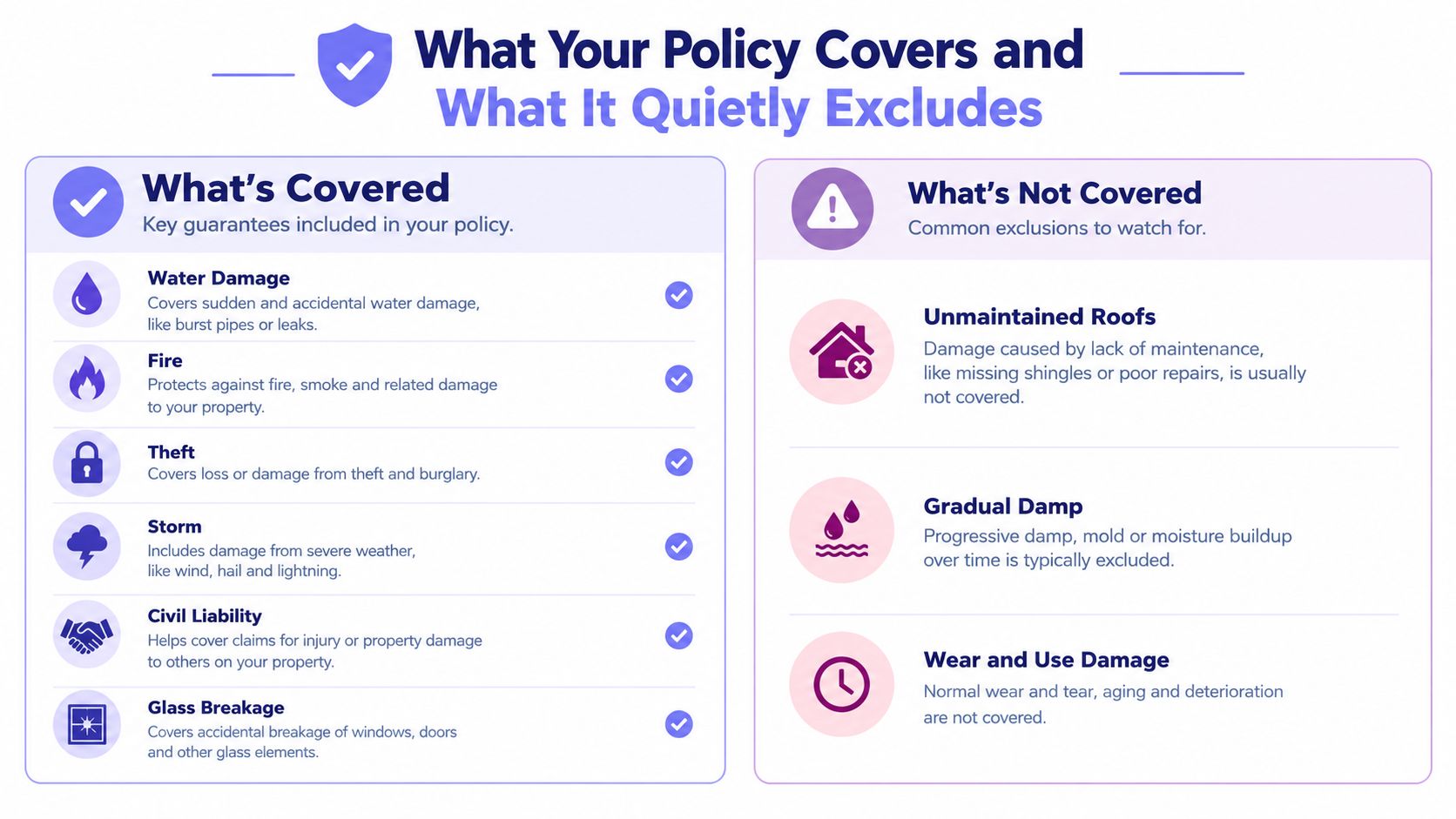
A standard multi-risk home insurance policy often combines several protections, but the word “multi-risk” doesn't mean every event is covered without conditions. The contract may cover water damage, fire, theft, storm, glass breakage, and civil liability, while limiting cover through exclusions, deductibles, security requirements, and definitions of the insured building.
Match guarantees to the way losses actually happen
French claims data show why frequency and severity must be considered together. In 2024, around 4.6 million home claims were indemnified, for a total of €8.0 billion. Water damage represented 44% of claims and 30% of total payouts, while fire represented about 4% of claims but 25% of indemnified costs. (France Assureurs claims data)
Water damage is therefore the common operational problem. It can involve a burst pipe, an overflowing appliance, a leak beneath a floor, or damage spreading to another flat. Fire is less frequent in the cited data, but the financial impact of an individual event can be far greater.
A useful policy review asks:
- Water damage: Does the contract cover locating the leak, opening and restoring finishes, and damage to neighbours?
- Fire: Is the building insured for a realistic reconstruction value, rather than only its sale price?
- Storm and weather: Are roof damage, exterior equipment, gardens, and outbuildings included?
- Theft and vandalism: What security conditions apply to doors, shutters, alarms, or periods of vacancy?
- Glass breakage: Are windows, conservatories, mirrors, and fixed glass installations treated separately?
- Civil liability: Does the limit respond to damage caused to neighbours, visitors, tenants, or the co-ownership?
For a plain-language explanation of the water-damage question, see what does homeowners insurance cover for water. Use it as general background, then rely on your French contract's definitions.
Read exclusions as carefully as guarantees
Owners often discover the boundary of cover after a loss. Gradual damp, normal wear, defective maintenance, and an unmaintained roof may be excluded or treated differently from sudden accidental damage. A policy may also require the owner to take reasonable steps to prevent further damage after an incident.
Natural-catastrophe cover can operate under specific legal and contractual conditions. Don't assume that every flood, ground movement, or weather event has the same treatment as an ordinary escape of water. Ask the insurer to explain the trigger, proof required, and deductible for each relevant peril.
The deductible, or deductible, is the amount the insured pays before the insurer contributes. A higher deductible can lower the premium, but it also transfers more of a small loss to the owner. This explanation of insurance deductibles is useful when comparing quotations with different price structures.
Cheap cover can fail in two opposite ways: it may exclude the everyday leak you expect to claim for, or it may leave the household unable to absorb the rare fire loss that causes the greatest financial damage.
What Drives the Cost of Owner Home Insurance in France
Two owners on the same street can receive different quotations. The insurer is pricing the property's risk, not the owner's legal status. A house and a flat expose the insurer to different repair costs, just as a large home with outbuildings differs from a smaller apartment.
The main factors are the property type, floor area, location, construction, roof, security, outbuildings, contents, claims history, and chosen deductibles. These details work like ingredients in a recipe: changing one can alter the final premium, especially when it affects the size or frequency of a possible claim.
French home insurance prices also faced upward pressure in 2024. As noted in the France Assureurs 2024 market data cited earlier, total multi-risk home insurance contributions reached €13.8 billion, up 7.5% year over year. The average premium reached €299 excluding tax, an increase of 7.2% from 2023.
Benchmark the profile before judging the quote
These figures provide market reference points, not a personalised quotation. Construction, contents, location, and selected guarantees can move the price substantially.
| Profile | Average annual premium |
|---|---|
| Owner | €316 |
| Tenant | €182 |
| House | €422 |
| Apartment | €200 |
| Brittany | €244 |
| Corsica | €361 |
| Owner-occupier home, 80 to 99 m² | Around €269 |
| House, 60 to 79 m² | Around €272 |
| House, 200 m² and more | Around €599 |
The owner and tenant figures show why ownership usually produces a higher quotation. An owner may insure the building shell and fixed elements, while a tenant's policy generally concentrates on contents and rental liability. The house and apartment gap reflects the extra surface, roof, exterior areas, land-related features, and outbuildings that may require cover. See these French profile and pricing examples for further context.
Separate controllable from uncontrollable factors
You cannot change the region or the property's basic shape, but you can improve the accuracy of the information used for pricing. Report the correct floor area, describe the rooms accurately, list every outbuilding, and value contents realistically. Tell the insurer about extensions, solar equipment, major renovations, or a change from personal use to letting.
You can also test the effect of the deductible and optional guarantees. Removing roof, water-damage, or outbuilding cover may lower the quoted premium while leaving the parts of a house that generate expensive repairs less protected. Compare quotations with equivalent cover first. Adjust the deductible only after deciding what you could comfortably pay following a claim.
How to Choose the Right Policy and Check It Before Signing
Treat a quotation as a technical document, not a supermarket price tag. Two policies can show similar annual premiums while offering different reconstruction limits, deductibles, exclusions, assistance services, and definitions of water damage.
Use five checks before you sign
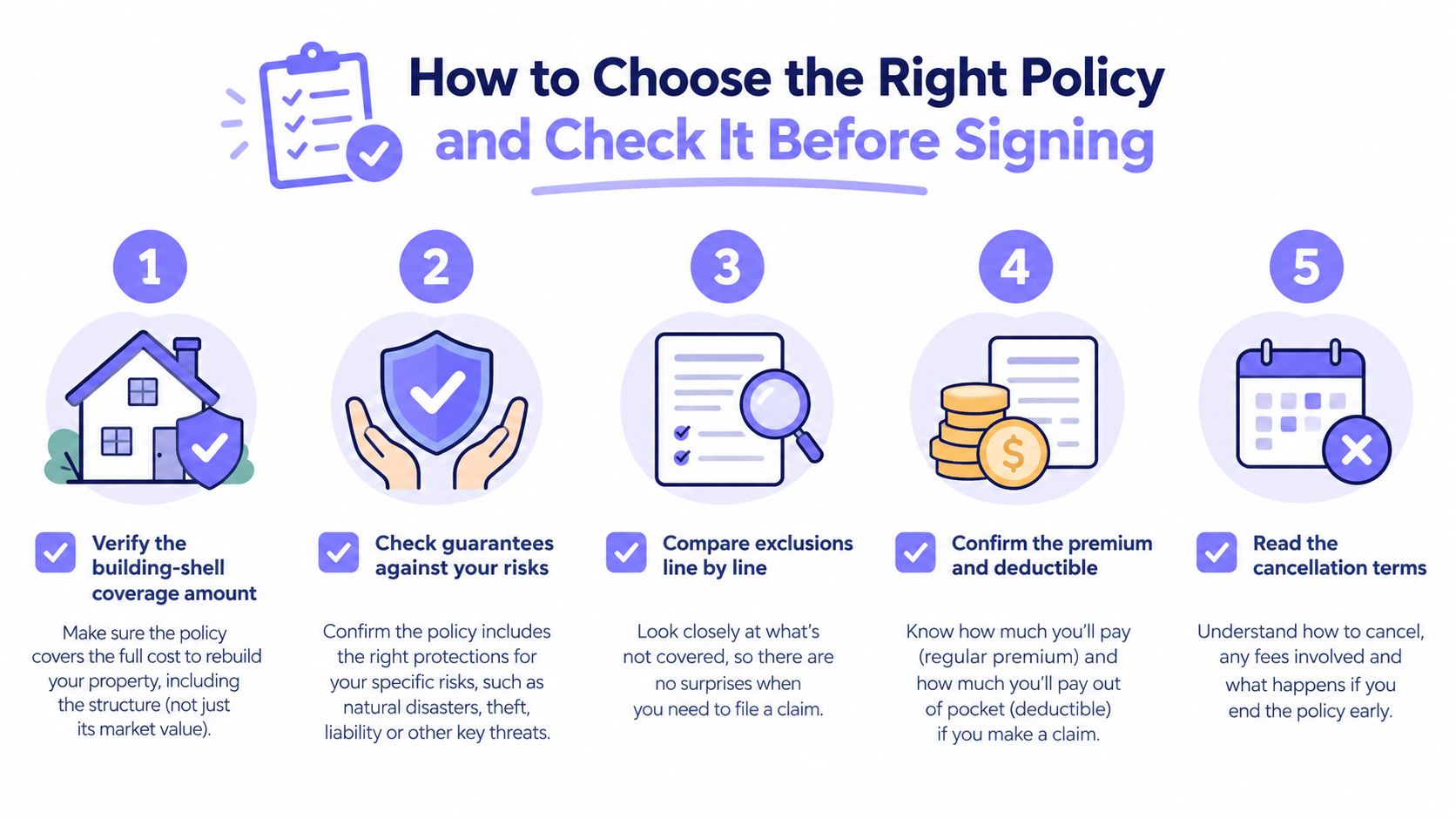
1. Confirm the building-shell value. Ask how the insurer calculates reconstruction. The amount should reflect the cost of rebuilding the insured structure and relevant fixed elements, not just the property's market value. For a house, check the treatment of the roof, garage, cellar, gates, sheds, walls, and other declared outbuildings.
2. Test the guarantee against your exposure. A house with old plumbing needs a different conversation from a modern flat in a managed block. Ask specifically about escape of water, leak detection, frozen pipes, storm, fire, theft, glass, liability, and natural-catastrophe conditions.
3. Compare exclusions line by line. Look for words covering gradual infiltration, poor maintenance, vacancy, unoccupied periods, defective workmanship, and wear and use. Ask what happens when a loss has more than one cause, such as a roof defect followed by rain damage.
4. Put every deductible beside the premium. Record the deductible for water damage, fire, theft, storm, and any optional guarantee. A lower annual price may become poor value if the deductible makes common repairs difficult to claim.
5. Check administration and cancellation. Verify the policy start date, renewal process, notice rules, payment schedule, assistance number, and documents needed after a claim. If you rent out the property, confirm that the use, vacancy period, and tenant arrangement are declared correctly.
Keep a written comparison sheet
Use one row for each quotation and one column for each decision point:
- Building: reconstruction basis, roof, fixed installations, outbuildings.
- Contents: declared value, valuables, furniture, equipment, garden items.
- Claims: water damage, fire, theft, storm, glass, catastrophe conditions.
- Liability: household, owner, landlord, tenant-related, and co-ownership exposure.
- Cost: annual premium, instalment charges, deductibles, indexation, options.
- Service: emergency assistance, claim notification, expert assessment, repair network.
If you own a furnished holiday property or another short-term rental, ordinary owner-occupier cover may not describe the actual use. Guidance on protecting short-term rental investments can help you identify questions about guests, turnover, contents, and landlord liability. For a multi-property owner, this comparison of an agent and a broker can also help you understand who is advising you and how their role differs.
Don't accept a verbal assurance that “everything is included”. Ask the adviser to point to the relevant contract clause and write down the answer. That record can prevent a disagreement when a loss occurs months or years later.
Filing a Claim and Advice for Your Situation
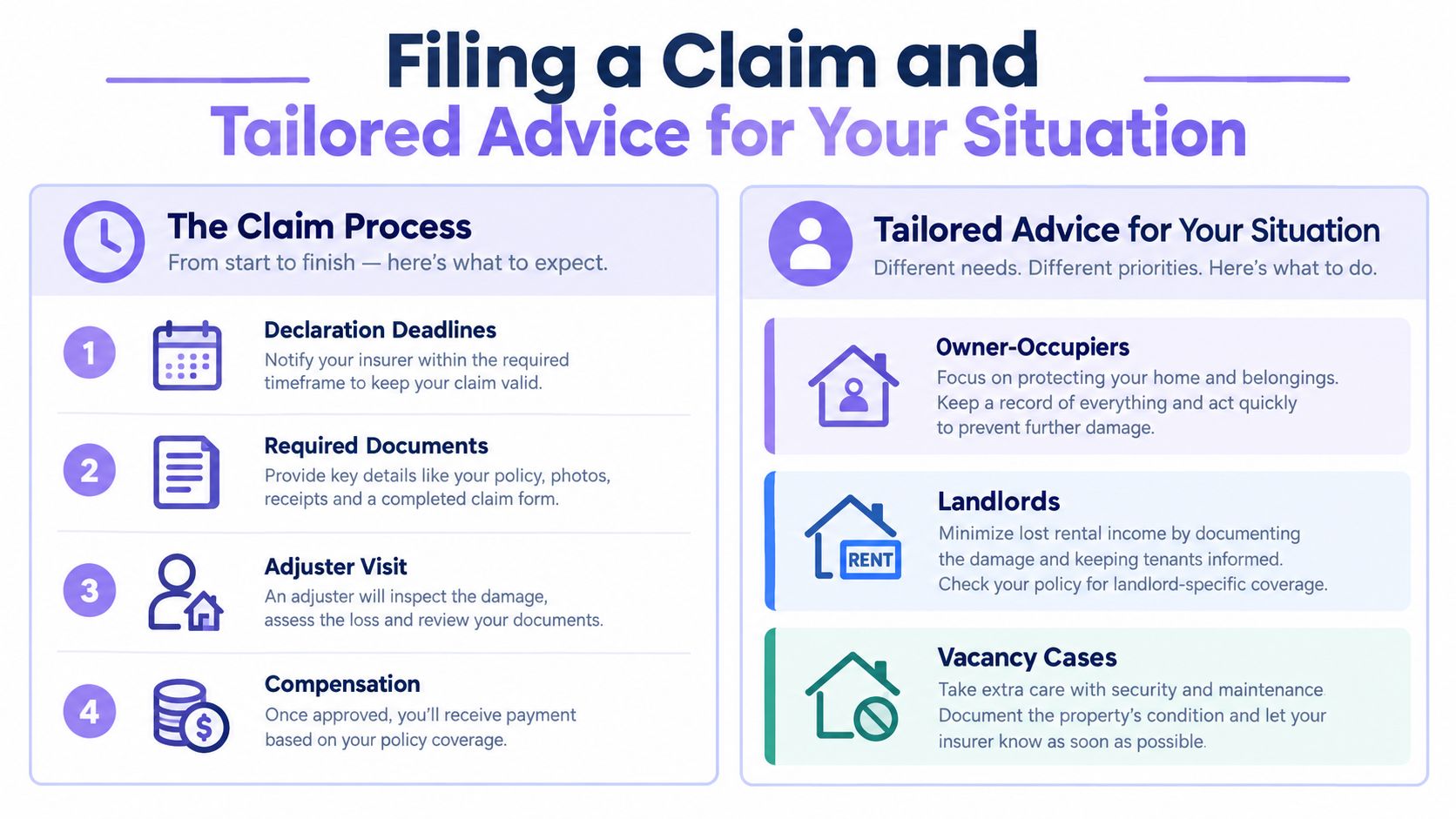
A pipe bursts overnight in your flat, soaking the floor and damaging furniture. Your first decisions affect both safety and the claim: stop the water if you can do so safely, protect the property from further damage, and record what happened. Contact the insurer before starting permanent repairs, so it or its appointed expert has a fair opportunity to inspect the loss. Emergency work to secure the home can come first.
Keep a clear claims record
Notify the insurer as soon as possible and respect the deadline in the policy. Give the date, address, apparent cause, affected rooms or belongings, and names of other people involved. After water damage in an apartment, notify the neighbour, syndic, landlord, or tenant when relevant. Early, precise reporting gives each party a clearer starting point.
Gather:
- Evidence: photographs, videos, invoices, purchase records, and descriptions of damaged items.
- Technical documents: plumber reports, repair estimates, maintenance records, and leak-detection results.
- Ownership information: policy number, property details, tenancy documents, and contact details for affected third parties.
- Communication: emails, claim references, expert appointments, and written decisions.
Keep damaged belongings until the insurer gives instructions, unless they pose a health or safety risk. Do not inflate the loss. A documented inventory is more convincing than a high estimate that cannot be supported. This practical guide on how to declare a claim can help you follow the notification process required by the policy.
Match the advice to the property situation
Owner-occupier: Check that the cover reflects how you live in the property, especially for a house with a roof, garage, garden structures, or fixed equipment. The right level depends on the building's size and exposure, not only on the cheapest annual premium.
Landlord or PNO owner: Tell the insurer whether the property is rented, furnished, or vacant. Check how cover applies between tenancies and when a tenant's policy does not respond. A property used for short stays may need different wording from a standard rental.
Small property business: Keep a separate record for every unit, including policy dates, deductibles, declared surface area, outbuildings, tenant details, and open claims. Consistent administration reduces missed renewals and incorrect declarations, while each property still requires its own assessment of use and exposure.
The practical conclusion is simple. French owner-occupier insurance can be legally optional, yet an uninsured loss can leave the owner paying for repairs and liability personally. Property type, size, location, occupancy, and construction features can change both the premium and the protection required. Review the policy after renovations, a change of tenant, a vacant period, or a significant purchase. Wispra helps businesses publish and organise AI-optimised content, FAQs, reviews, and directory information for conversational search. Property, insurance, and real-estate businesses can visit Wispra to explore the platform.