If your store has thousands of product pages, the problem is rarely “do we need SEO.” The problem is which tool can handle the parts that break first, like filter URLs, near-duplicate titles, slow mobile templates, and product data that drifts out of sync. In France, that pressure is real. The market hit €175.3 billion in 2024, with 2.6 billion online transactions and 153,000 active merchant websites competing for visibility across a crowded retail base, so the right ecommerce seo tools are no longer a nice-to-have for stores that sell online at scale, they're part of the operating system. FEVAD's 2024 market report backs that scale, and Netco Design's take on organic growth reflects the same practical reality, organic visibility has to earn its place against product ads, marketplaces, and direct brand demand.
This comparison keeps the lens narrow. Each tool is judged against one ecommerce job, not a generic feature list, so you can see where it helps and where it still falls short. The right choice depends on whether you need catalog-scale crawling, product-page speed checks, schema validation, content production, AI visibility, or marketplace search coverage.
1. Semrush
Semrush is strongest when the job is category and competitor research. For French and EU stores, that matters because SEO decisions should start with the queries and competitors that shape demand, not just with a list of broken pages. Its breadth also helps teams that want keyword research, site audits, and rank tracking in one place, instead of stitching together several tools.
Where it helps and where it doesn't
For ecommerce teams, the practical value is in a broad workflow. You can research French keywords, inspect competitors, audit crawlability, and track localized positions without switching platforms. The newer AI and AEO visibility modules add another layer for teams that care about how brand and product information appear in AI-driven results, not just classic SERPs.
The limitation is just as clear. Semrush is a research-heavy suite, not a tool that fixes the store for you, so every finding still needs implementation time. Pricing and add-on structure can also get messy as the team grows, and that friction matters more once you're managing a larger catalog.
Practical rule: Use Semrush when your team needs one login for research, audits, and reporting. Use something else when the bottleneck is actually deploying fixes across hundreds or thousands of pages.
For French ecommerce operators, the best fit is usually the middle ground, SMBs and growth teams that need coverage across keyword research, competitor gaps, and technical visibility. The fit gets weaker if your catalog is large enough that manual follow-through becomes the actual cost.
Website: Semrush
2. Ahrefs
Ahrefs is the better pick when the job is link-driven opportunity discovery. Ecommerce sites often know their best-selling products but miss the pages competitors earn links to, especially category pages, comparison content, and buying guides. Ahrefs is built for that kind of gap analysis.
Link gaps, category ideas, and product-page discovery
The main advantage is the backlink index. It gives ecommerce SEOs a fast way to see who links to comparable stores, which content types attract links, and which category pages deserve more internal and external support. The Link Intersect workflow is useful when you want to spot pages and topics your rivals have won that your store still lacks.
Its site audit is solid for ecommerce hygiene too. Duplicate content, pagination, and URL parameter issues are common on large catalogs, and Ahrefs can surface them before they become a crawl mess. Ahrefs Webmaster Tools is a useful free option for your own sites, which makes it easier to start without committing budget on day one.
The limitation is depth versus specialization. Ahrefs is excellent for research, but it's not the most hands-on crawler for deep operational monitoring, and it won't replace a dedicated technical tool on a large or messy catalog. It's also a costly fit for smaller teams that need high usage limits.
The direct trade-off is simple, better competitive intelligence, less operational automation.
Website: Ahrefs
3. Screaming Frog SEO Spider
Screaming Frog is the tool you reach for when the job is SKU-level crawling and diagnosis. It's still one of the best options for boutiques, in-house teams, and agencies that need to inspect a store page by page and understand exactly what the crawler sees.
The technical checks that matter on ecommerce sites
Its strength is control. You can crawl JavaScript-heavy pages, extract product details, check canonicals and hreflang, and validate pagination or custom fields in ways that fit the site you are running. That makes it especially useful for stores with template problems, inconsistent product data, or indexing issues that don't show up in a simple dashboard.
For ecommerce teams, the custom extraction angle is underrated. Checking price, availability, or schema at the page level helps you catch issues that would otherwise hide in a catalog export. The integrations with Google Search Console, GA4, and PageSpeed Insights are useful because they let you connect crawl data to search and performance data without rebuilding everything manually.
Its biggest limitation is operational, not analytical. Screaming Frog is desktop-based, so very large sites need stronger hardware or segmented crawls. Collaboration is also less turnkey than in cloud tools, which means it fits hands-on analysts better than distributed teams.
The internal link below is useful if you want a deeper breakdown of technical audit benefits in ecommerce contexts. This technical SEO audit guide for ecommerce gives that broader framing.
Good fit: boutique catalogs, agency audits, and teams that want exact issue reproduction.
Weak fit: large organizations that need shared dashboards, governance, and multi-team workflows.
Website: Screaming Frog SEO Spider
4. Oncrawl
Oncrawl is the strongest choice when the job is crawl budget and log analysis at enterprise scale. For large French or EU catalogs, that's a real advantage because the issue is rarely just “is the page indexable.” It's often “is Googlebot spending time in the right parts of the site.”
Why large catalogs use it differently
The combination of crawling and server-log analysis is what makes Oncrawl useful on ecommerce sites with filter pages, faceted navigation, and repeated templates. You can see how Googlebot behaves, then connect that to canonicalization, duplicate content, and internal linking decisions. That's more actionable than a pure crawler when the site already has thousands of URLs.
The segmentation layer also matters. Breaking reporting by category, brand, or other commercial groups lets teams prioritize fixes where revenue is most likely to move. Oncrawl's JavaScript crawler is another plus for modern storefronts that render critical content client-side.
The trade-off is budget and procurement. Oncrawl is built for mid-market and enterprise teams, not small stores, and pricing is contract-based. That makes it a poor fit if you need a quick self-serve decision or a tool you can test casually.
A cloud crawler only pays off when someone is actually using the logs. If no one on the team reads them, you're buying depth you won't apply.
Website: Oncrawl
5. Botify
Botify is best when the job is prioritizing fixes across very large, very complex retail sites. It combines crawling, log files, rank data, and prioritization, which gives enterprise teams a path from diagnosis to action instead of another pile of technical findings.
Where Botify is stronger than a standard crawler
The reason large ecommerce teams buy Botify is workflow, not novelty. Its machine-learning-driven prioritization helps identify what matters first, and its Activation layer supports implementation rather than stopping at discovery. That matters when multiple teams own different parts of a site and every change needs coordination.
Botify also handles JavaScript rendering and ecommerce segmentation, which keeps it useful on modern storefronts with many templates and content types. For organizations managing marketplaces or very large catalogs, the platform's enterprise support and automation can save time that would otherwise be lost in manual triage.
The limitation is obvious. This is a premium, enterprise-first platform with annual contracts, so it's overkill for small catalogs. If your store doesn't have enough URL volume or internal complexity to justify the governance overhead, the platform will feel heavy.
Website: Botify
6. JetOctopus
JetOctopus is the practical choice when the job is high-volume crawling and log analysis without enterprise bloat. It sits in a useful middle zone, powerful enough for agencies and large stores, but often easier to justify than the biggest enterprise suites.
A good fit for technical teams that want speed
Its cloud model matters. Large crawls, JavaScript rendering, log analysis, and integration with Google Search Console or GA4 all live in the same workflow, so technical teams can move faster than they can with a desktop-first setup. The added AI internal linking features are interesting for teams that want recommendations without leaving the platform.
JetOctopus also has a stronger pricing story than some larger competitors because it's more transparent and comes with generous limits and unlimited seats. That combination can be important for agencies, where multiple people need access but not every user needs an expensive individual license.
The weakness is ecosystem maturity. It doesn't have the same brand recognition, community depth, or template polish as the biggest enterprise platforms. Reporting can also feel less refined if your team wants executive-ready dashboards out of the box.
Website: JetOctopus
7. SE Ranking
SE Ranking is strongest when the job is affordable reporting and tracking for SMB ecommerce teams. It's one of the better value plays if you need rank tracking, audits, keyword work, and backlink monitoring without moving into enterprise pricing.
What it covers well, and what stays outside the box
For smaller stores, the appeal is straightforward. You get a broad toolkit, clear plan structure, and enough flexibility to manage standard ecommerce SEO tasks without overbuying. Local rank tracking is useful for French businesses selling in specific regions, and the optional AI Search add-on extends coverage into emerging discovery layers.
The platform also works well for team reporting. It's easier to justify than a premium suite when you need a consistent view of site health, rankings, and keyword groups, not a full technical operations stack. The linked dashboard guide is worth reading if your team needs better reporting hygiene. This SEO analytics dashboard guide is a good companion piece for that kind of setup.
The limitation is clear. SE Ranking does not change the site for you, and the deeper AI search tracking is an add-on rather than a core capability. That makes it a reporting base, not an implementation engine.
Website: SE Ranking
8. Lumar
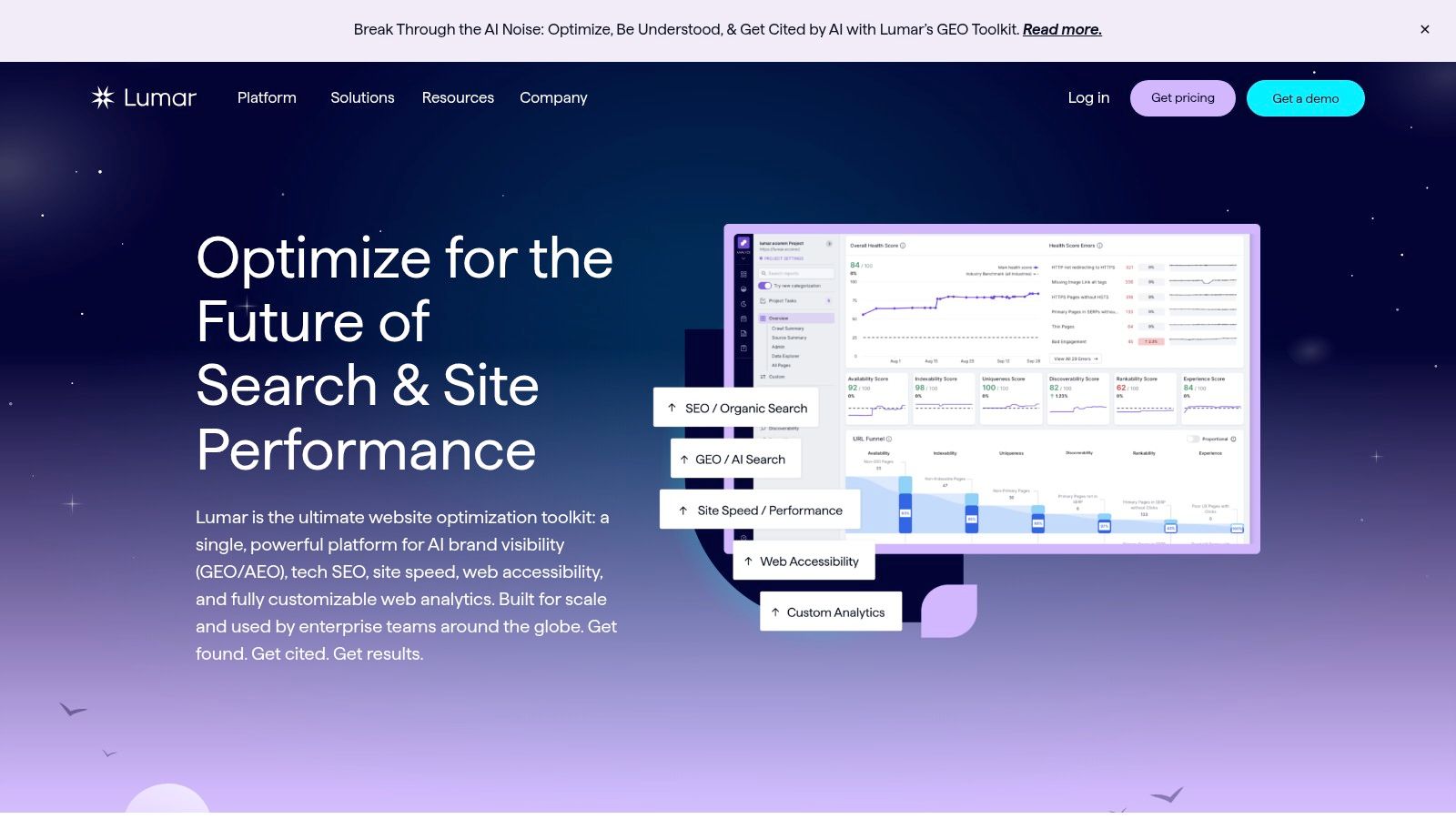
Lumar is the right tool when the job is site governance across SEO, accessibility, and performance. Large ecommerce brands tend to accumulate issues across teams, and Lumar is built for the kind of reporting and workflow discipline that helps untangle that mess.
A broader ops platform, not just an SEO crawler
The useful part here is scale plus governance. Lumar's cloud crawling supports custom dashboards for ecommerce sections, while issue workflows help teams assign and track fixes across departments. That makes it valuable for organizations where SEO, development, and content don't sit inside one tidy workflow.
Lumar also goes beyond classic SEO with accessibility and speed packaging, which can be helpful when digital operations need a wider lens. If your internal team already treats performance and accessibility as shared responsibilities, Lumar can unify reporting in a way that a pure crawler can't.
The downside is that breadth comes with onboarding cost. Quote-based pricing and enterprise packaging mean it's not a casual buy, and its flexibility can make rollout more involved than a narrower tool. Smaller teams often don't need that level of process overhead.
Website: Lumar
9. Babbar
Babbar makes the most sense when the job is French link and semantic analysis. That's a narrower task than many global suites cover well, but for French and European ecommerce teams, the local interface and authority metrics can make day-to-day analysis simpler.
Why a France-built tool can be useful
The platform's BAS, popularity, trust, and semantic metrics are useful for understanding which pages deserve authority support and which topics should sit together in a hub structure. Ecommerce teams can use that to prioritize category pages, related collections, and content clusters with more confidence.
Babbar's backlink and anchor analysis are also practical for link audits. If you're working in French, the interface and euro billing can make the tool easier to adopt than a global suite with more generic defaults. That matters when the team is small and doesn't want to wrestle with setup.
The limitation is scope. Babbar is not an all-in-one ecommerce platform, and it doesn't try to be one. If you need crawling, product-page monitoring, and content workflows in one place, you'll outgrow it quickly. It's best treated as a specialist layer for link and semantic work.
Website: Babbar
10. Myposeo
Myposeo is the practical answer when the job is French-localized rank tracking and SERP analysis. It's especially useful for agencies and brands that care about local reporting, desktop and mobile tracking, and a French workflow.
A good reporting layer for France-focused teams
The value is in its localization. If your ecommerce business sells in France and your reporting has to be readable by local stakeholders, Myposeo is easier to deploy than a tool built primarily for English-speaking teams. Integrations with Matomo and Google Search Console also help keep the reporting stack aligned with the rest of your data.
Its white-label reporting is useful for agencies that need to present clean results without rebuilding decks every month. For SMBs, the platform can also be a straightforward way to keep visibility checks and audits in one place.
The limitation is index depth. Myposeo's keyword and link databases are smaller than the biggest global competitors, and pricing details are less transparent online. That makes it a better localized reporting tool than a deep global research suite.
Website: Myposeo
Top 10 Ecommerce SEO Tools: Feature Comparison
| Platform | Core Capabilities | AI / GEO & Ecommerce Fit | Best For | Value & Standout |
|---|---|---|---|---|
| Wispra Annuaire IA | AI-ready business directory, content engine, visibility analytics | ✨ Built for recommendations in ChatGPT, Perplexity, Gemini, and Google AI | 👥 SMBs, local businesses, freelancers, agencies, and ecommerce stores | 💰 Pricing not provided; setup in 2 minutes, no website changes |
| Semrush | All-in-one SEO, research, audits, and rank tracking | AI/AEO tracking plus French and EU ecommerce workflows | 👥 SMBs and ecommerce teams managing SEO at scale | ✨ Broad toolkit; add-ons and plan limits can complicate costs |
| Ahrefs | Backlink, keyword, competitor, and site analysis | Strong for ecommerce content gaps and competitor research | 👥 SEO teams and site owners | 🏆 Strong link data; free Webmaster Tools for own sites |
| Screaming Frog SEO Spider | Desktop technical SEO crawler and custom audits | ✨ JavaScript rendering and SKU-level checks; free up to 500 URLs | 👥 Boutiques, technical SEOs, and agencies | 💰 Free tier; paid license offers extensive audit control |
| Oncrawl | Cloud crawling and server-log analysis | Ecommerce workflows for crawl budget, indexability, and large catalogs | 👥 Mid-market and enterprise SEO teams | 🏆 Deep technical reporting; contract-based pricing |
| Botify | Crawling, logs, rank data, prioritization, and activation | Ecommerce segmentation and automation for complex sites | 👥 Large retailers and marketplaces | ✨ Enterprise workflows and support; premium pricing |
| JetOctopus | Cloud crawling, log analysis, and analytics integrations | AI bot behavior analysis, JavaScript crawling, and internal-link recommendations | 👥 Agencies and ecommerce teams with large sites | 💰 Transparent pricing and generous limits; broad crawl toolkit |
| SE Ranking | Rank tracking, research, audits, and reporting | Optional local marketing and AI/AEO visibility features | 👥 SMB ecommerce businesses and agencies | 💰 Strong price-to-feature ratio; some features require add-ons |
| Lumar | Enterprise website optimization, governance, and automation | Configurable SEO and AEO/GEO options for complex sites | 👥 Large brands and digital teams | ✨ Covers accessibility and performance too; quote-based pricing |
| Babbar | Backlink, authority, and semantic analysis | French-market link and topic-hub research | 👥 French and European ecommerce SEO teams | 💰 Competitive pricing; French-built with euro billing |
| Myposeo | Rank tracking, SERP analysis, and audits | Localized desktop and mobile tracking for French markets | 👥 French agencies and brands | ✨ White-label reports; pricing and limits are less transparent |
Building Your Ecommerce SEO Stack
Start with the problem that costs you the most. If filters and duplicate URLs are draining crawl budget, begin with a log-aware crawler like Oncrawl, Botify, or JetOctopus. If your catalog is smaller, Screaming Frog or an affordable suite will usually cover the core work without overbuying.
Validate every finding in Google Search Console before you change templates. That sounds basic, but it prevents bad assumptions from getting baked into product pages, category pages, and faceted navigation. Measure by category or page type, not just site-wide, because ecommerce gains usually appear unevenly across a catalog.
The second decision is whether your team needs research, implementation, or measurement. Semrush and Ahrefs are strongest when you want discovery and competitor context. Screaming Frog, Oncrawl, Botify, Lumar, and JetOctopus are better when the work is technical and operational. SE Ranking, Babbar, and Myposeo make more sense when you need localized reporting or a tighter budget.
Marketplace SEO deserves its own lane too. French shoppers don't just discover products through classic Google results. DHL's France report found that 96% of surveyed French consumers purchase from marketplaces, and that changes how you should think about visibility, delivery promises, and review signals. That report also shows that basket abandonment can follow when preferred delivery or return options are missing, which is a reminder that operations and search visibility are tied together.
AI discovery is a separate layer from crawl health. Tools that measure AI answers help you understand how brands appear in chat and answer engines, while ecommerce SEO tools still do the work of keeping the store indexable, fast, and commercially clear. Wispra Annuaire IA fits that second layer for teams that want AI visibility for product catalogs, but it should sit alongside technical SEO, not replace it.
If you're choosing today, make the first buy around your biggest bottleneck, not around the longest feature list. Then add one research tool and one technical tool only if your team has the time to use both well.
If you want a single place to start with AI visibility for ecommerce, Wispra Annuaire IA is built to help stores get recommended by AI search engines while keeping product catalogues, FAQs, and structured content aligned. It fits naturally beside technical ecommerce SEO tools when you want AI discovery coverage as well as classic search visibility. Visit Wispra Annuaire IA to see how that layer can complement your SEO stack.