Eight in 10 new business profiles are read by an AI assistant by the day after they go live on a directory, according to Wispra's General barometer. Most French consumers also research a business online before making contact, so online reputation management is part of everyday customer service, not a task saved for a public crisis. Your next customer judges your opening hours, complaints and professional credibility before you know they're looking.
The goal is accurate information, credible feedback and a proportionate response. That includes a surface many owners skip: the answers AI assistants generate about your business. When one of those answers gets your prices, services or standing wrong, the error reaches prospects who never visit your website.
What Online Reputation Management Really Covers
A prospect searches your company name on their phone before calling. Your map listing says you're open, a recent review mentions an unanswered complaint and your website describes a service you no longer offer. They haven't spoken to anyone, but they already have reasons to hesitate.
Think of your online presence as a shop window that's never switched off. Your website, directory entries, customer reviews and AI-generated descriptions are separate panes of glass. You can clean some yourself; for others, you must contact the person responsible.
Online reputation management is the ongoing practice of monitoring, influencing and responding to what people and machines find about your business. Reputation is what the next customer concludes before speaking to you, and you can only manage the evidence behind that conclusion.
The work behind the definition
Monitor means knowing what's being said and where. That includes complaints outside your own social accounts, incorrect directory entries and answers generated from outdated sources.
Influence means publishing reliable information and earning genuine feedback. It doesn't mean buying praise or making every customer sound delighted.
Respond means answering concerns, correcting factual mistakes and changing the operational problem behind a legitimate complaint. A polished reply won't compensate for repeatedly missing appointments.
Public relations concentrates on media relationships and public stories. SEO concentrates on search visibility. Online reputation management crosses both disciplines but also covers sources you don't own, including customer discussions and machine-generated summaries.
The useful starting point is therefore an inventory, not a campaign. Know which surfaces customers encounter, which facts you can change directly and who will act when something needs attention.
Where Your Reputation Lives Across Online Surfaces
A buyer rarely reads a single page. They might check a map listing, scan written reviews, glance at social comments and ask an AI assistant whether your business suits their needs. Each stop answers a different question.
A study of Google Maps and French local businesses describes how the platform orders businesses through data-driven metrics. The practical implication is straightforward: maintaining business information belongs in operations, not just marketing.
Online surfaces that shape a business reputation
| Surface | What it tells a buyer | Who controls it | How often to check |
|---|---|---|---|
| Google Business Profile | Hours, category, photos, star rating and reviews | Owner edits the profile; Google decides ranking | Weekly |
| Review platforms (Google, Tripadvisor, Trustpilot) | Star average, written experiences and owner replies | Customers write reviews; owner responds | Weekly |
| Industry and local directories | Name, address, phone and category consistency | Owner, through claim forms and data feeds | Quarterly |
| Social profiles | Tone, posting activity, comments and messages | Owner manages posts; users control their comments | Weekly |
| Press, blogs and forums | Editorial coverage and third-party opinions | Journalists and community members | Monthly alert review |
| AI assistants | Summary of who you are and how customers feel | System operators and source publishers; owner influences through accurate information | Monthly question test |
These are suggested audit intervals, not reasons to leave an active complaint unattended. Use notifications for urgent messages.
Ownership isn't complete control
You own your website and manage your social posts. Claimed listings give you editing access, but platforms still control presentation, moderation and ranking. Editorial coverage and community discussions require correction requests or constructive participation rather than direct edits.
Say a bakery's map listing still shows winter hours. A customer arrives on a closed Sunday and leaves a poor review about the wasted journey. The immediate problem isn't review sentiment. It's an outdated field nobody checked.
Assign an owner to each surface and record the route for requesting changes. The surface you check least can become the one that costs you most.
Why Reputation Now Decides Small Business Sales
In France, 96% of respondents said a company's or brand's online reputation influenced their decision to buy in a 2015 IFOP survey for Semji, which also found that 88% consulted reviews, forums or blogs before buying online and 73% did so before buying in a physical store; 85% said negative reviews could prevent an online purchase and 87% said negative press coverage could do the same, according to Semji's account of the survey.
The headline finding makes the commercial issue clear.
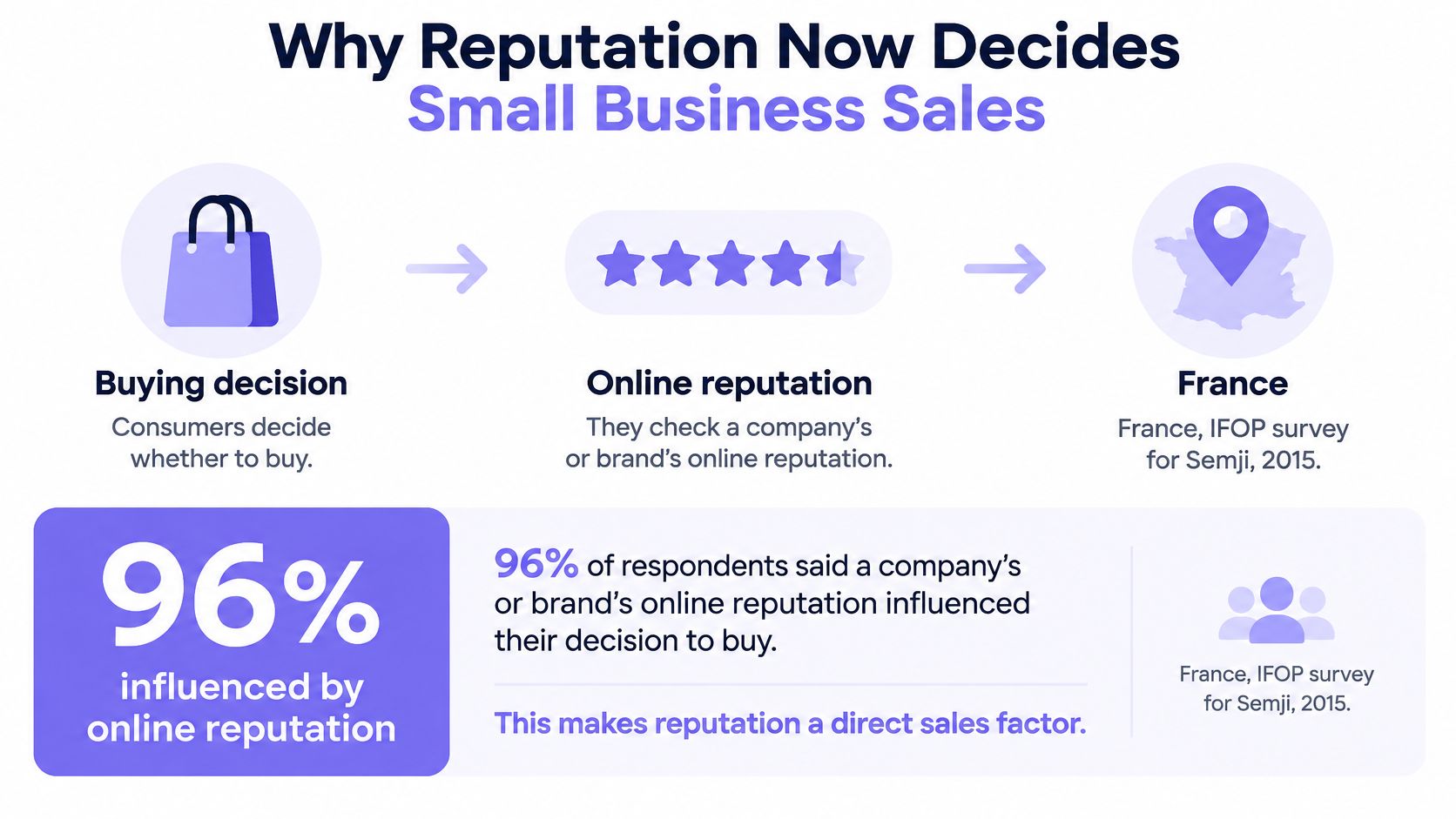
Those are historical survey responses, not a current conversion forecast. They describe reported influence, not the revenue a particular business will gain from improving its rating. Treat them as a directional benchmark, not a promise.
What this means for a local operator
A plumber can lose an enquiry because reviews repeatedly mention missed appointments. A boutique can lose a visit because public replies sound hostile. A property agency can create hesitation when its advertised services and customer accounts don't match.
Small businesses have a particular operational exposure: when there are few reviews, each detailed complaint occupies more of the picture. The person responsible for answering may also be serving customers, managing stock or travelling between jobs.
The right response isn't to chase a flawless score. It's to remove avoidable uncertainty about whether you're reliable and whether you put mistakes right.
For a closer look at buyer behaviour, consider how business reviews influence purchase decisions. Read complaints for the objections they reveal, not just the rating attached to them.
This accompanying video offers another format for considering reputation's role in the buying journey.
Commercial reality: You won't receive a notification when someone reads an unresolved complaint and chooses a competitor.
That's why reputation belongs alongside enquiry handling and service quality. The cost of neglect includes opportunities that never become visible in your sales records.
Reviews and Listings You Can Actually Control
Keep one authoritative business record containing your name, address, phone number, services, prices, opening hours and relevant attributes. Give someone responsibility for approving changes and pushing them to every public listing.
For example, changing holiday hours on your website doesn't complete the job if the map listing still advertises normal opening. Record where the update was submitted, whether it was accepted and whether the public version now matches.
Directory expansion should come after accuracy. Free AI Directories' guidance on judging whether a directory is worthwhile can help you assess a listing before creating another maintenance obligation. Choose relevant, editable entries rather than submitting your business everywhere.
Collect feedback without manufacturing praise
Ask customers for an honest review shortly after a completed service. Include a direct route to the review form and keep the request neutral. Don't offer rewards tied to a positive rating or send only satisfied customers towards public platforms.
An OECD review of consumer ratings cites a French study estimating that 10–30% of reviews were fake, with as many as 45% considered suspicious, and discusses the French NF Z74-501 framework, including author identification, prohibition of purchased reviews, chronological display and disclosure of moderation practices.
Those estimates aren't an accusation against any particular platform or reviewer. They explain why average rating and review volume aren't sufficient controls.
A sudden burst of praise may follow a genuine review request campaign. Equally, repeated wording may warrant investigation. An anomaly is a reason to check, not proof of misconduct.
Make responses useful to the next reader
Thank positive reviewers for something specific without revealing private transaction details. For criticism, address the issue raised, explain the next step and avoid arguing about the customer's character.
For directory maintenance, use these practices for optimising business listings in the age of AI to organise updates rather than treating each listing as an isolated task.
Keep these controls in your routine:
- Preserve transaction evidence. Retain an appropriate internal reference where available, without exposing customer information publicly.
- Monitor review velocity. Investigate unexpected spikes and record legitimate campaign activity.
- Flag repeated wording. Check unusually similar text before drawing conclusions.
- Review account anomalies. An empty history can justify scrutiny, but doesn't prove a review is false.
- Answer legitimate criticism openly. Resolve the experience instead of seeking artificial amplification or removal just because feedback is negative.
How to Build Social Proof and Respond to a Crisis
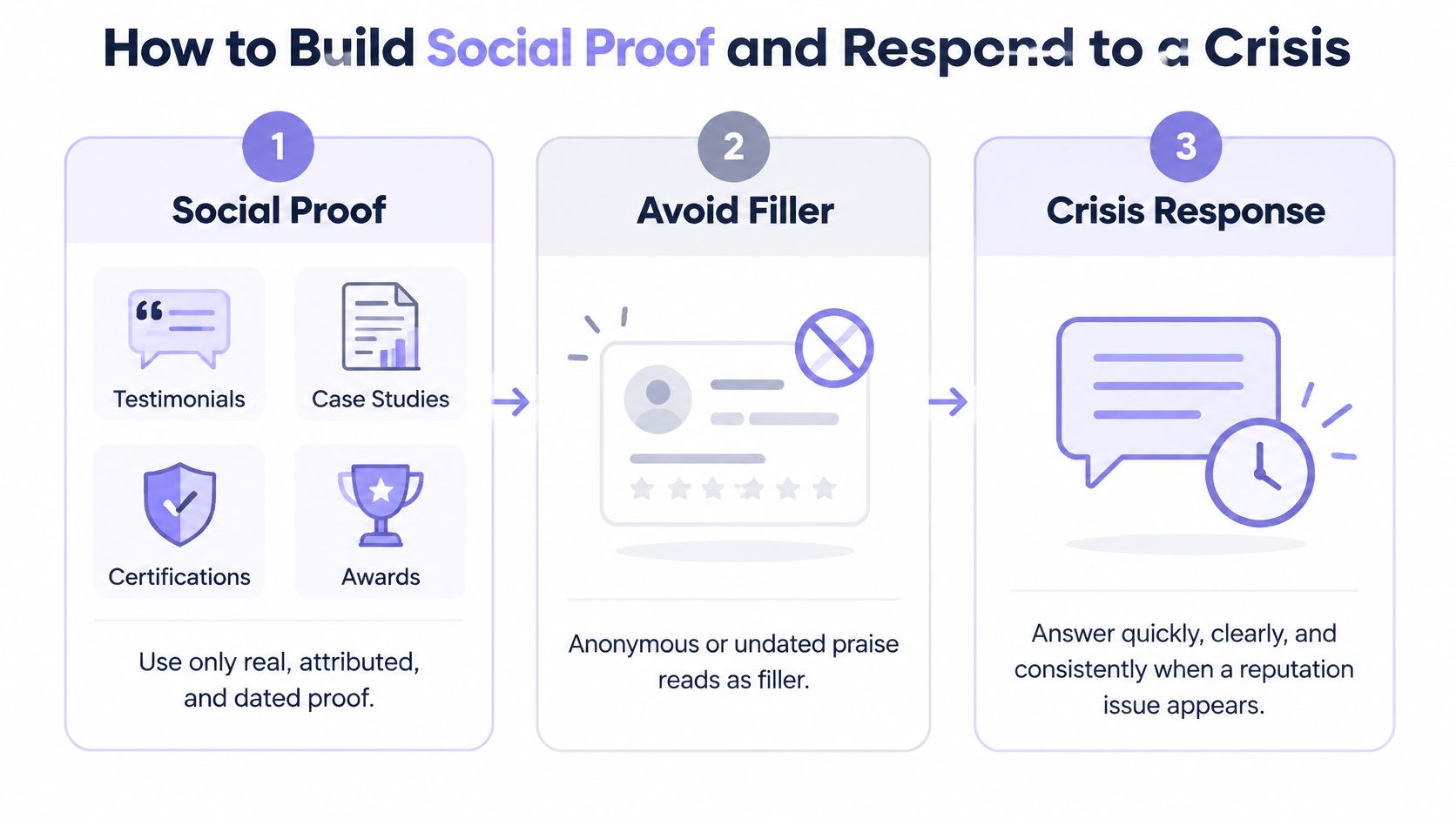
Testimonials, case studies, certifications and awards should be real, attributed and dated. Obtain permission where needed, explain what the evidence relates to and remove credentials that no longer apply. Anonymous praise without context gives buyers little they can verify.
Separate evidence-building from emergency response.
A calm response procedure
- Verify the facts promptly. Save the original content, check relevant records and speak to the staff involved. Don't publish a confident denial before checking.
- Classify the issue using the severity table. Distinguish an isolated service failure from a safety concern or spreading allegation.
- Publish a short acknowledgement. Recognise the concern and state what you're checking without speculating or disclosing personal information.
- Move detailed discussion to a named contact by email or phone. Give the customer a usable route, not a vague instruction to contact support.
- Fix and document the cause. Record what changed, who owns it and whether affected customers need an update.
- Once resolved, invite the customer to update their review if they wish. Don't make a refund or remedy conditional on changing it.
- Choose the appropriate escalation. For potentially unlawful content or personal-data issues, consider factual correction, a publisher request or search-engine delisting with qualified advice.
Crisis severity levels and first response
These are suggested operational targets, not legal standards.
| Severity | Typical example | Target first response | Owner |
|---|---|---|---|
| Low | One unhappy customer review | By the next working day | Business owner or manager |
| Medium | Repeated complaints about the same issue | Within 24 hours, with a process fix announced | Manager |
| High | Viral social post or press report | Within 2 hours, with a short holding statement | Owner and communications lead |
| Critical | False claims, safety or legal issues | Within the hour, with legal advice before detailed replies | Owner and legal counsel |
Removal isn't a universal remedy
The CNIL's annual report records 20,150 complaints in 2025, 10% more than in 2024, highlighting privacy issues involving commerce, real estate, work and social networks. Privacy rights belong in a reputation response plan, but they aren't a blanket right to remove criticism.
Whether material qualifies for erasure or delisting requires examining its accuracy, lawfulness, continued necessity and applicable freedom-of-expression or public-interest protections. Removing content from its original website is different from removing a search result.
Don't promise deletion. Preserve evidence, avoid retaliatory posts and get advice before making legal accusations. Angry replies and unexplained silence both leave observers without a credible account of what you're doing.
Measuring Reputation With the Numbers That Matter
A star rating alone is a weak management dashboard. You also need to know whether feedback is credible, complaints receive answers, public information matches and AI-generated descriptions are correct.
Use the following as working measurement targets, not industry benchmarks. Keep definitions stable so changes mean something.
Reputation metrics and how to read them
| Metric | What it reveals | Healthy direction | Check every |
|---|---|---|---|
| Average rating and 90-day trend | Direction of customer sentiment | Stable or rising | Month |
| Verifiable review ratio | Share of reviews tied to a real transaction | Close to 100 percent where verification is available | Quarter |
| Response coverage | Share of reviews answered by the business | Every review answered where appropriate and possible | Week |
| Time to first response | Speed of handling complaints | Shrinking without sacrificing accuracy | Week |
| Listing accuracy score | Consistency of name, address, phone and hours | No conflicting fields | Quarter |
| Review anomaly rate | Sudden clusters or repeated phrasing | No unexplained spikes | Month |
| AI answer accuracy | Whether assistants describe you correctly | Correct on all core facts | Month |
Build a reproducible baseline
Record your current rating, unanswered reviews and conflicting listing fields. Then prepare a working set of ten realistic buyer questions, such as who offers emergency plumbing in your town or which estate agency handles a particular property type.
Run identical prompts across the AI-search services your customers might use. Save the wording, answer, date, cited sources and location context. At Wispra, we measure a customer's presence across 10 real questions from their field.
Record recommendation frequency separately from factual accuracy. An answer can recommend you while giving the wrong price, or describe you accurately without recommending you.
For selecting a monitoring workflow, this overview of brand monitoring tools provides a useful starting point. Keep the dashboard exportable so someone can inspect the underlying evidence.
Read combinations, not isolated scores
A rising rating with falling response coverage suggests an unattended queue. More AI recommendations with incorrect prices indicate a source-information problem, not an unqualified success.
Connect reputation work to commercial outcomes cautiously. You can compare traffic before and after lead capture using Expressify AI as part of that investigation, but traffic changes alone don't establish that reputation work caused additional sales.
Book a short monthly review with a named decision-maker. End it with an assigned correction, a deadline and a way to verify completion.
Managing Reputation for AI Search and Best Practices
A 2025 survey covering France, Germany, the UK and the US found that 68% of respondents had used ChatGPT to research local products or services, yet 19% trusted AI-search tools for local search, compared with 45% for traditional search, according to Localogy's coverage of the Yext survey. These are findings across the surveyed countries, not France-only rates.
That gap challenges the assumption that being mentioned is enough. An inaccurate recommendation is a reputation problem, even when it places your business prominently.
AI-generated answers deserve a factual audit, not just a visibility score.

Make claims traceable
Use a practical publishing and correction routine:
- Publish a verified reference page. Put current services, locations and contact details on your own site, with dates where freshness matters.
- Keep entity details consistent. Use the same business identity across relevant directories and professional profiles.
- Invite specific, authentic feedback. Customers can describe the service and location in their own words. Don't supply keyword-heavy scripts.
- Answer real buying questions. Explain service boundaries, eligibility, exclusions and how quotations work.
- Repeat a stable question test. Preserve comparable prompts rather than changing the test whenever results disappoint.
- Review sensitive claims manually. Pricing, qualifications, health, legal services and property information need particular care.
- Correct upstream information. Contact the publisher of an inaccurate cited page rather than only disputing the generated answer.
A wrong qualification is more urgent than an awkward description. Prioritise errors by potential harm, then document the correction request and retest after the underlying source changes.
Visibility tools don't control recommendations
Wispra is a French platform, and we measure business visibility across Google AI Overviews, Google AI Mode, ChatGPT, Gemini and Perplexity. That measurement helps identify where a business appears and what needs closer inspection.
We don't promise how long it takes for AI engines to cite a business. No provider should promise a citation timeline it cannot control.
Audit accuracy before celebrating exposure. A recommendation that misstates your services can create disappointed customers rather than useful enquiries.
Tools help organise observations. They don't replace accurate source material, professional judgement or the service customers receive.
Start With a Reputation Baseline This Week
- Create your surface inventory. List your map profile, review platforms, directories, social accounts, third-party coverage and AI answers. Record access credentials securely and identify who can request corrections.
- Run your buyer-question test and save the complete answers. Include questions about suitability and limitations, not just prompts designed to produce a recommendation.
- Capture the starting position. Record ratings, unanswered feedback, listing conflicts and factual errors. Keep screenshots or exports so later comparisons don't depend on memory.
- Fix business-information conflicts before commissioning more content. These are direct edits you can verify, unlike attempts to influence independent recommendations.
- Add a neutral review request to job completion. Give staff a repeatable process and make sure dissatisfied customers receive the same opportunity to leave public feedback.
- Put the dashboard review in the diary. Assign someone authority to choose the next correction and confirm it's finished.
Choose a routine you can maintain
A spreadsheet is enough when your footprint is manageable. Give each issue a source, owner, action and status. Avoid building a reporting system that consumes the time needed to fix the actual problems.
If you want tracking organised through Wispra, setup starts with a free profile: you give your company name, and we publish the profile in a format AI engines read. The free report covers questions from your field and the state of our four levers: Verified Identity, Authority, Reputation and Expertise.
After the free report, you can choose the Performance plan, which covers all four levers and measures visibility every month. Choose that option for an ongoing measurement routine, not because a tool can guarantee recommendations or erase criticism.
The immediate decision is whether to establish a baseline now or continue making changes without a reliable comparison. An imperfect but documented starting point is more useful than a polished dashboard created after the work is finished.
Visit Wispra to create your free business profile and get a report showing your presence across real buyer questions and the state of your reputation-related visibility levers. Use the findings to identify inaccurate information, prioritise corrections and establish a baseline before investing in broader visibility work.