Search engine optimization (SEO) helps search engines discover, understand, index and rank a website's pages, so people can find them through unpaid results. In France, Google is by far the most used search engine, so it is the main one most businesses need to consider.
A bakery owner, property agency or online shop might search for a service they offer and see a competitor near the top, while their own site is hard to find. SEO can sound like a technical trick, but it is a system for helping people find useful, relevant information about a business.
That system can lead to three outcomes: a page appears in search results, someone clicks through to the site, or an AI answer names the business. These outcomes can overlap, but they are not interchangeable. For a small business, a page-one ranking may be the wrong goal if it attracts visitors unlikely to become customers.
What Search Engine Optimization Means and How It Evolved
Think of a search engine as a library catalogue. Discovery means your book is on a shelf the librarian can reach. Understanding means the catalogue card describes the book accurately. Ranking means your book appears prominently when someone asks about its subject. SEO helps search engines do all three for your web pages, so they can show them to people looking for the information, products or services you provide.
Say a bakery owner in Lyon searches for sourdough delivery and finds a competitor near the top of the results. The competitor may have a clear delivery page, a useful description of its service area and a website that works well on a phone. The other bakery might offer just as good a product, but if its delivery details are difficult to find or understand, search engines and potential customers have less reason to choose it.
Organic results are unpaid listings that search engines select as relevant to a query. Paid ads are separate placements that businesses pay for. SEO focuses on earning organic visibility through accessible pages and useful, relevant information, not on buying a place in the results.
The French market helps explain where to focus. StatCounter's France search-engine market-share figures report that, in August 2025, Google held 88.74% of total search-engine share, while Bing had 4.67% and Yahoo 1.68%. Most French SEO work therefore focuses on Google's organic results, while other search engines and specialist search experiences can still matter for particular audiences.
From repeating keywords to answering people
SEO has changed as search engines have changed. In the 1990s, engines relied heavily on matching words in a query to words on a page. That made repeating keywords an obvious tactic, even when it made a page awkward to read.
Google's launch and PageRank brought links into the picture as signs of a page's importance. Some site owners responded by buying links, which led search engines to target manipulative practices. Later, updates such as Panda and Penguin put greater pressure on thin content and unnatural links. As mobile use and language-understanding systems developed, the work broadened again. Search engines increasingly needed to interpret the purpose behind a query and the actual people, places and services a page describes.
That's why SEO today combines technical access, content relevance, useful site structure and a good experience across devices. A page needs descriptive titles and headings, meaningful internal links, accurate business information and content that answers the searcher's question.
Practical rule: Write for the person who needs the answer, then make the page clear enough for a search engine to recognise that it provides one.
SEO isn't keyword stuffing, a one-off website fix or a promise of a page-one ranking. It's ongoing work to help the right pages become visible and useful. A bakery might improve a local delivery page, while an online shop might make its product categories easier to explore. The right changes depend on what customers search for and what the business needs those pages to accomplish.
How Search Engines Find, Index and Rank Pages
A plumber's service page may explain the work clearly, yet still fail to appear in search if a crawler cannot find or process it. Search engines move through several stages before a page can show up for a query. For businesses in France, Google is the search engine many customers encounter, but the process below applies broadly.
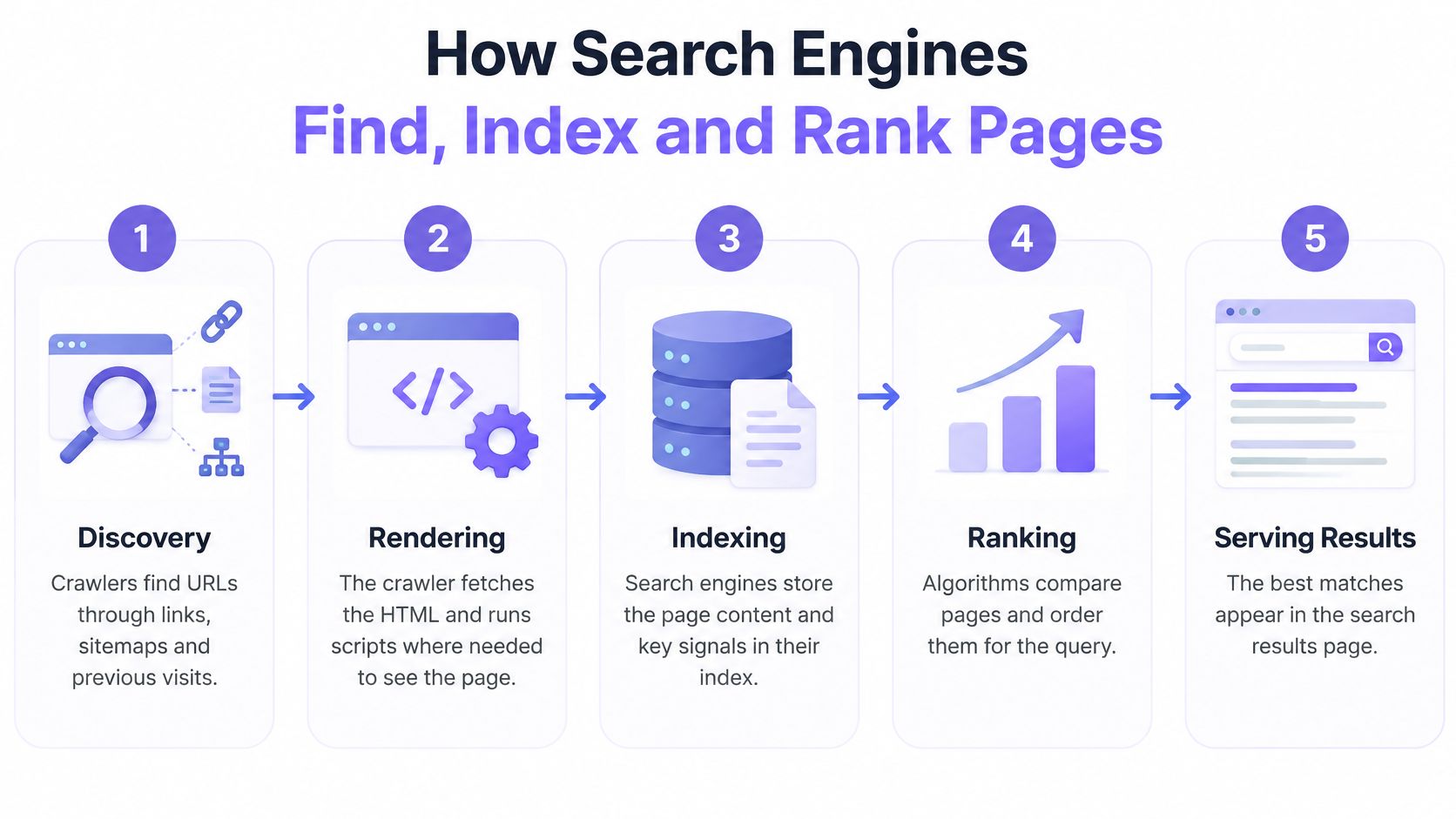
The five stages
Discovery. Crawlers find URLs by following links, reading sitemaps and revisiting pages they already know about. A page with no links pointing to it can be difficult to find, even when its content is useful. Learn more about how crawlers find pages in SEO.
Rendering. Search engines fetch a page's HTML and may run scripts to process the content a visitor would see. If important information appears only after a script runs and the page does not render reliably, search engines may not evaluate it fully.
Indexing. The search engine processes the page and may store its content and signals in an index, a database of pages available for search. Discovery does not guarantee inclusion: a page can be found without being indexed.
Ranking. When someone searches, the engine compares relevant indexed pages. It considers how well each page matches the query, along with factors such as usefulness, usability, freshness and location.
Serving results. The search engine displays results and snippets. Some searches may also show AI-generated summaries. What appears depends on the query and the search experience.
Where a page can get stuck
Suppose a plumber's service page is blocked by a robots.txt rule. Crawlers may not be able to access it as intended, so the page may not be properly processed or considered for ranking. Clear service information cannot help if the search engine cannot reach the page.
Google primarily uses a page's mobile version for crawling, indexing and evaluation. If service details or links appear on desktop but are missing on mobile, Google may not have the same information to assess. Check that the mobile page includes the important content, loads reliably and is usable.
In Google Search Console, the Page indexing report shows pages that are not indexed, while URL Inspection lets you check specific pages. These checks can help identify whether a page is inaccessible, excluded from the index or available to compete for relevant searches.
Four SEO Components and How They Work Together
A Lyon bakery can appear in search as a ranked link, earn a click, or be named in an AI-generated answer. Those outcomes depend on different parts of SEO working together. A page-one ranking may be the wrong goal for a small business if the page attracts the wrong searches or fails to help people decide what to do.
| Component | Core question it answers | Typical example | Usual owner |
|---|---|---|---|
| On-page SEO | Does this page clearly match the query? | A Lyon bakery page titled “Sourdough Delivery in Lyon” with a matching H1 and internal links | Content owner or marketer |
| Technical SEO | Can search engines reach, render and index the page? | Removing a noindex tag accidentally left on a product category page | Developer or web agency |
| Off-page SEO | Do trusted sites vouch for this business? | A local food blog reviewing the bakery and linking to its menu | Owner, PR or outreach contact |
| Local SEO | Is the business clearly identified for its area? | A Google Business Profile with correct opening hours and matching address data | Owner with a listing manager |
What each part does
On-page SEO organizes the information visitors and search engines find on a page. The title, headings, useful content and internal links should all support the same subject. A page called “Sourdough Delivery in Lyon” needs to explain the bakery's delivery service in Lyon; the title alone cannot do that work.
Technical SEO covers how a site is built and presented to search systems. It includes crawl access, mobile usability, page versions and structured information. For example, a noindex tag accidentally left on a product category can keep that page out of search results, even if its content is useful.
Off-page SEO includes links and mentions from other websites. A relevant review and link from a regional food publication can provide a useful signal of recognition. A long list of unrelated directory entries is less likely to help visitors understand why the bakery is a good match. For background on how automated tools collect information from websites, read understanding web scraping basics.
Local SEO connects a business with searches tied to a place. A complete business profile and clear service-area information help people find the right shop or service. For a small business, being named in an answer or receiving a call may matter more than outranking every competitor on a broad search.
Each component supports the others. A useful page needs technical access to appear in search, while links have little practical value if the destination cannot be indexed. Start by identifying the biggest obstacle: fix access problems first, then improve pages that appear for the wrong searches or fail to answer customers' questions.
Local SEO Depends on One Consistent Business Identity
For local businesses, SEO isn't just about putting a city name on a page. It's about helping search engines and customers recognise the same real business wherever it appears. France-specific reporting estimates that 46% of Google searches in France have local intent, while 88% of French consumers research a business on Google before an interaction, according to Hi-Commerce's local SEO figures.

Search systems compare a business's name, address, phone number, services and opening hours across its website, business profile, directories and other sources. When those details agree, it's easier for both people and search engines to understand which business they're looking at and whether it fits a search.
Suppose a plumbing firm calls itself Dupont Plomberie on its website, but Plomberie Dupont SARL in a directory. If two different phone numbers also appear, a potential customer may wonder which listing is correct. A search engine faces a similar problem: inconsistent details make it harder to connect those references to one entity. For practical advice on getting found by nearby customers, see this guide to getting recommended on your digital high street.
Five ways to make your business easier to identify
Standardise contact details. Use the same business name, address and phone number on your Google Business Profile, website footer and directory listings.
Describe the business clearly. Add Organization or LocalBusiness structured data when it fits the business type. Keep it consistent with the information customers can see on the page.
Write useful service and location pages. Explain the services you offer and where you offer them with genuine local details. Changing only the city name on a copied page gives customers little reason to trust it.
Keep reviews active. Ask customers for reviews steadily and respond to each one with a helpful, professional reply. Avoid treating reviews as a substitute for accurate business information.
Update opening hours. Check holiday hours before they change, so a customer doesn't arrive to find the business closed.
For a business with multiple locations, give each location its own page with details that distinguish it, such as local staff, photos and services. Avoid publishing interchangeable pages that only swap one town name for another.
Measure results by location, query category and actions on your business profile, rather than relying only on broad national rankings. For a more detailed way to align your company details, use this business information consistency checklist.
Measuring SEO Beyond Rankings
A high ranking doesn't guarantee a click, and a click doesn't guarantee a useful business outcome. That distinction matters more as search results include AI-generated answers. A French-language analysis citing an Ahrefs study of 300,000 keywords estimated that the top-ranking page's click-through rate fell by 58% when an AI Overview appeared; the same analysis reported median declines of 5.7% in CTR and 8.8% in clicks across 963 domains (the analysis of Google AI Overviews in France).
The numbers describe different measurements, not a promise that every page will lose clicks. The useful lesson is to ask what a searcher needs and what success should look like for that query. An informational search may be valuable because it introduces people to your expertise, while a local search for a service may be valuable because it brings a call or enquiry.
| Metric | What it tells you | Where to read it | Warning sign |
|---|---|---|---|
| Impressions | How often pages appear in results | Google Search Console performance report | Impressions rise but clicks stay flat, pointing to a snippet or intent mismatch |
| Clicks and click-through rate | Whether titles and snippets earn visits | Google Search Console | CTR falls on a page still ranked near the top, possibly because an AI Overview absorbs clicks |
| Average position | Where pages rank for each query | Google Search Console | Position improves but enquiries stay flat, so the wrong queries may be winning |
| Branded search volume | Whether people remember and seek the business by name | Google Search Console or Google Trends | Visibility improves but branded searches stay flat, suggesting weak brand recall |
| Qualified actions | Calls, form submissions and direction requests | GA4 events or call tracking numbers | Traffic grows while actions stay flat |
| Organic conversions | Leads or sales attributed to organic visits | GA4 | Conversions appear only under direct traffic, a sign of broken attribution |
Match the measure to the query
Say a dental clinic has a blog post explaining dental crowns and a local page for its Nantes practice. If an AI answer reduces clicks to the informational post but the Nantes page generates more calls, judging SEO by overall blog traffic would miss the business outcome. The clinic should distinguish informational visibility from commercial results.
Set a baseline before changing titles, pages or technical settings. Review impressions and clicks weekly to catch changes, then examine branded searches and calls monthly so you can judge whether visibility is bringing people closer to choosing the business.
A business can receive fewer clicks and still be named in an AI answer. That mention may help a potential customer recognise the business later, but it isn't the same as a visit, call or sale. For an additional guide to tracking shop search performance, see how to measure Shopify search performance with Rankira.
Start with a simple scorecard: impressions for your most commercially important pages, qualified actions such as calls and enquiries, and the trend in searches for your business by name. Those measures help you judge whether SEO is creating the kind of visibility your business needs, instead of treating every ranking as a result in itself.
Optimising for Conversational AI Beside Traditional Search
A local business can be present on the web without being clearly understood by a conversational AI system. Coverage of a study involving 474 small-business websites and 118 ChatGPT and Perplexity responses found that AI systems could access local businesses but often didn't clearly identify who they were. Clear descriptions of a business's identity, location, services and expertise were a key condition for appearing in answers, according to coverage of AI Overviews in France and local business visibility.
Generative engine optimisation (GEO) means making a business and its information understandable and citable in conversational AI tools. For many local firms, the first step may be clarifying what the business does and where it operates, rather than publishing another general blog post. Getting indexed means a page can be found; it doesn't mean an AI will recommend the business for a query such as “best estate agent near me”.
| Factor | Traditional search (SEO) | Conversational AI (GEO) | Practical implication |
|---|---|---|---|
| Output | A ranked list of links | A synthesised answer naming a few sources | Aim to be named, not only listed |
| Main signals | Relevance, links and page experience | Clear entity facts, consistent third-party references and direct answers | Keep business facts identical across the web |
| Content shape | Pages matched to keywords | Answer-first sections written as questions and answers | Answer the question in the first few sentences |
| Click pattern | The searcher chooses from links | The searcher may stop at the answer | Value may come from recommendation, not visits |
| Local recall | Map pack and profile listings | Business described by name, service area and specialty | State specialties and service areas plainly on key pages |
Make the business easy to describe
A clear business description should say what the company is, which customers it serves, where it operates and what it does particularly well. Keep those facts aligned across the website, directories, profiles and reviews. If an accountant works with freelancers in Marseille, the site should say so plainly, rather than expecting a system to infer the speciality from scattered pages.
Answer common customer questions directly. A page can explain who a service is for, what it includes, which area it covers and how to get in touch. That helps a person make a decision and gives an AI system a more straightforward description to draw on. For more on the relationship between conversational discovery and search optimisation, see this guide to ChatGPT SEO.
AI systems don't all work the same way, and being cited or recommended isn't guaranteed by a particular format or SEO change. SEO earns the page, and GEO earns the mention inside the answer. Most small businesses need both, and pages that rank in traditional search can still inform many AI answers.
Start With Your Business Facts This Month
In 2024, 63% of French micro-enterprises, small businesses and medium-sized enterprises reported taking action on organic SEO, according to the Afnic study reported by France Num. You don't need to repair everything at once. SEO takes time to develop, so set a baseline and judge progress against it rather than reacting to every short-term ranking change.
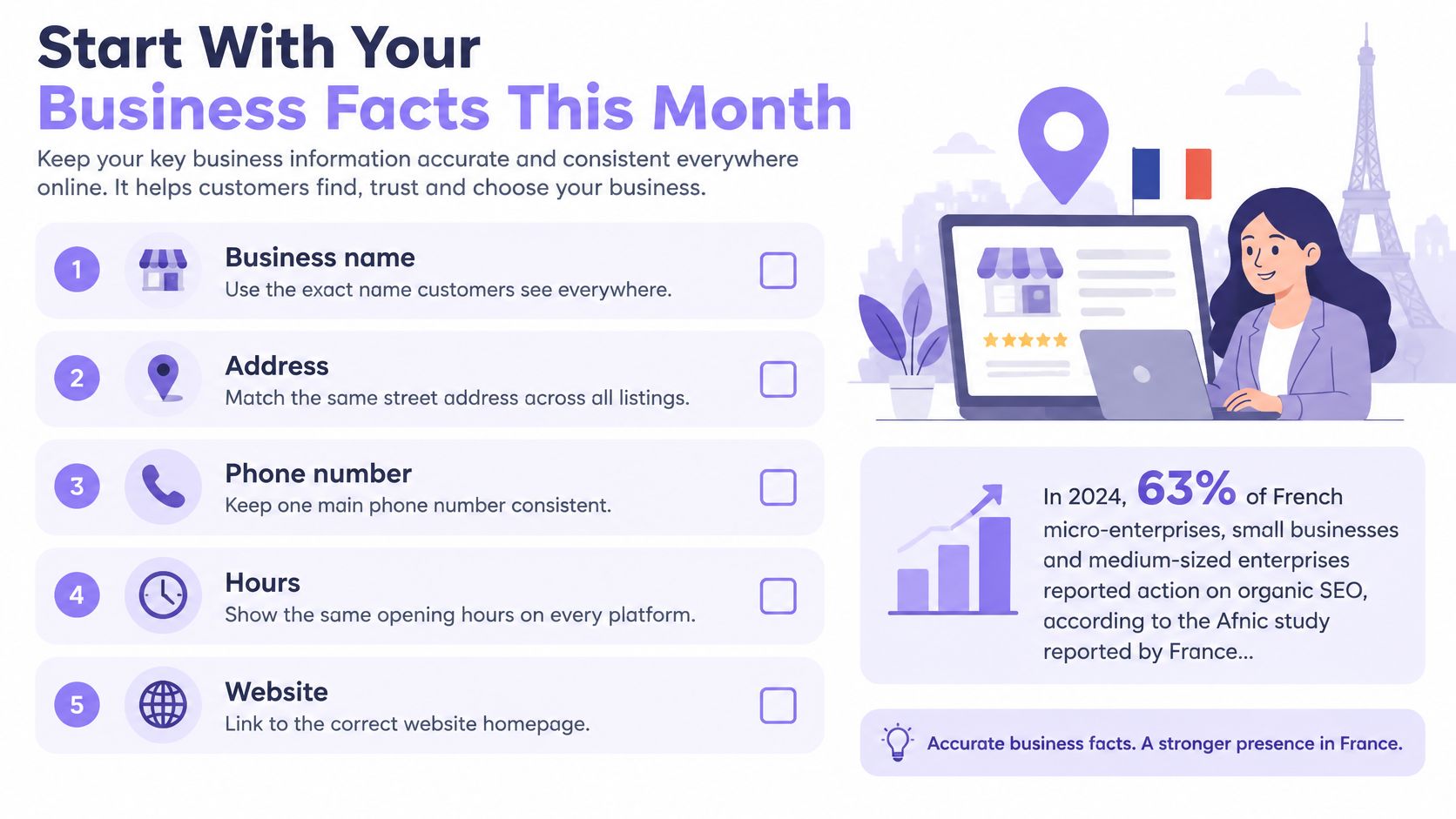
A practical 30-day order
Confirm access. Make sure you can access Google Search Console and the Google Business Profile for your business. Without access, you can't check indexing issues or manage the information customers see.
Complete your profile. Fill in the business profile using the name, address and phone details you've standardised across your website and listings. Don't create a second version of those details for the profile.
Fix technical blockers. Check Search Console for indexing errors, broken pages and problems that affect the mobile layout. Fix access and page problems before spending time on copy that customers may not be able to find.
Choose target searches. List five to ten valuable searches that combine a service with a city or service area, then assign each to the most suitable page. This helps you avoid making several pages compete for the same purpose.
Record your starting point. Note impressions, clicks, calls and enquiries before making major changes. A baseline gives you something more useful to compare than memory or a single ranking check.
Check AI visibility regularly. Once a month, ask AI assistants questions your customers might ask and note whether they name your business. Treat the results as observations, not a guarantee or a substitute for tracking real enquiries.
For businesses that want help maintaining these tasks, our optional Performance plan includes keeping company information up to date, bringing review platforms together and maintaining them, publishing indexable content, and measuring AI visibility monthly. It's one route for ongoing upkeep, not a promise of a particular search position or result.
Your first action for the coming week is simple: confirm that you can access Google Search Console today. With that in place, you can check whether your pages are visible and decide which improvement will help customers find you next.
Wispra helps businesses keep their online information organised and improve how they're understood in traditional search and conversational AI. If you want support building a clearer visibility system for your business, visit Wispra.