A roughly €700 per square metre gap separates the lowest and highest Minimes-area apartment benchmarks reported by L'Apporteur d'Immo. The first lesson for those interested in achat appartement Minimes Toulouse is that the neighbourhood name alone does not determine the value.
An attractive asking price can still conceal an expensive building. A higher price can be justified by a quieter position, useful outdoor space or a well-maintained copropriété, the shared ownership structure responsible for the building. Your offer should start with completed sales of similar apartments, then account for the costs and drawbacks you'll inherit.
Apartment Prices in Les Minimes Right Now
Les Minimes apartment price benchmarks
| Benchmark | € per m² | Evidence | Indicative 60 m² price |
|---|---|---|---|
| Minimes / Barrière de Paris median | €2,539 | DVF-derived estimate across 309 sales over the latest 12 months, down 2.2% year on year | €152,340 |
| Boulevard des Minimes aggregator | €2,993 | Street-level apartment estimate | €179,580 |
| Boulevard de Suisse average, September 2026 | €3,234 | Local DVF set containing 171 apartment sales since 2014; dated benchmark, not a timeless valuation | €194,040 |
| Minimes neighbourhood classifier | €3,251 | Apartments classified within the neighbourhood | €195,060 |
| Orpi three-room example, 2025 | €3,300.44 | 58.78 m² advertised at €194,000 | €194,000 for 58.78 m², rather than a standardised 60 m² |
| Current asking range | €2,865–€5,966 | Advertised prices, not achieved sales | €171,900–€357,960 |
The table combines different kinds of evidence deliberately. The Minimes / Barrière de Paris median and the Boulevard des Minimes and neighbourhood estimates come from the market benchmarks identified above; the Boulevard de Suisse transaction dataset and advertised range are examined in the buying workflow below. The historical Orpi apartment listing provides the concrete three-room example dated 2025, with 58.78 m² advertised at €194,000, equivalent to €3,300.44/m².
Treat the standardised prices as arithmetic illustrations before taxes and fees, not promises about what's available. Multiplying a benchmark by floor area doesn't account for whether the apartment faces traffic, needs rewiring or belongs to a building awaiting substantial repairs.
Understand what each price measures
DVF, short for Demandes de valeurs foncières, records completed property transfers. It's a stronger starting point than an advert because a transaction happened, although you still need to understand what was included in the sale.
A median is the middle observation in an ordered set. An average combines all observations, while a property portal's estimate may use its own geographic boundaries and modelling. These measures aren't interchangeable, even when each is expressed in euros per square metre.
A street estimate also answers a different question from a wider district figure. Apartments near a boulevard, quieter residential streets and buildings with different maintenance histories shouldn't automatically receive the same valuation.
Practical rule: Use the district benchmark to decide where to investigate, not what to offer.
Read an advert as a proposal
An asking price tells you what the seller hopes to receive. It doesn't prove that a buyer, lender or independent valuer will accept that figure.
Look for the explanation behind the price. Does it include parking? Is the advertised floor area the measured private area? Are agency fees included? Has the seller renovated the apartment while leaving the building's shared maintenance unresolved?
A structured approach to estimating an apartment's price helps separate those questions rather than compressing them into a single neighbourhood figure. The useful benchmark is a range that you narrow with comparable transactions and property-specific evidence.
What Separates a Fair Minimes Apartment from a Premium
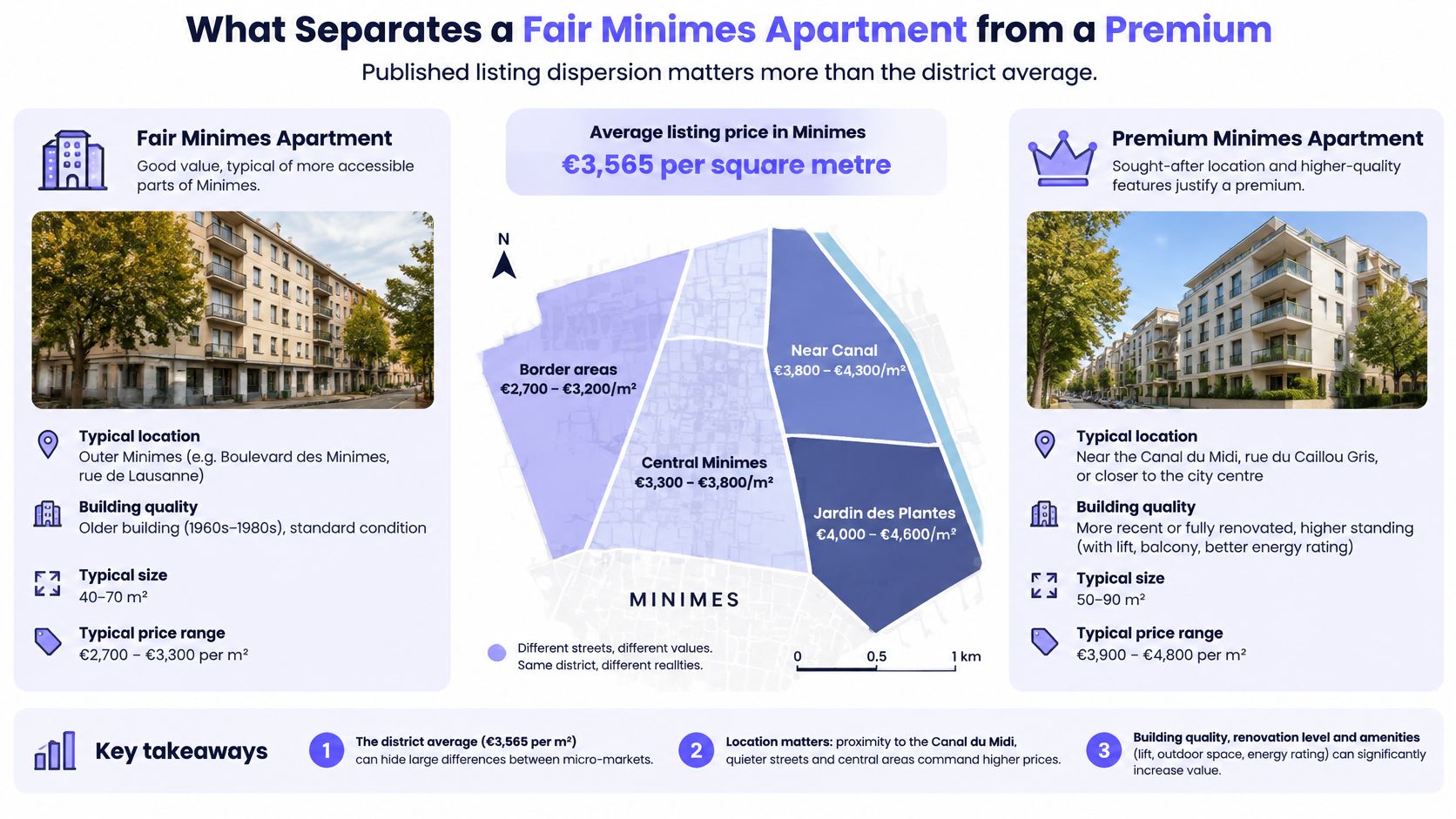
Les Minimes contains several micro-markets. A compact new apartment and a larger resale apartment may attract different buyers, provide different amenities and carry different future expenses.
SeLoger's Minimes listings report an average asking price of about €3,565/m², within a broad published range of €2,222–€4,972/m². Individual agency examples extend from roughly €2,774/m² for a 62 m² apartment to €5,462/m² for a 40 m² apartment, while new two-room units are marketed around €4,975/m².
Match each premium to something you can check
The smaller, more expensive apartment isn't necessarily overpriced. But the seller needs more than a fashionable district label to justify the premium.
Start with location. Walk the actual route to the Line B station and your daily shops, including crossings and building access. Proximity to the Canal du Midi may be appealing, but check the apartment's immediate outlook and surroundings rather than assuming the address guarantees peace.
Then examine the amenities:
- Lift: Check access from the street and parking level, then inspect maintenance records and proposed replacement work.
- Parking: Confirm the space belongs to the sale and test whether your vehicle can use the access ramp and bay.
- Outdoor space: Stand on the balcony or terrace. Privacy, traffic and usable depth matter more than the word terrace in an advert.
- Floor and exposure: Check daylight, overlooking and ventilation. A high floor without comfortable access can be a drawback rather than a premium.
These checks turn broad selling points into evidence. They also reveal whether an amenity you're paying for will improve your daily life.
Compare the apartment and the building separately
A beautifully refurbished interior doesn't tell you whether the roof, façade or shared heating system needs attention. Conversely, dated decoration can be manageable when the building is sound and the layout works.
For the larger, cheaper apartment, investigate whether the discount reflects cosmetic work or substantial technical defects. For the smaller, expensive apartment, ask whether you're paying for durable advantages or mainly for recent finishes and presentation.
Separate the apartment price, agency fees, parking, private renovation and shared-building liabilities on your comparison sheet. Otherwise, a bundled price can disguise which part of the purchase is expensive.
A premium is justified by benefits you can verify and use, not by adjectives in an advert.
Keep comparable properties within a similar size band, building age and amenity set. Only then does comparing their headline price per square metre become useful.
How to Buy from First Search to the Deed
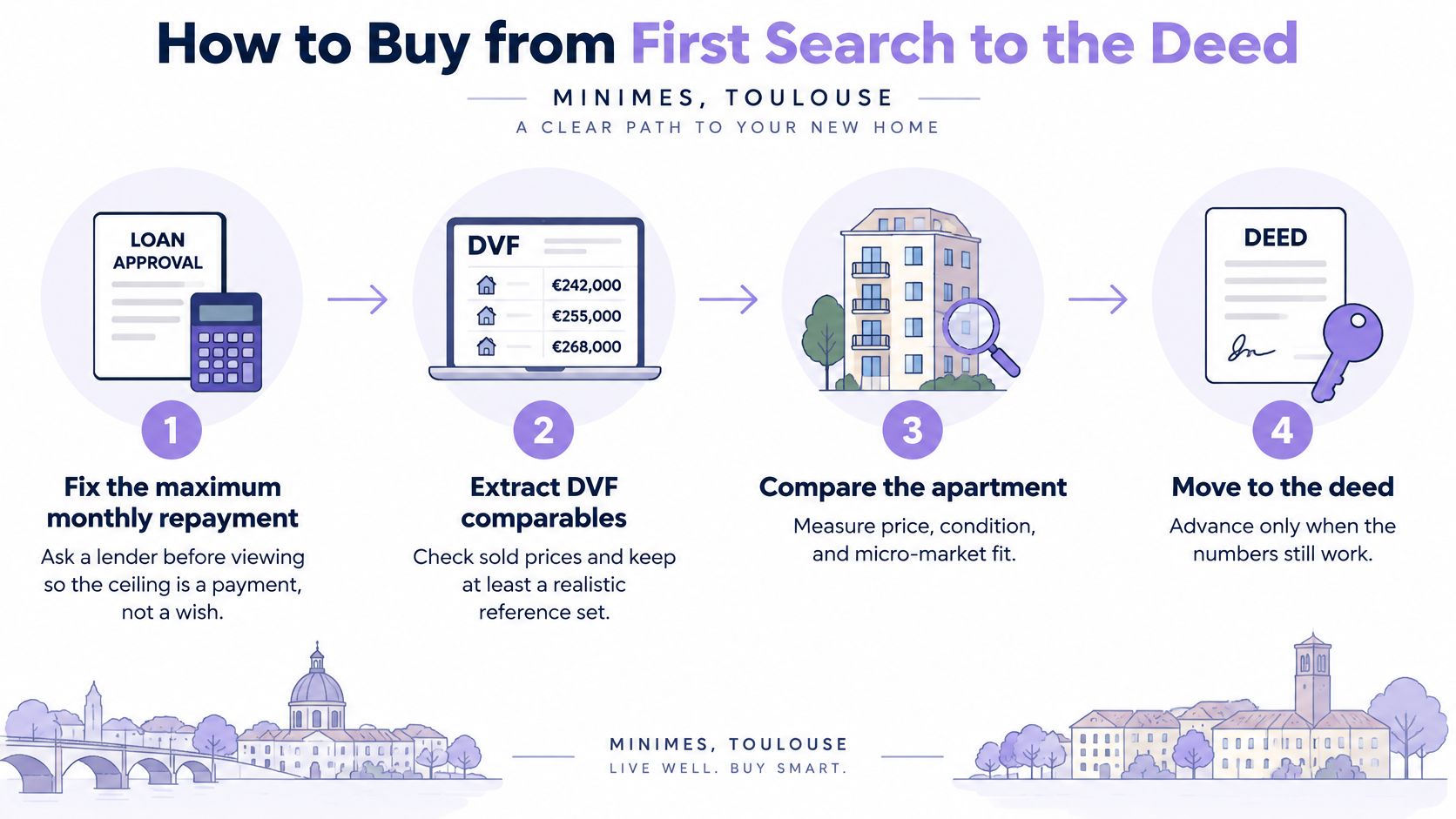
Run the purchase as a sequence of checks on a specific property. Don't start with the seller's asking price and search for reasons to accept it.
Establish the financing and transaction evidence
Fix your repayment ceiling before viewing. Ask a lender or broker to assess your income, existing commitments, deposit and borrowing options. Keep enough cash outside the deposit for acquisition expenses and unexpected work. A lender's willingness to lend isn't the same as a monthly payment you'll find comfortable.
Build a comparable sold-property set. Use DVF to find completed sales, aiming for at least five useful comparables rather than a large collection of loosely related addresses. The Immo Data Boulevard de Suisse dataset records 171 apartment sales since 2014 and gives a September 2026 average of €3,234/m², while advertised examples span approximately €2,865–€5,966/m². Filter transaction evidence by location, date and floor area, then investigate floor, lift, condition, parking and outdoor space through supporting documents. DVF alone won't reliably explain every feature.
Calculate the comparable median, then show adjustments separately. Record each comparable's price per square metre and identify the middle value. Keep renovation, noise, daylight and building condition on separate lines rather than hiding them inside an unexplained discount. Exclude transactions involving bundles of property when you can't sensibly separate their components.
The most useful spreadsheet has room for uncertainty. Mark an unknown condition as unknown, rather than assuming every sold apartment was renovated or every transaction included the same amenities.
Test the property before committing
Visit when the drawbacks are easiest to detect. Return during traffic or other likely disturbance, not only at the seller's preferred quiet appointment. Check the bedrooms with windows open and closed, look for damp around external walls, and ask what lies above and below the apartment. Test the practical route home from the station.
Request the copropriété file before settling the offer. Ask for recent general-meeting minutes, the works plan where available, maintenance records, annual charges, arrears information and relevant insurance claims. Read for recurring leaks, repeatedly postponed repairs and disputes, not just approved expenditure. Request the DPE, the energy-performance diagnostic, and its estimated energy expenditure.
Verify the diagnostics and measured area. Compare the advertised floor area with the Carrez measurement supplied for the sale. Check whether enclosed balconies, storage or other spaces have been described separately. Ask qualified contractors to investigate technical concerns rather than treating the diagnostic pack as a complete renovation specification.
A broader apartment purchase checklist can help organise the documents, but the content matters more than whether the agent has sent a complete-looking folder.
Turn the findings into contractual terms
Write an evidence-based offer. Start from the adjusted comparable median and explain any reduction with a specific defect, quotation or documented liability. Include the intended financing condition and have the wording checked by your notaire. Don't assume that an informal message or an accepted offer has no legal consequences.
Review the preliminary contract before progressing to the deed. Have the notaire check the compromis de vente, its conditions, annexes and treatment of shared-building expenditure. Resolve discrepancies in area, included property and works allocation before signing. Continue monitoring financing and documentary requirements through to completion.
This order prevents a common mistake: negotiating enthusiastically against an advert before discovering what the apartment is worth and what the building will cost.
Total Cost and Negotiation Levers in Minimes
For an existing apartment, Crédit Agricole's guide to notaire costs gives a general acquisition-cost allowance of about 7–8% of the purchase price, or roughly €17,500–€20,000 on a €250,000 resale. Applying that same allowance to a €194,000 purchase gives approximately €13,580–€15,520, before renovation and financing expenses.
All-in cost sketch for a Minimes resale
| Cost item | Rule of thumb | On €250,000 |
|---|---|---|
| Negotiated price | Anchor to a comparable DVF median, then adjust | €250,000 |
| Notaire costs on a resale | About 7–8% of price | €17,500–€20,000 |
| Agency fee | Check whether the advert is honoraires inclus | Add the contractual fee only if excluded from the price |
| Loan guarantee and dossier | Obtain the lender's written quote | Enter the quoted guarantee and arrangement charges |
| Renovation | Use diagnostics, an inspection and contractor quotations | Enter the quoted private-apartment works budget |
| Copropriété works | Read minutes, budgets and the works plan | Enter the documented share you expect to fund |
| Moving and contingency | Preserve accessible cash after completion | Ring-fence a reserve appropriate to the move and unresolved risks |
The percentage allowance isn't a personalised quotation. Departmental transfer-tax rules and your circumstances affect the final amount, so ask the notaire for a transaction-specific estimate.
Separate cash needed from monthly affordability
Your purchase needs to pass both tests. You need enough cash to complete and enough ongoing income to own the apartment without exhausting your budget.
Acquisition costs may need funding from savings rather than being fully covered by the mortgage. Renovation invoices can also arrive soon after completion, especially if the apartment needs work before you move in.
Ask the lender to distinguish the mortgage repayment, borrower insurance and initial financing charges. Then add building charges, property-related taxes, home insurance, energy and routine maintenance to your household budget.
Agency fees deserve their own check because adverts can present the price in different ways. Confirm the seller's net price, the fee amount, who contractually pays it and whether your displayed purchase price already includes it; this guide to who pays estate agency fees helps clarify the distinction.
Don't add the same expense twice. If the advertised figure already includes the agency fee, entering it again as an extra overstates your cash requirement.
Treat collective works as part of the purchase
A copropriété owns and manages shared parts of the building through its owners and appointed manager, the syndic. You're buying an apartment, but you're also accepting exposure to decisions about the roof, façades, lift and other common facilities.
Read the minutes alongside the budget and maintenance documents. A repair that appears repeatedly without a clear funding decision deserves more investigation than a completed project with paid invoices.
Guy Hoquet Minimes' agency listings illustrate the mix of older residences, including buildings from the 1980s, and new developments with projected delivery dates in 2028. Those are different purchase risks: an existing building can be inspected, while a projected delivery requires careful scrutiny of construction timing and contractual arrangements.
For shared works, distinguish between:
- Completed and paid work: Check what was done, whether defects remain and whether guarantees or claims are relevant.
- Voted work awaiting payment: Ask the notaire to establish payment dates and the seller-buyer allocation in the contract.
- Discussed but unapproved work: Seek estimates and understand why owners haven't committed.
- Unexplained deterioration: Obtain technical advice before deciding that a low price compensates for the uncertainty.
A works fund balance isn't proof that every future project is covered. Ask how the proposed project will be financed and what share attaches to the apartment's ownership interests.
A discount only protects you if it covers the liabilities you'll actually take on.
Negotiate with costs rather than impressions
A useful negotiation distinguishes a repair bill from a preference. Replacing failed equipment can be quoted; disliking a kitchen colour is your choice, not automatically the seller's expense.
Present the comparable valuation and then identify the apartment's departures from it. Attach contractor estimates for necessary private works and the available building documents for collective expenditure.
Be careful with ground-floor, noise and energy adjustments. These don't all work like invoices: a noisy position may affect enjoyment and resale even when no practical repair will solve it.
Avoid double-counting. If your comparables already share the same ground-floor position or dated condition, their transaction prices may already reflect those drawbacks.
The seller may reject a cost-based reduction. That doesn't make your budget wrong; it means the property isn't available on terms that work for you.
Audit daily life and off-plan timing
Visit the parking access, bin storage, entrance and shared corridors. Check whether you can comfortably bring shopping, a bicycle or a pushchair through the building.
A transport-friendly location can let you use the car less, but only if the routes suit your actual routine. Test the journey rather than assigning a premium merely because the advert mentions the metro.
For an off-plan purchase, request the specification, contractual delivery provisions, staged-payment arrangements and financing assumptions. Allow for the possibility of overlapping housing costs and ask how estimated shared charges were calculated.
Don't assume a new apartment and a resale attract identical acquisition costs or financing treatment. Get separate professional quotations rather than applying a resale rule to both.
The decisive question isn't whether the headline price looks low. It's whether the apartment remains affordable after you've read the building budget and funded the risks you can reasonably identify.
Decide Whether to Offer or Walk Away
Offer when completed comparable sales support the adjusted price. Renegotiate when a documented defect changes what you'll need to spend. Walk away when a material liability remains impossible to establish.
These decisions depend on evidence, not on how persuasive the viewing felt. An apartment can be appealing and still be the wrong purchase at the seller's terms.
Offer when the uncertainties are manageable
A defensible offer combines a credible valuation, workable financing and an understandable building file. You don't need a flawless apartment, but you do need to know what you're accepting.
Send a clear written proposal with the property identification, intended price and financing terms for professional review. Keep your supporting comparison sheet and quotations so that any discussion stays focused on the property.
Before proceeding, ask whether you'd still want the apartment if prices didn't rise. A purchase that only works with an optimistic resale assumption leaves little room for ordinary ownership costs.
Renegotiate when you can explain the difference
A newly obtained quotation or clarification about collective expenditure can justify changing your proposal. Explain exactly what changed and how it affects your budget.
Don't reopen negotiations over every minor imperfection. Concentrate on issues that materially affect cost, usability or resale, and avoid presenting personal preferences as technical defects.
Use DVF transfer records for achieved-price evidence, the notaire for contractual and acquisition-cost questions, and agency stock for understanding the alternatives being advertised. Each answers a different question.
Leave when verification stops
A seller doesn't have to accept your valuation. You don't have to accept an asking price unsupported by comparable transactions or a purchase whose building liabilities remain unclear.
Missing documents may sometimes be obtainable, so set out what you need before making an irreversible commitment. If a significant issue can't be resolved, postponing or abandoning the purchase is more useful than inventing a reassuring estimate.
Your budget should survive the purchase, not merely get you through the signing appointment.
This week, build your sold-comparable sheet before booking another serious viewing. If you decide to offer, send the financing wording to your notaire for review at the same time rather than leaving it for later.
Wispra helps estate agencies structure property information and publish AI-optimised content so buyers can find clearer answers about neighbourhoods, budgets and apartment features. If you market apartments in Les Minimes, visit Wispra to explore how your agency can make its listings and local guidance easier to discover through AI search.