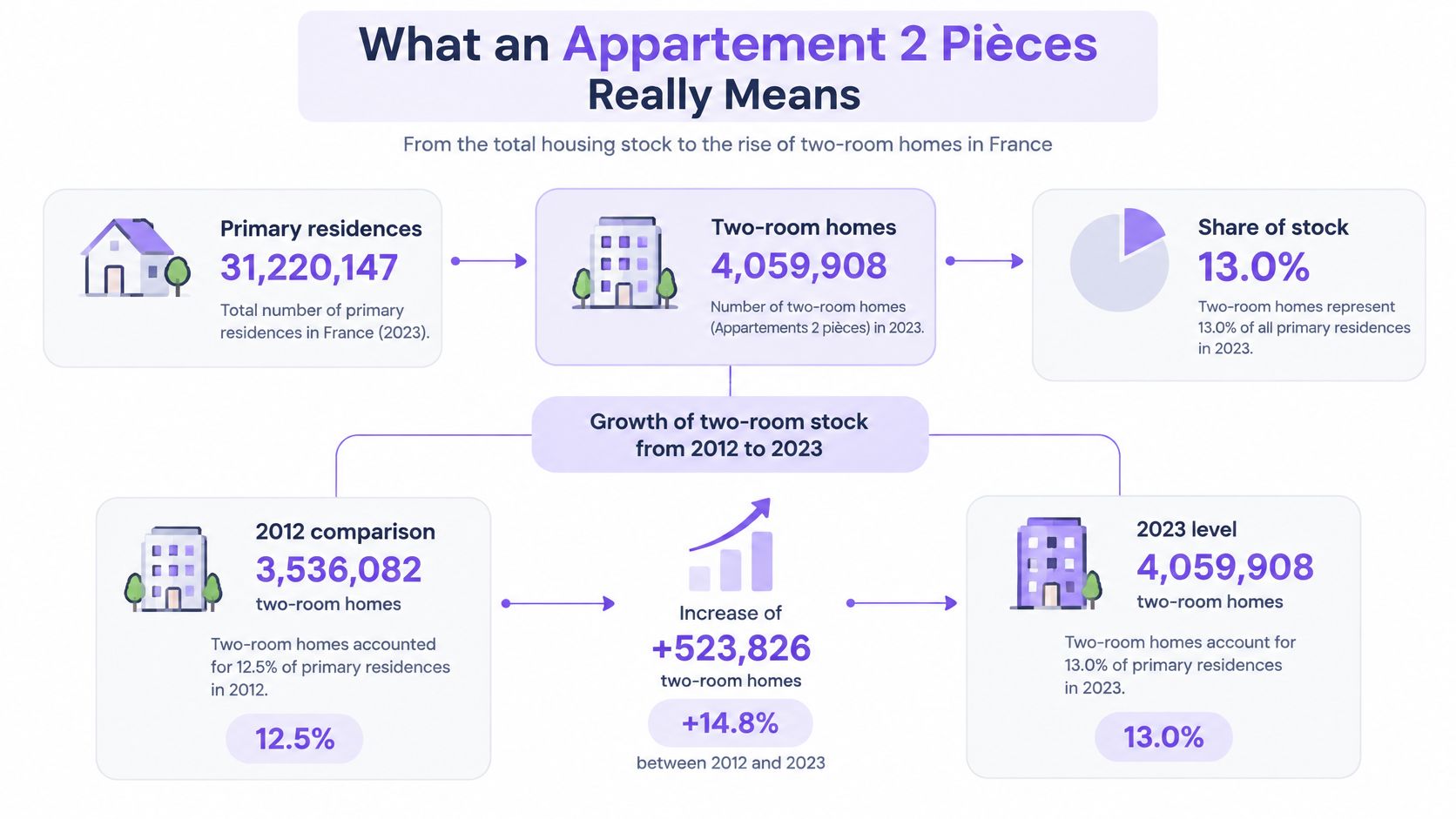
Two-room homes account for 13.0% of primary residences in France excluding Mayotte, according to the Insee census. That makes the French two-room home a mainstream housing choice, not a specialist category for students or occasional city stays.
But a search for appartement 2 piece tells you surprisingly little about whether a flat will suit you. The room count doesn't reveal how much usable space you'll get, what the advertised rent leaves out, or whether the energy rating could make renting the property problematic. The useful comparison is layout, total monthly occupancy cost and energy-related risk, not euros per square metre alone.
What an Appartement 2 Pièces Really Means
An appartement 2 pièces, commonly advertised as T2 or F2, normally contains a living room and a separate bedroom. Think of it as a studio that gained a closing door between sleeping and daytime life.
Say you arrive at a flat with an entrance hallway, a bathroom, a kitchen, a sitting room and a bedroom. You've walked through several distinct spaces, but the advertisement can still correctly describe a two-room flat. The kitchen, bathroom, WC, entrance and corridors don't normally count as additional pièces.
The English wording can cause confusion. “2 piece” doesn't refer to a furniture set, and it doesn't promise equally sized rooms. A generous living room attached to a narrow bedroom can carry the same T2 label as a more balanced plan.
What the label promises
The distinction matters when you compare photographs. An open kitchen might occupy the back wall of the living room, while a separate kitchen might sit behind its own door. Neither arrangement automatically changes the basic room category.
Use the label as a starting point, then establish:
- Which room is the bedroom. Ask for a floorplan rather than inferring it from a bed in a photograph.
- Where each main room gets daylight. A glazed internal partition isn't the same thing as an outside window.
- How the rooms connect. A bedroom reached through the sitting room offers different privacy from one reached off a hallway.
- Where everyday equipment fits. A kitchen photograph may conceal the absence of space for a fridge or washing machine.
The census infographic puts this familiar housing format in context.
Who the format can suit
A separate bedroom can work well for a single person, a couple, a student or someone moving for work. It lets one person sleep while another reads, cooks or takes a call, although it doesn't create a separate home office.
The wider housing context helps explain its importance. In early 2024, apartments represented 44% of primary residences, and nearly 40% of apartments had only one or two rooms, according to Insee's housing overview.
Practical rule: Treat T2 as a description of room organisation, not a guarantee of comfort, floor area or affordability.
Size Rent and Purchase Benchmarks
Appartement 2 pièces size and price benchmarks
| Benchmark | Surface | What it represents | Money figure |
|---|---|---|---|
| Rental habitability minimum | 9 m² or 20 m³ in one main room | Legal decency threshold, not a full flat, explained by Service Public | Not a market rent |
| 2024 government rent-map T1–T2 | 37 m² | Unfurnished reference in the government rent-map dataset | Commune advertised rents |
| Completed-rental benchmark | Market sample surface, not a prescribed size | Completed transactions rather than every advertised T2 | Charges-inclusive benchmark discussed below |
| 2023 observatory T2 | About 45 m² | Representative T2 size in the rental-observatory publication | Use the local observed €/m² |
| SeLoger purchase snapshot | Individual example, not a national standard | One analysed investment market | Purchase and rent comparison below |
The legal floor isn't a design target
The habitability threshold concerns at least one main room, not a promise that an entire flat of that size makes a practical T2. Under the Service Public rule linked in the table, the floor-area route also requires a minimum ceiling height of 2.20 m.
Surface habitable means usable habitable area measured under a specific method. It excludes walls, partitions, stairs, ducts, door and window embrasures, and areas beneath 1.80 m ceiling height under that same guidance. An advertisement's total floor area can therefore give a more generous impression than its habitable surface.
That distinction becomes tangible in an attic flat. You may be able to place low storage beneath the roof slope, but you can't use that strip in the same way as standing-height floor space.
Ask the agent for the measurement document and a dimensioned plan. Surface alone also doesn't establish rental decency: daylight, ventilation, heating, water, sanitation and electrical safety need checking.
Compare like with like
The government reference and the observatory example serve different purposes. One supports comparisons between commune-level advertised rents; the other describes a rental-market typology. Neither establishes what your particular flat should cost.
A local comparison should match the property's:
- Location, including neighbourhood and transport access.
- Condition, rather than treating renovated and tired interiors as equivalent.
- Building characteristics, including floor, lift access and construction.
- Rental terms, especially furnishing and what the charges include.
For Île-de-France, Lyon, Marseille and a mid-sized city such as Rennes, no verified local T2 rent figure is established here. Mark those comparison cells unknown until you've checked the relevant local observatory, rather than inserting a national estimate.
Use a consistent method to calculate the price per square metre, keeping purchase prices separate from monthly rents. Then test the resulting shortlist against your actual household cash flow.
If you need a framework for that affordability check, you can plan your rent budget with Fintrack. A sensible price per metre is useful evidence, but it isn't permission to exceed what you can comfortably pay.
Floorplans That Work in a Compact Flat
A compact flat succeeds when everyday activities fit without constant rearrangement. You should be able to open the wardrobe, cook dinner and move between rooms without folding away another essential piece of furniture.
Use floorplans to compare those movements, not just the shapes of the rooms.
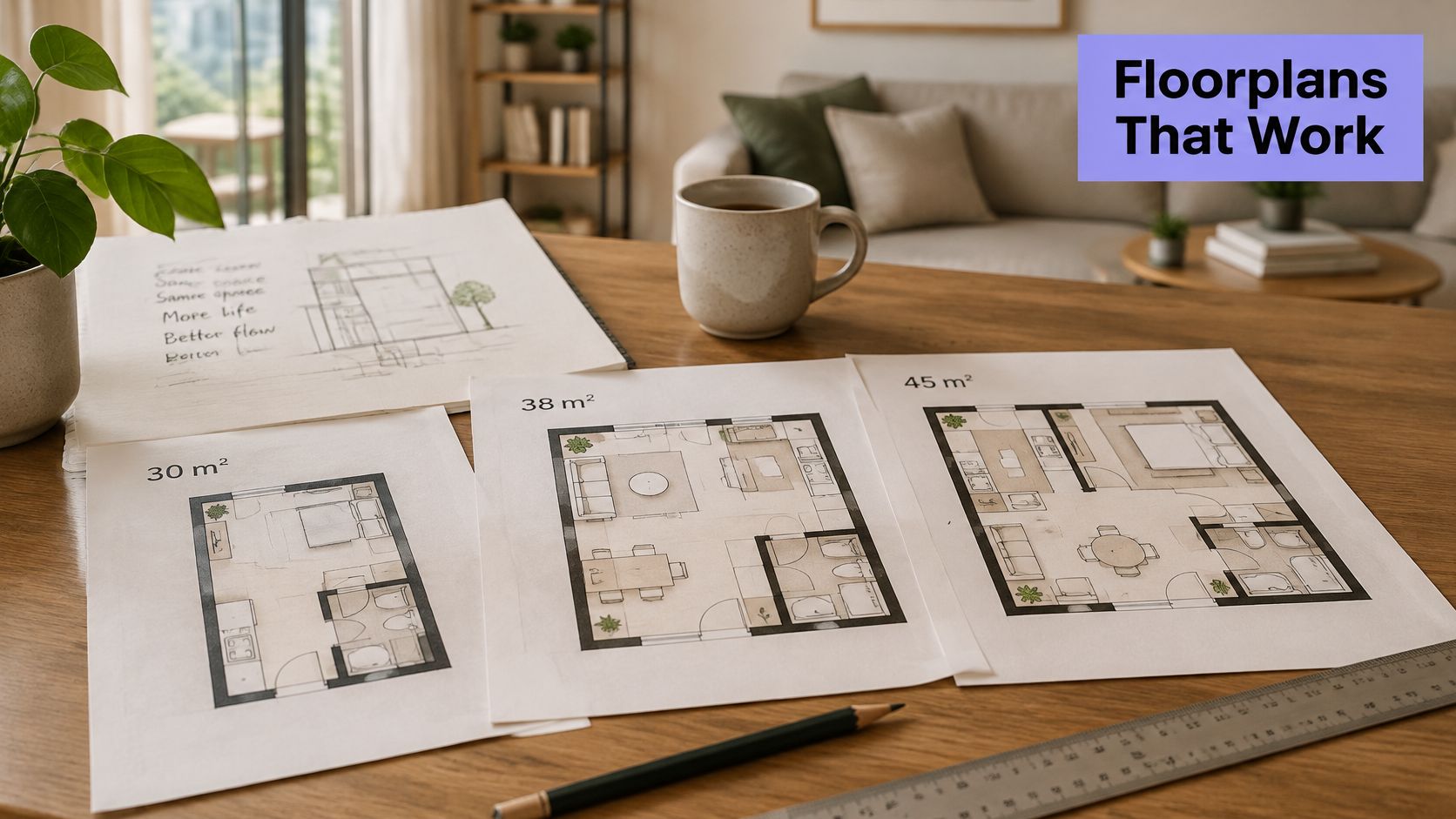
Follow a day through the plan
In a longitudinal plan, the entrance may lead past the kitchen into a street-facing living room, with the bedroom behind. This can separate noisy daytime activity from sleep, but inspect the bedroom carefully. A room carved out of the middle of the flat may have poor daylight or depend on borrowed light.
A corner plan can place the living room and bedroom against different external walls. That gives you a chance to check daylight and outlook in both rooms. It's particularly worth considering in a dense city centre, although traffic noise and neighbouring windows still matter.
An open-kitchen plan removes a partition and gives the living area more apparent width. The trade-off is that cooking smells, extractor noise and washing-up remain in your only sitting space. Check whether the extractor works and whether the furniture arrangement leaves enough preparation surface.
A spacious photograph can hide an awkward route from the entrance to the bedroom. Follow that route on the plan before judging the décor.
For another way to inspect compact layouts, use this video alongside your own measured plan.
Run a furniture fit test
Draw your actual furniture to scale, either on graph paper or in a simple floorplanning tool. Include door swings and the space needed to use the furniture, not just its footprint.
- Start with the bed. Leave a usable route beside it and check that drawers and wardrobe doors can open.
- Place the sofa and table. The dining position shouldn't obstruct the route between the sink, hob and fridge.
- Check the bathroom. Open the shower door in your sketch and test whether it conflicts with the WC or basin.
- Locate appliances. A washing machine needs a suitable water supply, drain and electrical connection, not merely an empty gap.
Watch for constraints that a cosmetic renovation won't solve. A kitchenette beside the building's plumbing stack may be difficult to relocate, and moving it could require permissions as well as technical work.
A bedroom reached through the living room may be acceptable for your household, but less convenient when someone entertains while another sleeps. Extra advertised area won't compensate for a second room that's effectively a windowless box.
True Monthly Cost Beyond the Headline Rent
A T2 can offer better value per room than a studio and still cost more every month. Total occupancy cost includes the expenses you must pay to live there, not just the amount printed most prominently in the advertisement.
For context, the Journal de l'Agence account of LocService's rental observatory reports that T2 homes represented 26% of completed French rentals in 2025, with an average of €715 per month including charges for 42 m². That's a market reference, not a ready-made personal budget.
True monthly budget lines for a T2
| Cost line | Typical figure or rule | What to verify |
|---|---|---|
| Advertised rent excluding charges | Base rent stated in the draft lease | Commune comparison for a similar surface |
| Recoverable charges | Provision or fixed package specified in the lease | Included services and last regularisation |
| Rent including charges | Base rent plus the stated charge payment | Whether energy remains outside this total |
| Heating and hot water | Separate bill or collective charge | Energy type, metering and who pays |
| Security deposit | Upfront cash requirement, separate from rent | Applicable cap and amount in the lease |
| Agency fee | Request an itemised tenant quotation | Applicable zone, surface and tenant/landlord split |
| Home insurance | Obtain a quote for the actual address | Annual premium and cover |
| Parking or cellar | Add the quoted optional payment | Whether you can decline it |
| Transport pass | Use the operator's current fare | Required zones and commuting route |
Read the charge wording
Hors charges means excluding charges. Charges comprises means the advertised total includes a stated charge amount, but it doesn't mean every household expense is included.
With provisions sur charges, you pay estimated amounts that are later reconciled against recoverable expenditure. Ask for the last annual statement so you can see whether the advertised provision has been realistic.
A forfait is a fixed charge package rather than the same estimate-and-reconciliation arrangement. Read what it covers instead of assuming it includes heating, internet or every communal service.
Separate monthly affordability from move-in cash
The deposit and agency payment affect whether you can move in, but they shouldn't be confused with recurring consumption. Keep an upfront cash list alongside the monthly budget and obtain written amounts before committing.
Insurance can be paid annually, so convert the quoted premium into a monthly budget allowance. Do the same with any other recurring annual expense, while retaining the actual payment date in your cash plan.
Consider two hypothetical flats with the same advertised rent. One includes collective heating and sits within walking distance of work; the other requires separately paid electric heating and a rail commute. The cheaper-looking interior or larger living room doesn't tell you which household bill will be easier to carry.
Ask the agent: Which payments are fixed, which are provisions, and what was the last annual charge adjustment?
Don't accept an unexplained agency-fee total or a verbal assurance that the charges are low. Request the written breakdown, heating arrangements and supporting charge statement before deciding that a rent is affordable.
Renting Versus Buying a Two-Room Flat
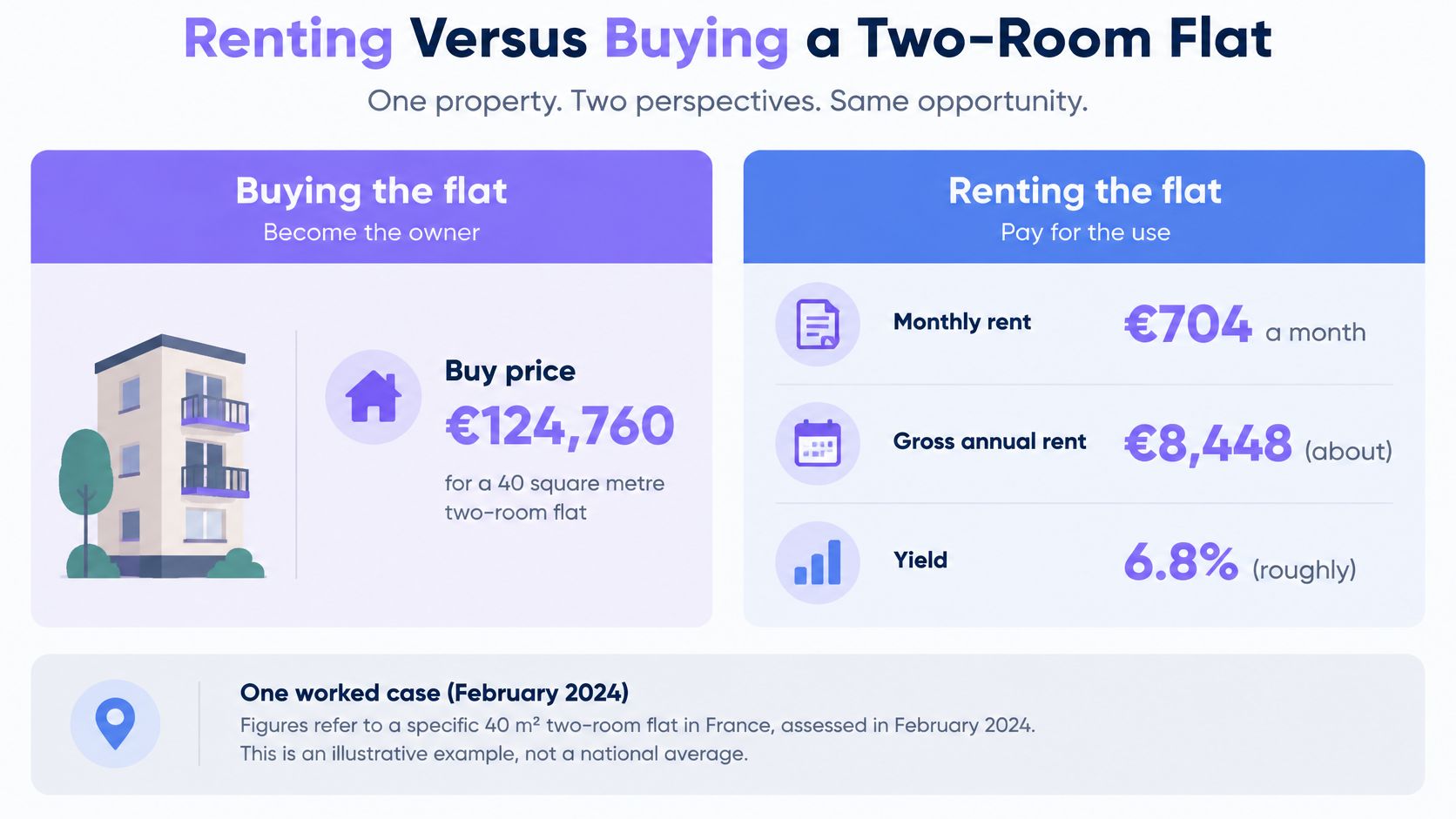
A purchase comparison needs an actual property case, not a national slogan about rent being wasted money. In one investment market analysed by SeLoger as of 1 February 2024, a 40 m² two-room flat cost €124,760 to buy and rented for €704 per month, equivalent to a calculated €8,448 annual gross rent and approximately 6.8% gross yield.
That calculation divides annual rent by purchase price. It doesn't deduct acquisition costs, tax, vacancy, maintenance, building works or financing, so it isn't a forecast of what an investor would keep.
The infographic shows that single worked case, rather than a national price.
Rent or buy a French two-room flat
| Criterion | Renting | Buying |
|---|---|---|
| Cash to start | Deposit, possible agency share, first rent | Personal contribution, acquisition costs, loan fees |
| Monthly outlay | Rent, charges, tenant energy, insurance | Loan, copropriété charges, taxe foncière, works |
| Time horizon | Better suited to an uncertain or short stay | More plausible when you expect to stay longer |
| Freedom to leave | Give legally applicable notice | Arrange a sale and accept market timing |
| Control of works | Negotiate with the landlord | Decide within ownership and copropriété rules |
| Rent regulation | Applicable controls may protect the tenant | Applicable controls may restrict rental income |
| Best fit | Student, newcomer, mobile worker | Settled household or informed investor |
Flexibility has a financial value
Renting can be the more practical choice when your job, household or preferred neighbourhood may change. You avoid tying up purchase capital and can test whether the area works for your daily life.
Buying gives you more control over the interior, but ownership doesn't mean independence from the building. In a copropriété, owners share decisions and expenditure concerning common parts such as the roof, façade and lift.
Read the meeting minutes, budgets and available works documents. Ask which projects have been discussed, approved and funded, rather than accepting a general statement that the building is well maintained.
Make the verdict conditional
A short or uncertain stay favours flexibility. A longer intended holding period makes buying worth examining, but only after you've allowed for acquisition costs, financing and a realistic resale scenario.
For an investment, check whether local rent controls apply before using the agent's suggested rent in your calculation. A desirable address doesn't remove legal constraints or guarantee uninterrupted occupancy.
Use this apartment-buying guide to organise the purchase investigation. Choose buying only when both the household budget and the building documents support it, not merely because the gross yield looks attractive.
Energy Label and Checks Before You Sign
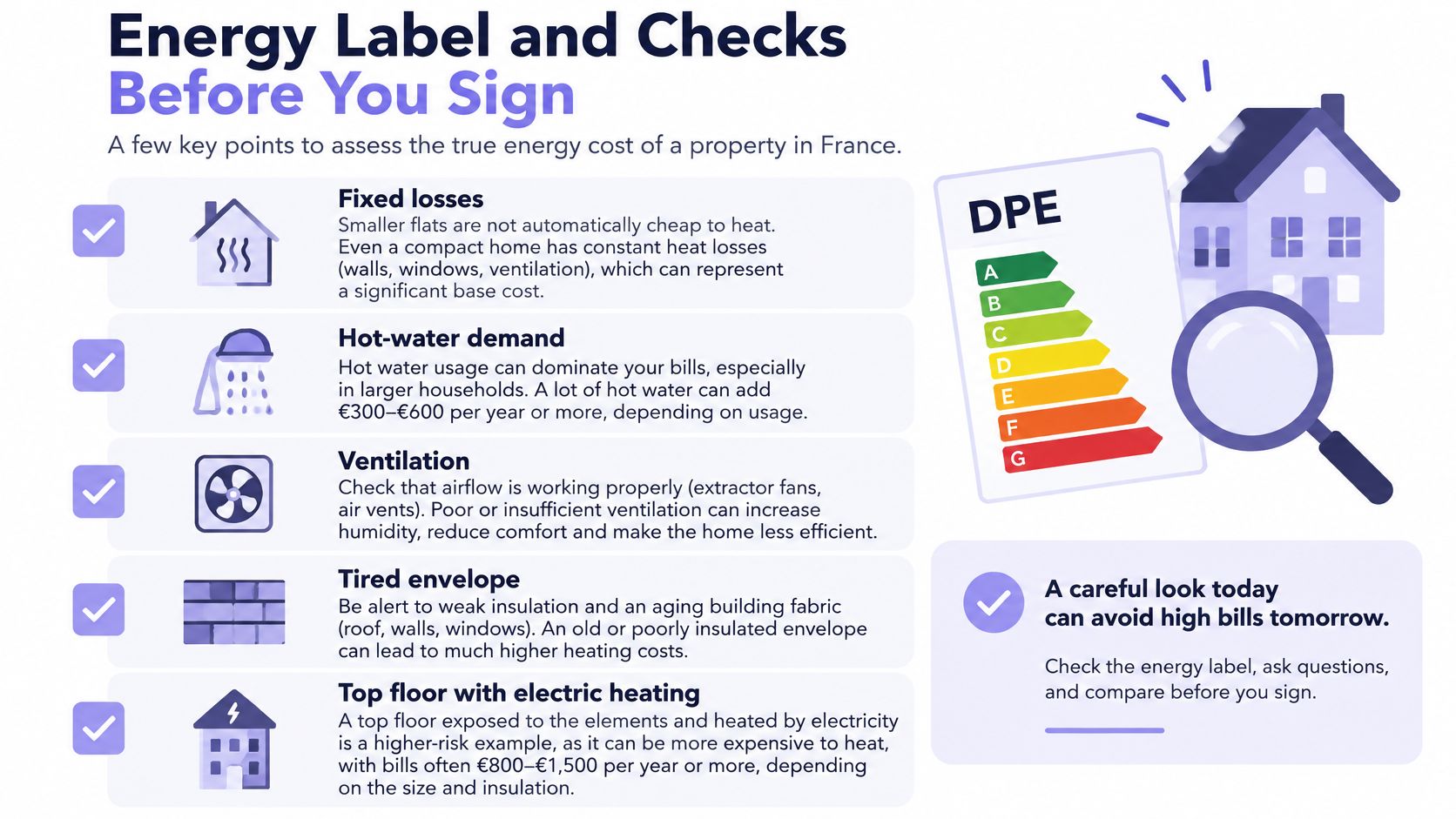
A smaller flat isn't automatically cheap to heat. Heat loss through the building fabric, hot-water demand and ventilation can outweigh the apparent saving from a compact footprint.
The DPE also affects whether a property can be rented. Since 1 January 2025, metropolitan homes rated G cannot legally be offered for rent, according to the French Economy Ministry's DPE guidance. Treat the rating as an availability and renovation issue, not an environmental badge.
These are the physical features to inspect alongside the report.
Take a document-led visit
- Request the full DPE. Check its date, property address and grade. A cropped advertisement badge isn't a substitute for the report.
- Read the annual energy estimate. Treat it as an assessment under stated assumptions, not a guarantee of your future bill.
- Identify the equipment. Record how heating and hot water are produced, how they're controlled and who receives the bill.
- Inspect ventilation. Look for air inlets and extraction points, and ask about maintenance. Persistent condensation or damp staining deserves an explanation.
- Ask about summer comfort. For an exposed upper-floor flat, inspect shading, roof insulation and the possibility of ventilating safely.
- Investigate renovation exposure. Landlords and buyers should consider the scheduled tightening affecting F and then E homes, including works that need collective approval.
- Test basic services. Check daylight, taps, heating equipment and visible electrical condition. Have unexplained defects assessed rather than diagnosing them from photographs.
- Challenge the asking price. Use suitable local rental comparisons and assess whether the condition justifies the proposed rent.
Link the flat to the building
An owner may be able to replace an internal appliance but need collective agreement for work affecting common elements. Ask who would authorise insulation, ventilation or heating changes, and whether those changes have already been discussed.
For a purchase, include the mandatory property-sale diagnostics in your document review. Don't assume a recently decorated interior means the building fabric has been improved.
Before signing, assemble a compact evidence pack: measurement method, full DPE, charge clause and last charge statement. Missing documents should produce a specific request and a pause in your decision, not an optimistic assumption.
Search Terms and Filters Before You Visit
Search appartement 2 pièces, T2 and F2 together. An English search for “2 piece” can return unrelated products, while a portal's bedroom filter may describe the flat differently from its room-count filter.
Set filters in a useful order
- Rooms first. Select the two-room category and confirm that the listing identifies a separate bedroom.
- Usable surface next. Choose a minimum that accommodates your actual furniture and daily activities, rather than accepting the smallest result.
- Measurement wording. Look for surface habitable, and flag listings that provide only an unexplained total.
- All-in price. Apply your occupancy budget, then inspect what the displayed rent includes.
- Energy status. Use the energy filter where available and request the full report before treating the result as suitable.
- Search geography. Save comparable searches in nearby communes so you can assess commuting cost without changing every other criterion.
Keep a short comparison sheet with columns for layout, monthly total, documents received and unanswered questions. That makes an attractive photograph less likely to distract you from an incomplete charge statement or awkward bedroom.
Save promising listings, but don't book every viewing. Ask the document questions first so your visits concentrate on flats you could realistically choose.
Pick a Flat or Publish the Listing
Tenants should turn the shortlist into a decision sheet. Rank suitable flats by the complete monthly bill, then keep unresolved document questions visible rather than treating missing information as a saving.
Buyers should attach a works assessment to each candidate. Read the copropriété minutes and establish which expenditure you would inherit before deciding whether the purchase fits your intended holding period.
Give each reader a concrete next action
- Tenants: Request the full report and charge documents for your preferred listing before submitting a final commitment.
- Buyers: Ask the selling agent to identify approved works, discussed works and the documents supporting those answers.
- Agents and landlords: Publish habitable surface, room arrangement, energy grade and charge inclusions clearly. Replace vague claims about low bills with the documents a prospective occupant needs.
Today, open a small shortlist of live listings and fill in every occupancy-budget line. Put any property with unresolved daylight, charge or energy concerns on hold until the person marketing it provides a satisfactory answer.
For agents and landlords, Wispra offers property-specific content campaigns with articles, FAQs and updates to help explain individual listings in AI search. Visit Wispra to explore how a two-room apartment's layout, charges and energy information can become clear, searchable property content.