Most borrowers treat assurance emprunteur comparatif as a race to the lowest monthly premium. That is the wrong metric. In France, the actual risk is buying a contract that looks cheaper on paper but is not economically equivalent when a claim arrives.
A serious comparison has to test guarantee equivalence, disability thresholds, exclusions, waiting periods, and the claims process, not just the sticker price. The market is large enough that this mistake matters at scale, 22.15 million contracts covered residential mortgages in 2024, generating nearly €7 billion in premiums, including €4.545 billion for death and total permanent disability cover and €2.285 billion for incapacity and disability cover (CCSF advisory document). A quick mortgage budget check with the home financing calculator from RealEstateCRM can help frame the broader borrowing cost, but it won't tell you whether your insurance really protects the loan.
| Comparison point | What price-only buyers see | What a rigorous comparison checks |
|---|---|---|
| Premium | Lower monthly cost | Equivalent guarantees and total contract value |
| Disability cover | “Included” | IPT and IPP thresholds, definitions, and triggers |
| Exclusions | Hidden in the fine print | Psychiatric, pre-existing, alcohol, drug, and activity exclusions |
| Claims outcome | Assumed to be fine | Refusal risk, documentation burden, and mediation path |
| Switching | Administrative formality | Lender acceptance and written justification |
The Hidden Risks of Chasing the Lowest Premium
The cheapest delegated policy can be the most expensive mistake in a 25-year mortgage if its protection is narrower than the bank's original offer. That is the core flaw in many comparison tools, they optimise for price, while the legal test is equivalence of guarantees. A lower premium means very little if the contract defines incapacity more tightly, waits longer before paying, or excludes situations that matter at claim time.
Why false equivalence is the real danger
French borrowers can change mortgage insurance at any time under the Lemoine framework, but the lender can refuse a replacement contract if the guarantees are not equivalent, and that refusal must be justified in writing (service-public guidance on mortgage insurance substitution). That sounds straightforward, but it shifts the burden to the borrower to prove that the new policy really matches the old one. A cheaper policy with a different indemnification basis is not a bargain if it changes the probability of payment when illness or disability strikes.
Practical rule: if two contracts are not equivalent at claim level, they are not comparable on price alone.
This is why a mortgage payment simulation should never sit in isolation. A borrower can estimate loan affordability with a tool such as a mortgage calculator, but the insurance leg needs a separate audit because it behaves differently from interest and principal. The useful question is not “what's the cheapest offer?”, it's “what coverage would I lose if this claim were tested in court or by the insurer's claims team?”
Why superficial comparisons fail expats and locals alike
Borrowers with prior health issues, self-employed professionals, and joint borrowers face the sharpest mismatch between headline savings and practical protection. A contract can look attractive because it is cheaper at subscription, then become harder to activate because of exclusions or narrow disability definitions. The consequence is simple, a lower monthly premium can hide a much higher claim denial risk.
The comparison must therefore start with the protection logic, not the monthly debit. If the cheapest offer changes the claim burden, it is not a neutral substitute. It is a different product.
Market Scale and the Impact of the Lemoine Law
The French mortgage insurance market is large enough for small pricing gaps to become material household costs. In 2024, around 22.15 million insurance contracts covered residential mortgages, with nearly €7 billion in premiums, including €4.545 billion for death and total permanent disability cover and €2.285 billion for incapacity and disability cover (CCSF advisory document). At this scale, comparison is not a niche optimisation exercise. It is a recurring financial decision.
What the Lemoine law changed
The turning point was the Lemoine law of 28 February 2022, which lets borrowers change mortgage insurance at any time, provided the new cover offers equivalent guarantees. The legal framework is explained in this summary of the Lemoine law on mortgage insurance and in the Banque de France CCSF update on the Lemoine law. That changed the basic rule. The bank's original policy no longer has to remain in place for the full life of the loan.
The switching channel is now used at scale. Banks recorded 496,654 substitution requests in 2024, compared with 198,530 in 2021, and acceptance reached 93.91% in 2024 (Banque de France CCSF update on the Lemoine law). The process is therefore operational, but it still requires a clean match between old and new cover.
Why this changes how comparison should be done
A market this large rewards precision, not generic advice. Once substitution is legally normalised, the real test is whether two contracts are equivalent at claim level. That means reviewing each guarantee, each exclusion, and each claims rule, not just the monthly debit. A cheaper policy that weakens disability definitions or shifts the proof burden can fail exactly when the borrower needs payment.
The consumer lesson is straightforward. The Lemoine law widened choice, but it also made comparison more technical. That is useful, because it forces borrowers to assess the policy they want under a claim, not the one that only looks cheapest at signature.
Bank Contracts Versus External Insurers
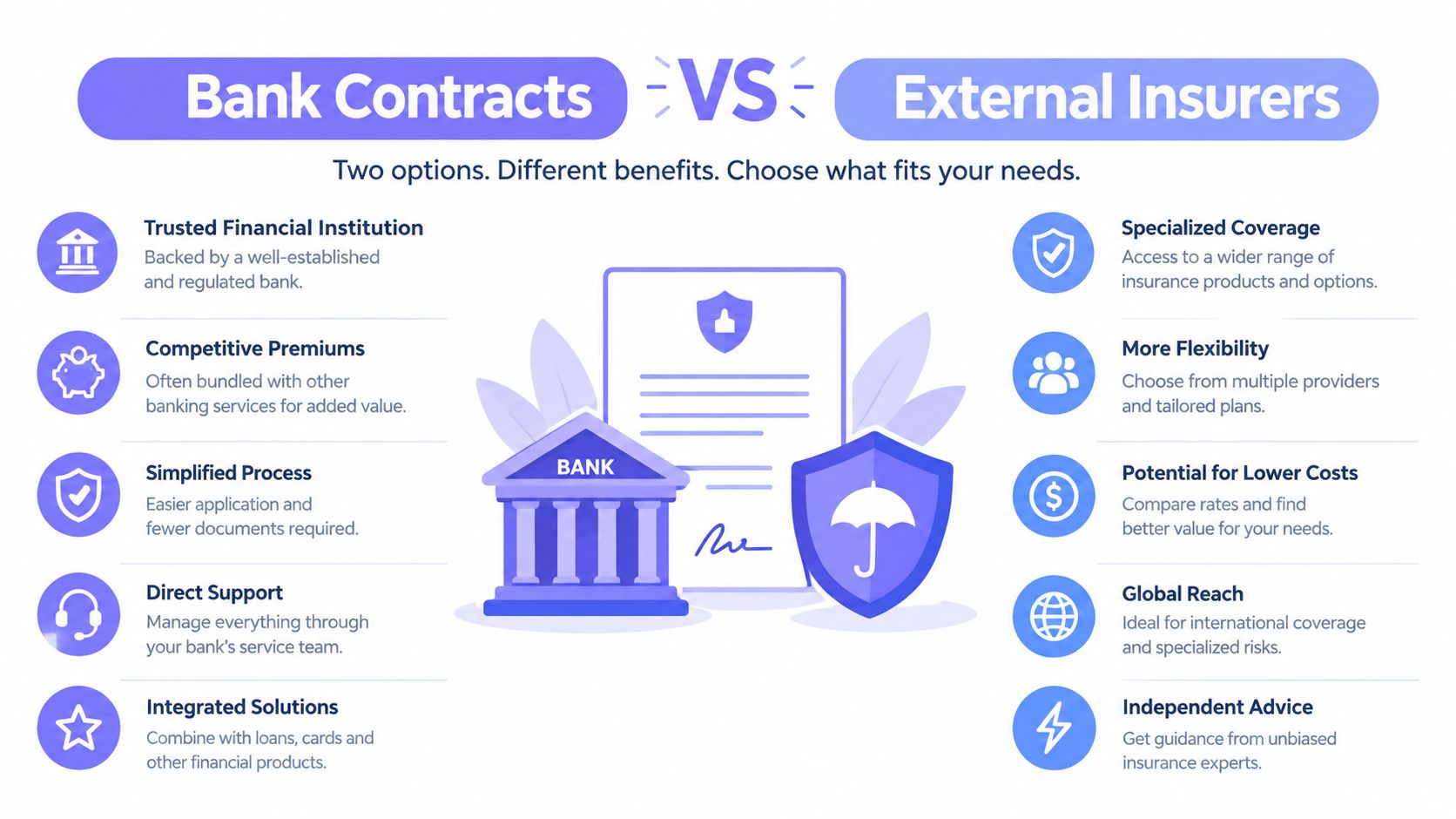
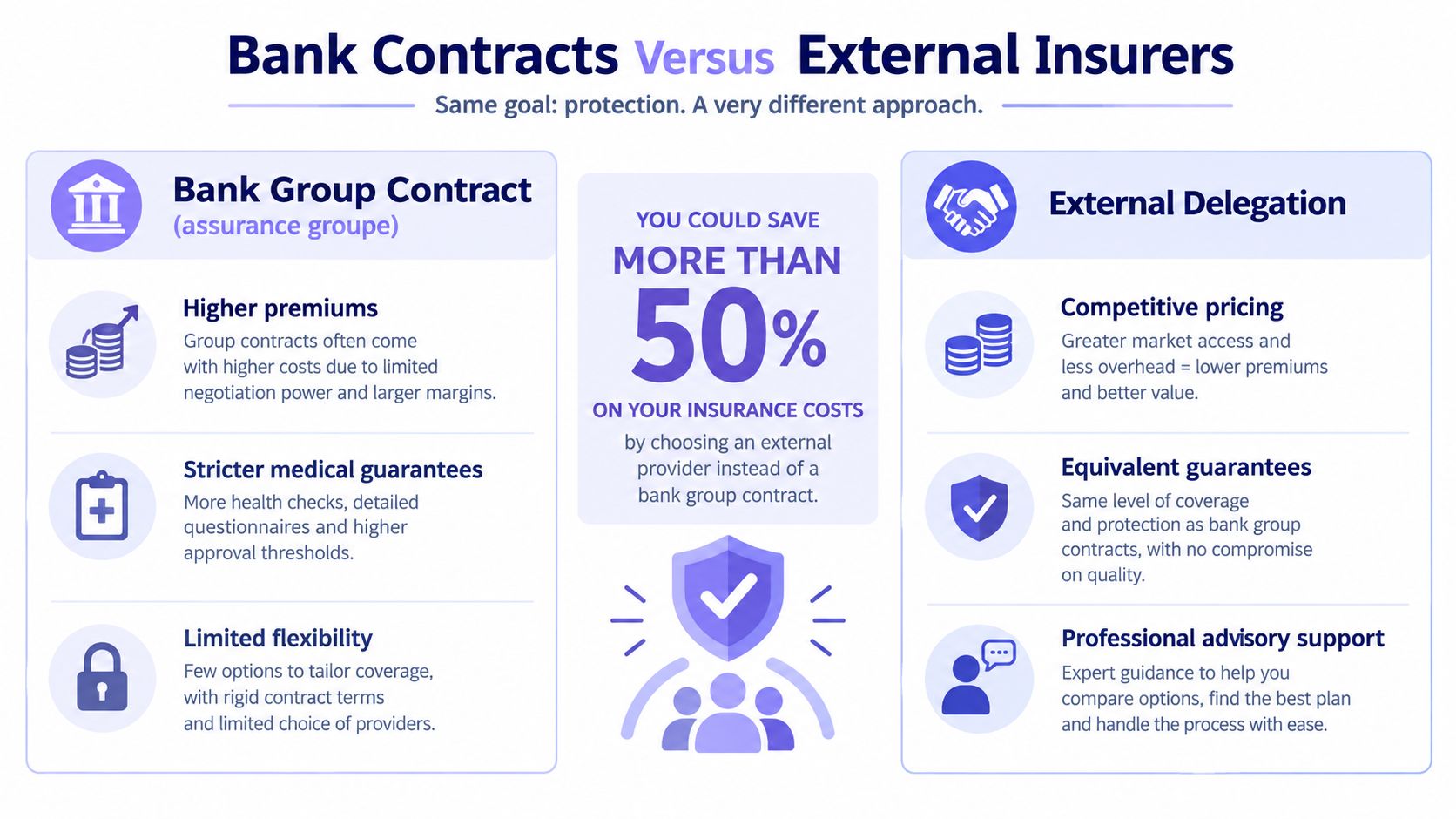
The right comparison is not ideological. It is structural. Bank group contracts and external insurers solve the same problem, but they often do it with different pricing logic, different underwriting logic, and different room for tailoring.
How the two models behave differently
A bank group contract pools borrowers into a common tariff structure. That tends to favour profiles the bank considers higher risk, because pricing is spread across the group rather than set as tightly on the individual. An external insurer usually individualises the tariff more closely, which can help borrowers with strong profiles, but it can also tighten the underwriting review.
That difference matters because a contract can be cheaper for one borrower and worse for another. A young, healthy borrower may find external delegation more attractive, while a borrower with more complex health or occupational history may value a group structure if the delegated offer introduces extra scrutiny. The point is not that one model always wins, it's that the better model depends on how the contract prices risk and how it defines protection.
What to compare beyond the premium
A rigorous assurance emprunteur comparatif needs to look at three layers.
- Tariff logic: is the premium smoothed across the group or adjusted to the borrower's profile?
- Coverage logic: are the guarantees built on the same disability and incapacity rules?
- Operational logic: does the insurer handle claims in a way that makes the promise real?
If the answer differs across these layers, then the products are not interchangeable. A cheaper monthly payment can be offset by a narrower benefit trigger or a more demanding claims process. That is especially relevant for buyers who assume that “same cover” on a comparison site means the same legal effect.
A bank policy is not automatically safer, and an external policy is not automatically better. The correct test is whether the borrower keeps the same practical protection under the new contract.
For borrowers making a long-term property plan, the right comparison also has to sit alongside the mortgage itself. A policy that seems efficient at signing may age poorly if its price or coverage structure fits badly with the borrower's health trajectory or occupation. That is why the product type matters, but only after the contract terms have been audited line by line.
Auditing Guarantees and Disability Thresholds
A serious comparison starts with the guarantees that are hardest to read and easiest to misunderstand. In French mortgage insurance, IPT and IPP are the fault lines, because they determine when disability protection activates. The CCSF cites proposed reference thresholds of 66% for total permanent invalidity (IPT) and 33% for partial permanent invalidity (IPP) to improve technical comparability between offers (Banque de France CCSF statement on clearer and stronger insurance guarantees).
What to check line by line
The useful audit starts with the benefit trigger. If one contract uses a narrower incapacity rule than another, the price comparison is distorted from the outset. Then come the exclusions, the waiting period, the occupational definition, and the compensation basis. These items are not decorative clauses, they decide whether the insurer pays.
A practical review should ask:
- Trigger threshold: does the contract align with the relevant IPT and IPP reference logic?
- Definition of incapacity: does it refer to the borrower's profession or to any profession?
- Compensation basis: is payment forfaitaire or indemnitaire?
- Waiting period: how long before the cover can start paying?
- Exclusions: what conditions or activities are carved out?
A borrower comparing offers should also read the contract as a future claims file, not a sales brochure. The cheapest policy can be inferior if it uses a tighter definition of disability or a more restrictive occupational test.
Why equivalence is technical, not rhetorical
Many buyers hear “equivalent guarantees” and assume that means broad similarity. It doesn't. Equivalence is judged clause by clause, and that is why a policy with a lower premium can still fail the lender's test. The comparison only works if both offers are mapped against the same protection standards.
Analyst's note: a lower premium only matters after you've proved that the new policy would respond in the same situations as the old one.
If you want a plain-language refresher before you compare clauses, the article on mortgage insurance defined is a useful starting point. But the more important task is to reconcile that general definition with the exact contract language you're reviewing.
Navigating Exclusions and Claims Resolution
The weakest contract is not always the one with the worst price, it's the one that fails when the borrower needs it most. That is why exclusions and claims handling deserve as much attention as the tariff sheet. The ACPR has highlighted a serious protection concern, for one-third of organisations examined, the refusal rate for indemnification exceeded 40% (ACPR presentation on customer protection).
Exclusions that change the real risk
Mortgage insurance policies often contain exclusions tied to psychiatric conditions, pre-existing conditions, alcohol or drug use, and activities or circumstances not declared at underwriting. Those clauses matter because they can sit in the policy until the claim date. A borrower comparing premiums only can miss the fact that two contracts expose them to very different claim outcomes.
That is why a good comparison is also a claims-readiness check. Ask whether the policy documents make it easy to show the medical facts, the occupational facts, and the timeline of the loss. If the answer is no, the policy may be cheap for a reason.
What to do when a claim is challenged
A borrower filing a claim should document the event carefully, keep the insurer's written requests, and ask for the contractual basis of any refusal. If the insurer's answer is vague, the borrower should escalate through the company's complaints process and then use mediation if the dispute remains unresolved. That sequence is not glamorous, but it is often the difference between a stalled file and a structured challenge.
The internal checklist matters too. The guidance in how to declare a claim is relevant because many disputes start with incomplete paperwork rather than an outright denial on substance. That doesn't solve every problem, but it reduces avoidable friction.
If a refusal isn't explained clause by clause, the borrower shouldn't treat it as final.
The bigger conclusion is uncomfortable but important. A market can become more competitive on price while still leaving claims governance too opaque for consumers. That means the best comparison has to cover both the savings side and the dispute-resolution side.
Executing a Seamless Policy Substitution
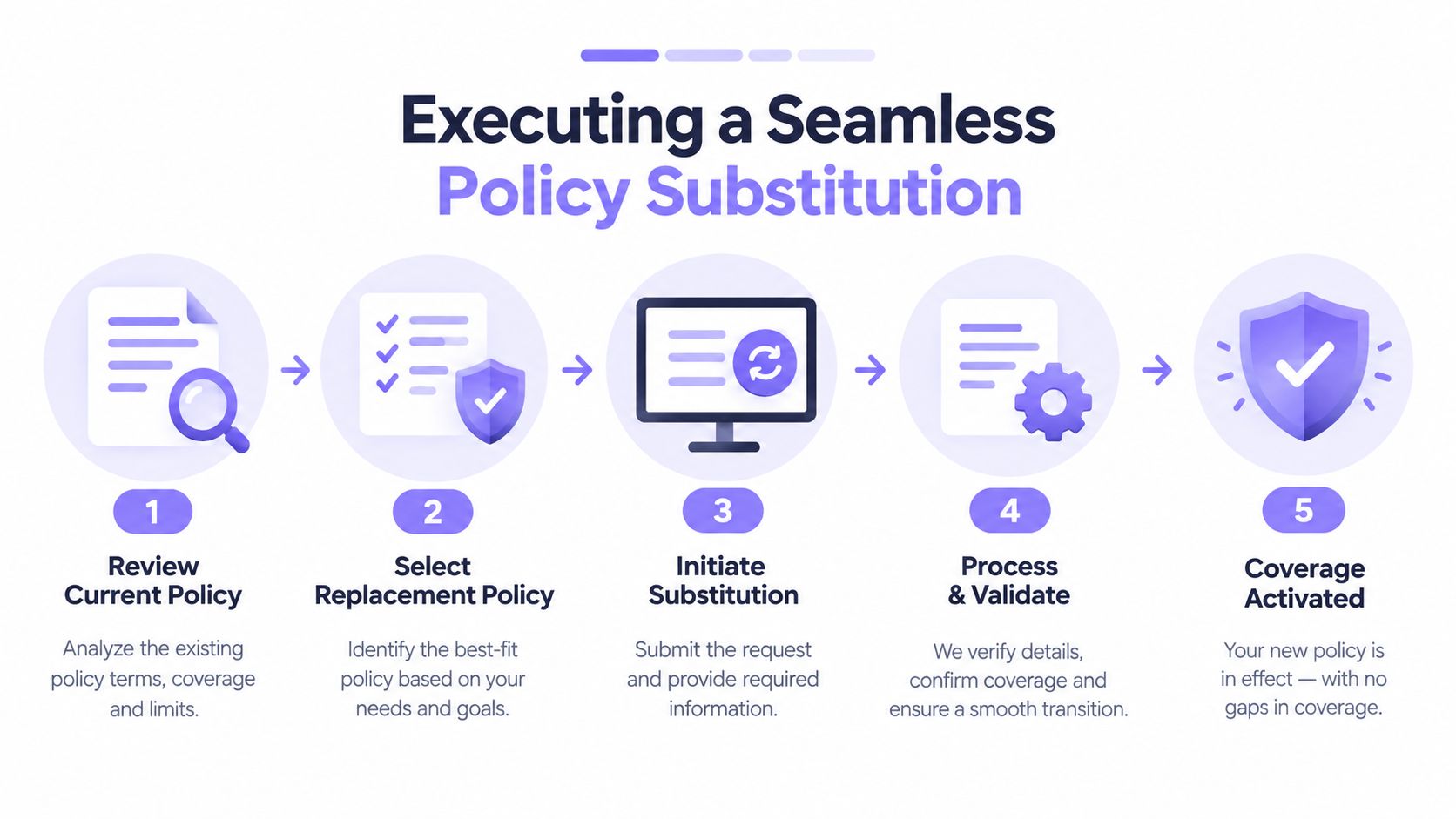
Once the right contract is found, the process becomes administrative rather than analytical. Under the Lemoine framework, the lender must respond within 10 working days, and any refusal has to be justified in writing (service-public guidance on mortgage insurance substitution). That rule gives borrowers a clear timeline, but only if the file is complete.
The substitution path in practice
The practical sequence is simple when it's handled well.
- Secure the replacement offer. The new contract should already match the lender's guarantee requirements.
- Prepare the equivalence file. The documentation has to show why the new policy satisfies the required guarantees.
- Send the substitution request. The lender then has to review it within the legal response window.
- Obtain written acceptance or refusal. If refused, the bank must explain the reason in writing.
- Check activation and cancellation. The new cover must be live before the old cover is fully phased out.
That's the clean version. The messy version is when the bank asks for back-and-forth clarification, which is why borrowers should keep every document aligned from the start. The internal guide on how to change mortgage insurance is useful as a procedural reference point if you need the mechanics in one place.
Why the process is now credible
The administrative route is not theoretical anymore. Banks recorded 496,654 substitution requests in 2024, compared with 198,530 in 2021, and the acceptance rate was 93.91% (Banque de France CCSF update on the Lemoine law). That volume shows that substitution has become a standard market behaviour.
For borrowers, the lesson is straightforward. If the replacement offer is in fact equivalent, the legal path is established. The primary effort is getting the equivalence file right the first time so the bank has no reason to slow the switch.
Resolving Complex Borrower Scenarios
A standard comparison tool works badly when the borrower profile is anything but standard. A self-employed consultant, an older borrower, and a couple sharing a mortgage all face different fault lines in the same insurance market. The right answer depends on how the contract treats occupation, health history, and shared cover.
Three borrower profiles that need extra scrutiny
A self-employed borrower should read the occupational definition very carefully. If the contract measures incapacity against any profession rather than the specific one exercised, the claims test can become less protective in practice. That detail matters more than a small premium difference because income interruption is often uneven for independent workers.
An older borrower should focus on underwriting and the long tail of health questions. A low premium means little if medical screening makes the policy harder to access or fills the contract with conditions that are difficult to satisfy later. In that case, the true comparison is between accepted protection and theoretical protection.
A joint borrower needs to check quotity, because the cover structure can look balanced while leaving one borrower underinsured. The cheapest combined premium is not the same thing as the best household protection. If one person carries most of the repayment capacity, the contract should reflect that reality.
What honesty in medical disclosure really means
The questionnaire de santé is not a box-ticking exercise. It is the basis on which the insurer prices and accepts risk. The safest approach is to answer fully and consistently, because an incomplete declaration can create claim problems later even if the policy was issued without issue at the start.
A truthful medical file protects the borrower more than a fast signature does.
If a bank rejects a delegated policy without a properly justified equivalence argument, the borrower should ask for the refusal in writing and test whether the stated reason really relates to guarantees rather than convenience. The law is on the borrower's side when the contract is equivalent, but the file still has to be organised with care.
The final point is simple. The strongest assurance emprunteur comparatif is not the one with the most attractive ad copy, it's the one that survives a real-life claim test for your exact profile. That is the standard a serious borrower should use.
If you want a sharper, clause-by-clause view of your current mortgage insurance, visit Wispra and use it to turn a superficial premium comparison into a proper protection audit. It's the fastest way to see where a cheaper policy is genuinely better, and where it's only cheaper on the surface.