The website looks fine. It was built three years ago, it loads, the logo sits in the top left. And the phone still stays quiet while a competitor two streets away appears first for every search that matters, including the ones people type at nine in the evening when they need someone now.
You've probably tried something already. A boosted post. A directory subscription. A cousin who said to post on Instagram every day. None of it changed the number that counts: enquiries from people who didn't know you existed yesterday.
The gap usually isn't content. It's accuracy and coverage. Opening hours on the Google listing are wrong, three services are buried in a paragraph on the homepage, half the site is excluded from Google's index, and nobody has looked at any of it since launch. Fixing those items costs hours rather than thousands of euros, and it decides whether you're findable at all. The scale of the competition is worth keeping in mind: France recorded 1,111,238 business creations in 2024, including 716,194 micro-entrepreneur registrations, according to figures attributed to INSEE and compiled in a local SEO data roundup for French small business. Most of those firms will chase the same handful of local searches, and only a fraction will do the boring work.
Quick Wins Ranked by Effort and Payoff
A plumber in Lyon rings me about a site that brings in nothing. Five pages, a stock photo of a wrench, no service pages. His Google listing has never been claimed and shows the opening hours of the workshop he left in 2021. He has never asked a customer for a review.
He doesn't need a content strategy. He needs four afternoons of unglamorous work in the right order, then a routine he keeps for a year. That's the shape of most small business audits I run: the gains sit where nobody wants to look, and the expensive work people ask for first (a redesign, a blog, ads) rarely moves the phone.
Rule of thumb: if a fix takes under two hours and corrects information a customer needs before they call, do it before you write another page.
Here's how I rank the six fixes by time and return.
| Quick win | Time needed | Main payoff | Do it first when |
|---|---|---|---|
| Claim and verify the Google Business Profile | 1-2 hours | Calls and direction requests | No listing exists or hours are wrong |
| Standardise name, address and phone across directories | 3-5 hours | Consistent local signals | Details differ across three or more listings |
| Create one indexable page per main service | About 1 day per page | Qualified organic visits | Services appear only on the homepage |
| Write unique titles and one H1 on commercial pages | 2 hours | Clearer search snippets | Several pages share one generic title |
| Fix excluded pages in Search Console | 1-2 hours | Pages that can appear in search at all | Coverage report shows excluded or errored URLs |
| Ask recent customers for reviews every week | 30 minutes per week | Trust and local visibility | Fewer than 10 reviews in total |
The website gap is still the largest one. INSEE data for 2022 shows that 82% of French micro-enterprises had internet access for professional use, but only 37% had a website, while 44% used social media and 42% held an account on at least one network (INSEE). The split varies by trade: 66% of micro-enterprises in accommodation and food services used social media, against 22% in transportation and storage.
That distinction matters because a social profile is rented space. One crawlable page that states your services, your area, your hours and a phone number is often the biggest first step a firm can take, and it takes a day rather than a quarter.
Budget explains why this stays undone. In the 2021 AFNIC study of more than 13,000 French companies, 59% of very small businesses and SMEs spent less than €300 per year on their online presence (AFNIC study). The six fixes above cost nothing but time, which is exactly why they fit.
Pick the two or three rows that describe your situation this week and start there.
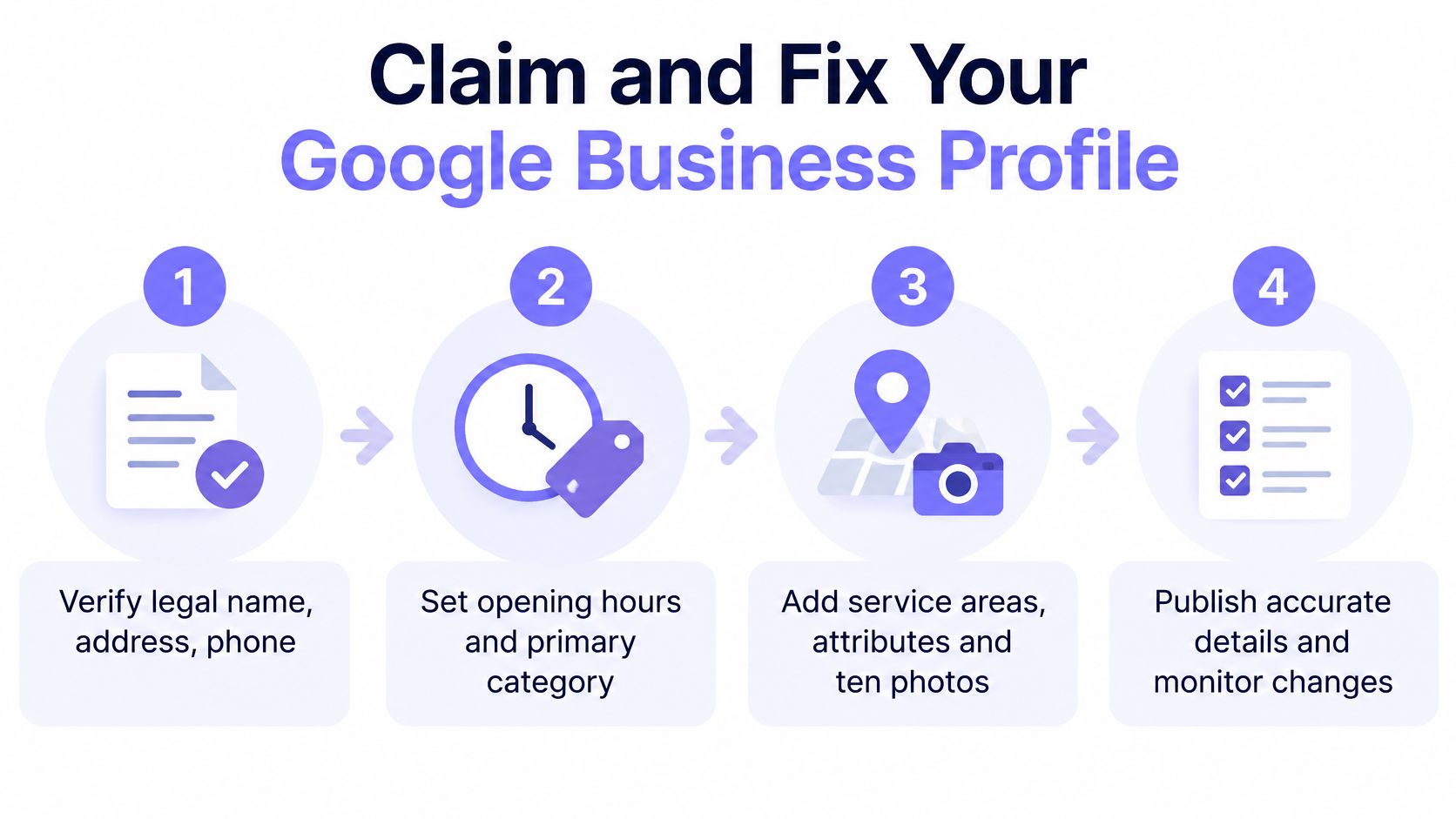
Claim and Fix Your Google Business Profile
Your Business Profile is the page most customers see before your website, so I'd fix it before touching anything else. Audit it field by field rather than rewriting copy: legal name, address, phone, opening hours, primary category, service areas, attributes, photographs and landing-page URL.
The payoff is disproportionate because local intent dominates the query mix. An estimated 46% of Google searches in France have local intent, and around 88% of French consumers research a business on Google before interacting with it, per French local SEO benchmarks.
- Verify legal name, address, phone, hours and primary category against your registration documents. The name on the profile must match the name on the paperwork; adding keywords to it is the fastest way to look untrustworthy and, in some cases, to lose the listing.
- Set every service area and attribute, then upload at least ten recent photos. Photos of the actual workshop, team and finished work outperform stock images because customers use them to judge whether you're real. The field order for photos, services and attributes is covered in this guide to optimising your Google Business listing.
- Point the profile at one landing page for your main service. Sending every click to a homepage that lists nothing specific wastes the visit.
- Resolve duplicate or suspended listings, then normalise the same details on your website and the main French directories. Two listings for one firm split reviews and confuse customers.
- Publish two or three local FAQs. "Do you deliver to Villeurbanne" and "what does a callout cost" are worth more than a paragraph about your values.
- Start the review routine the day the listing is verified. Ask each satisfied customer on the day of the job, in person or by message, with a direct link. Never gate requests by sentiment and never offer anything in exchange.
- Reply to every review within a few days, naming the service and the issue. Customers read the replies as carefully as the reviews themselves. A short answer that acknowledges a missed deadline and explains the fix does more for conversion than a dozen five-star ratings left unanswered.
A virtual-office address, a keyword-stuffed trading name and copied city pages all create the same problem: signals that contradict reality. Before you move on, check that the same five facts (name, address, phone, hours, main service) appear identically on the profile, in your website footer and on two directories.
Technical Checklist Before You Publish More
Publishing more pages onto a site Google can't crawl properly is how small firms waste quarters. Work in a fixed order: blocking indexation errors first, image weight and render-blocking scripts second, content third.
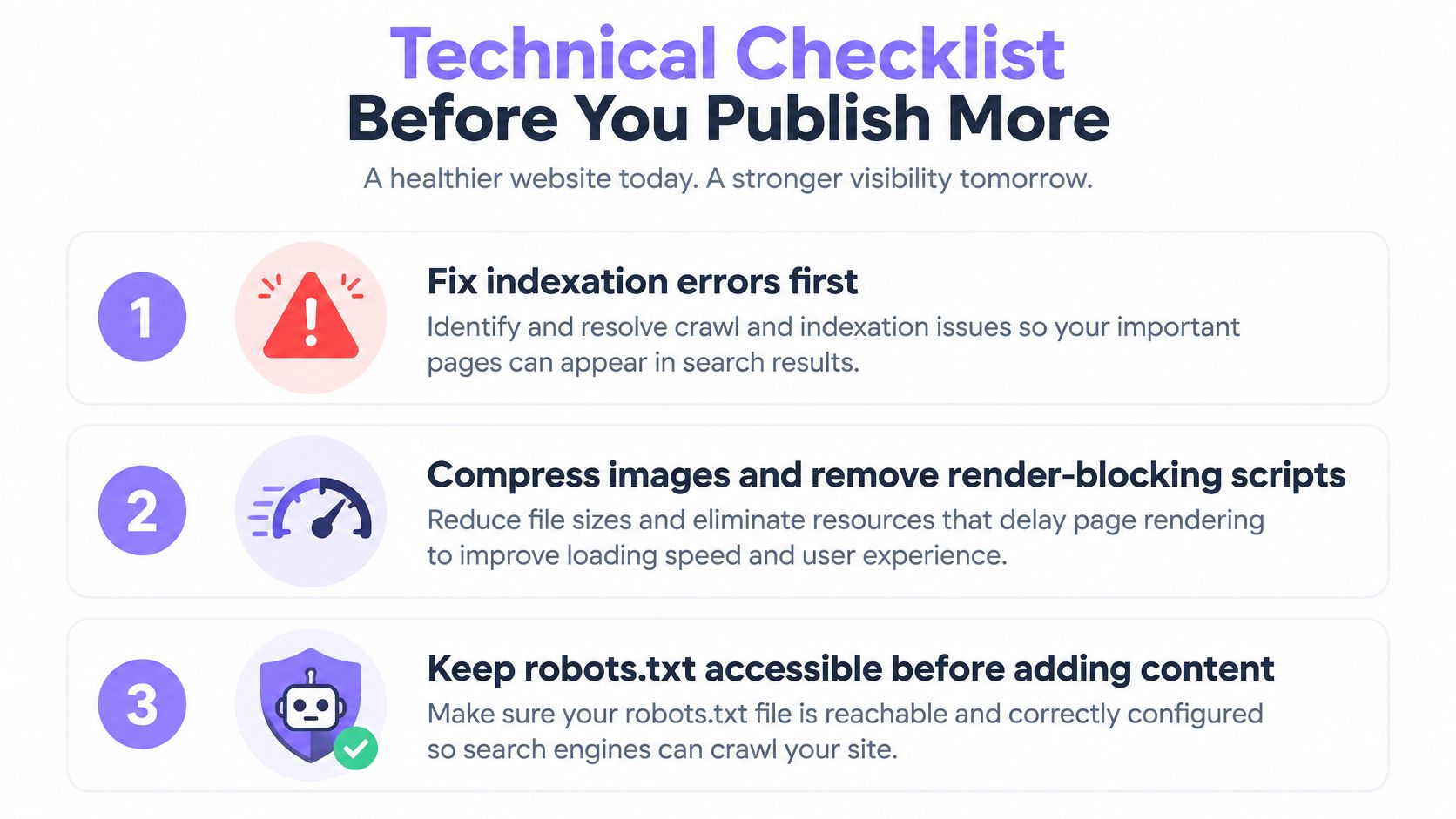
Each check below has a number you can compare against your own site rather than an opinion.
| Check | Target | How to verify |
|---|---|---|
| Largest Contentful Paint (LCP) | At or below 2.5 seconds | Search Console Core Web Vitals or PageSpeed Insights field data |
| Interaction to Next Paint (INP) | At or below 200 milliseconds | Search Console Core Web Vitals or PageSpeed Insights field data |
| Cumulative Layout Shift (CLS) | At or below 0.1 | Search Console Core Web Vitals or PageSpeed Insights field data |
| robots.txt | Commercial pages not blocked | Open yourdomain.com/robots.txt and test the key URLs |
| XML sitemap | Lists every commercial page, no broken URLs | Search Console Sitemaps report |
| Canonical tag | One self-referencing canonical per page | View page source |
| Title and H1 | One unique title and one H1 per page | Page source or a free crawler |
| Structured data | Organization or LocalBusiness on the homepage | Google Rich Results Test |
Two failures account for most of the slow mobile sites I test. A hero photograph of 3 MB is the usual cause of a failed LCP; resize it to the width it renders at, convert it to WebP, and a load that took four seconds often lands under 2.5. A chat widget that loads before your text does the same to INP, so defer it until after interaction or drop it entirely.
The click economics justify the effort. An analysis of 7.6 million French queries found the first five organic results took roughly 70% to 77% of clicks, with organic results capturing about 70% of mobile clicks and 80% of desktop clicks (Netpeak clickthrough study). Ranking in position eight is close to not ranking.
Where small sites break
- Desktop-only testing: your customers are on a mid-range Android phone on mobile data, and that's the device the timings must come from.
- Text hidden behind JavaScript: if the services paragraph only appears after a script runs, assume a search engine may never read it.
- Near-duplicate municipality pages: ten pages differing only by town name read as one thin page repeated.
- Rankings measured without segmentation: branded, non-branded, mobile and location-modified queries tell different stories and shouldn't share a single number.
Structured data belongs here as an addition, not a substitute. Add Organization or LocalBusiness markup once the pages are indexable and the titles are unique, because it clarifies facts you've already stated. For a companion walkthrough, the free SEO tools technical audit process follows the same sequence. Then run a monthly check on indexed valid pages and investigate any new exclusions.
Build Pages That Match How Customers Search
A bakery in Lille sells wedding cakes, sourdough and buffet catering. Its site has one page titled "Bienvenue" and a contact form. Three distinct customers arrive with three different questions, and none of them gets an answer.
The fix isn't a blog. It's three pages. The wedding cake page answers what a tiered cake costs, how far ahead to book and whether delivery to the venue is included. The sourdough page covers opening times, whether loaves are reserved and what happens on public holidays. The catering page covers minimum numbers, lead time and the deposit. Each answers the questions in the order the customer asks them, and the order is rarely the order a business owner wants to talk about the craft.
Start from the questions you already answer
You don't need keyword tools to find them. Read your last twenty customer emails. Open the questions section of your Business Profile. Listen on the phone for a week and write down the exact phrasing, including the anxious version people use when they're comparing three firms.
Then map one question cluster to one page. If two clusters keep landing on the same page, that page is doing too much and should be split. If a cluster has no page, that's your next afternoon's work.
Write the first paragraph for a stranger who has never heard of you. They should know what you do, where you do it and who it's for before they scroll.
A useful FAQ on each page has four to six questions, answered in two or three sentences each, with the price range or the constraint stated plainly. Vague answers ("prices vary depending on requirements") send people back to the search results, where a competitor answers properly.
Avoid the municipality trap. If you serve three towns, one page describing how you serve that area, with local detail such as travel time or a recent project type, earns its place. Fifteen pages with the town name swapped in reads as manipulation and helps nobody.
The time budget is real: one solid service page takes about a day of writing and photo selection, and a small firm can publish two a month without outside help. Six pages over a quarter beats twenty thin ones.
Before publishing, apply one test. Read only the first paragraph out loud. Can a stranger tell what you do, where, and for whom? If not, rewrite that paragraph before you touch anything else on the page.
Measure Visibility Including AI Answers
Rankings flatter. A page can sit in position two for a phrase nobody in your town types, and the owner feels successful while the phone stays silent. Measure actions and accuracy instead, on a monthly cycle short enough to catch drift.

| Metric | What it signals | Review every |
|---|---|---|
| Indexed valid pages | Whether commercial pages can appear in search | Monthly |
| Non-branded impressions | Demand from people who do not already know the business name | Monthly |
| Calls and direction requests | Local actions recorded in the Business Profile | Monthly |
| Qualified organic sessions and phone leads | Visits and calls that match a real service | Monthly |
| AI answer accuracy on ten customer questions | Whether ChatGPT, Perplexity, Gemini and Google name the business, state correct details and cite a real source | Monthly |
The ten question AI check
Write down ten questions a real customer would ask, phrased the way they'd say them: best electrician in Nantes for an emergency at night, who delivers wedding cakes in Lille in June. Ask the same ten to ChatGPT, Perplexity, Gemini and Google's AI surfaces on the first working day of each month. Record three things: whether you're named, whether the details are right, and which sources get cited.
The French evidence explains why this is worth an hour. INSEE reports that only 18% of businesses with at least 10 employees in France used AI in 2025, while 71% of non-users said they saw no use for it and 54% cited insufficient expertise as an obstacle (INSEE). Your customers are ahead of you: ARCEP finds generative AI used by 48% of the French population, up 15 percentage points in one year, with information search the leading use case at 73% of users (ARCEP report).
An assistant repeating an out-of-date address is quoting a source it read, usually a directory you forgot. Accuracy work comes first; visibility work follows. Tools shorten the loop: Wispra measures a business's visibility across Google AI Overviews, Google AI Mode, ChatGPT, Gemini and Perplexity, so the manual ten-question log becomes a tracked series.
That's the same discipline you'd apply to plain search tracking, and the dashboard habit is covered in this walkthrough of building a useful SEO analytics view.
The 90-day freshness rule
Add a second pass to the same monthly hour. Compare name, address, phone, opening hours and main service across the Business Profile, the website footer and two directories, and fix any mismatch that week. If your newest review is older than 90 days, restart the weekly ask with no incentive and no sentiment filter. When an assistant repeats old opening hours, correct the listing or page it cites that day instead of publishing another article.
A bakery whose Sunday hours change in June should expect the wrong hours to circulate for months unless it fixes the exact page an assistant is quoting. No official French benchmark sets a review freshness standard, so 90 days is a working target, not a rule someone handed down.
Your 30, 60 and 90 Day Roadmap
Ninety days is enough to fix the foundation and prove the direction, not enough to dominate a competitive local market. Plan in three blocks with one confirmable milestone each.
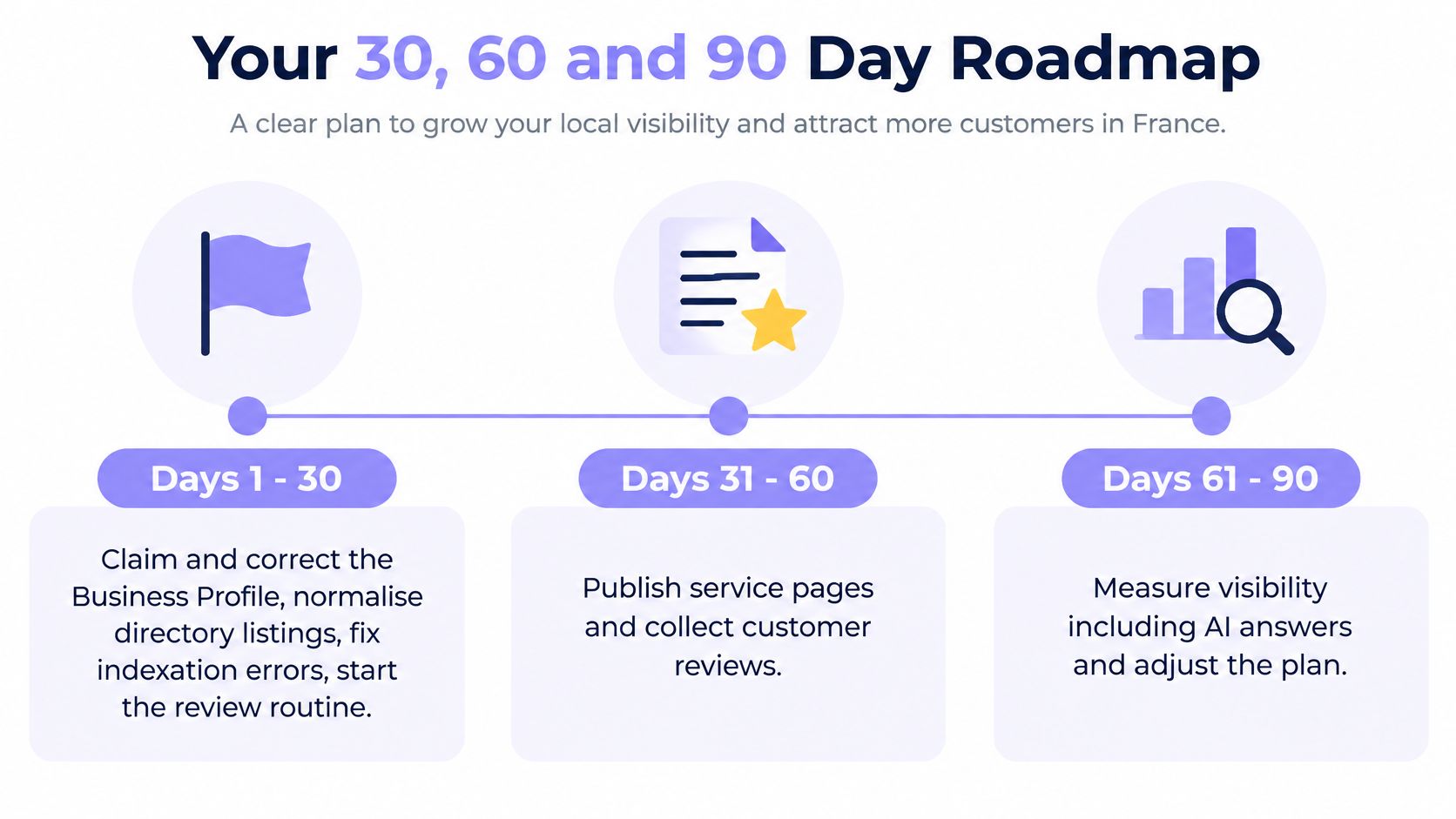
Days 1 to 30, fix what already exists. Claim and correct the Business Profile, normalise name, address and phone across the main directories and your footer, clear the indexation errors in Search Console, and start asking every satisfied customer for a review. Your milestone is unglamorous and verifiable: the same five facts appear identically on the profile, the website and two directories, and review requests are going out weekly.
Days 31 to 60, publish and connect. Write the first two or three service pages, the ones matching the questions your customers ask, and add the FAQ block to each. Run the technical checks from the earlier section against those new pages specifically, because a new template often brings its own image weight and script problems. Milestone: two pages indexed and receiving impressions for non-branded queries.
Days 61 to 90, measure and correct. Work the monthly table: indexed pages, non-branded impressions, calls, direction requests, qualified sessions, and the ten AI questions. Fix the factual errors you find at the source. Then choose one page to expand rather than adding a fourth thin one. Milestone: tracked calls and direction requests exist as a baseline you can compare against next quarter.
If a milestone slips, the cause is almost always one of the earlier checks, not a shortage of content. A page that never gets indexed will never earn a click.
Timelines vary with competition, site history and how much of the foundation was missing, and no honest provider can hand you a date. Wispra doesn't promise how long it takes for a business to be cited by AI engines, and anyone who does is guessing. What you can control is that the facts are right, the pages are crawlable and the monthly check happens.
If you'd rather not run the monthly accuracy check by hand, Wispra publishes your business profile in a format AI engines read and gives you a free report across ten questions from your field, including what ChatGPT, Gemini, Perplexity and Google's AI surfaces currently say about you. It takes about two minutes to set up, needs no changes to your website, and shows you which of the four visibility levers is holding you back before you spend another afternoon on content. Start with the free profile at Wispra and compare the answers against your own ten questions.