The popular advice is to pick one AI platform and let it handle marketing from end to end. That approach usually creates more overlap than efficiency. A CRM may be excellent at customer journeys but weak at AI search visibility, while a content platform may produce strong drafts without helping a local business become a named recommendation in ChatGPT or Perplexity.
The best AI marketing tools solve different jobs. This comparison covers AI visibility, CRM-led marketing, enterprise orchestration, email, SEO, content production, design, social publishing, conversational automation, and EU-focused multi-channel campaigns. The practical question isn't which platform has the longest feature list. It's which tool fits your audience, existing workflow, implementation capacity, review process, and budget model.
France is a useful market in which to test that distinction. AI adoption reached 18% of businesses established in France in 2025, compared with 10% in 2024, while adoption reached 58% among companies with 250 or more employees and 59% in information and communication (Banque de France analysis of AI adoption among French firms). The market is moving quickly, but the right choice still depends on the marketing job.
1. Wispra
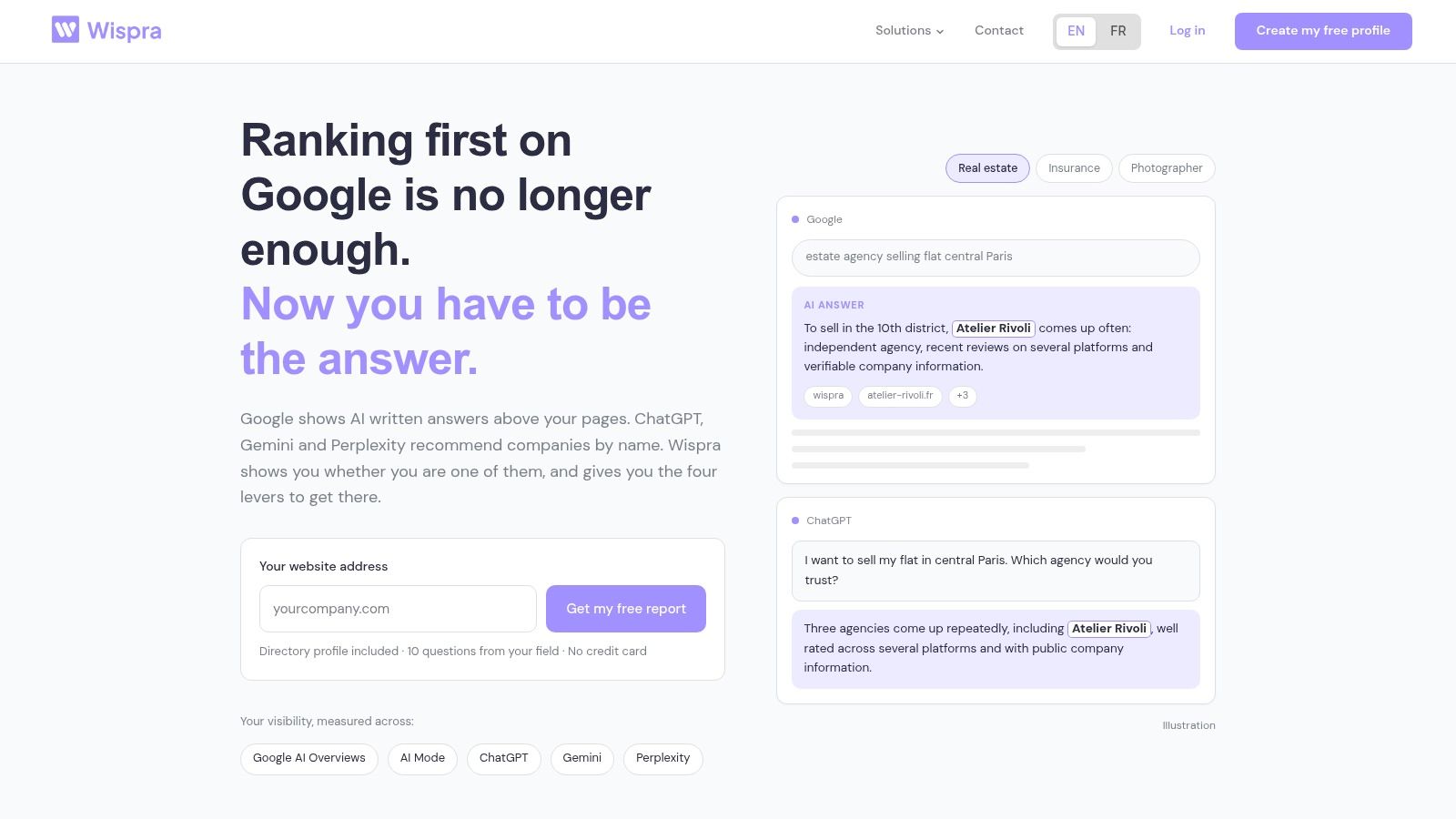
Wispra fits businesses whose immediate problem is AI visibility, not campaign production or CRM automation. It focuses on helping a company become a named recommendation in conversational AI answers when customers ask ChatGPT, Gemini, Perplexity, or Google AI which business to choose. That makes it relevant to French SMBs, local businesses, freelancers, agencies, e-commerce stores, and real estate professionals.
A strong Google ranking does not ensure that an AI engine will mention the same company. Wispra works on the signals generative engines may use to understand and verify a business, including identity, authority, reputation, and expertise. The platform creates a public, AI-readable business profile, consolidates review evidence, publishes structured material such as blogs and FAQs, and monitors visibility across real industry questions.
Where Wispra fits
Wispra suits teams that want to test AI visibility before changing their website or adding another major marketing system. Create a free directory profile, review visibility across relevant questions, then decide whether ongoing publishing and monitoring justify the cost. Setup takes about 2 minutes, requires no website changes, and the Performance plan costs €24 per month excluding VAT, with no commitment, according to Wispra's platform and pricing information.
The strongest use case is a business that depends on local trust and accurate public information. Connections to official French company registry data support verified identity, while public profiles and dated testimonials provide evidence that customers and AI systems can inspect. E-commerce businesses can connect catalogues from Shopify, WooCommerce, and PrestaShop, making product information easier for AI systems to interpret.
Practical rule: Use Wispra as a visibility layer alongside SEO. Keep your website, search strategy, review process, and conversion path in place.
Wispra cannot guarantee a recommendation. Generative answers vary by engine and query, and the platform does not control final citations. Its current focus is France-first, so businesses operating elsewhere should confirm that the available identity and data integrations match their market.
2. HubSpot AI
HubSpot AI, including Breeze and the AI Assistant, works best when your marketing team already wants the CRM to be the operational centre of campaigns. Instead of moving customer data into a separate AI writing tool, marketers can use AI inside the same environment as contacts, forms, landing pages, sales activity, service records, and campaign reporting.
That integration matters for SMB and mid-market teams. A marketer can draft email copy, generate blog outlines, create social posts, examine campaign context, and build workflows without switching between disconnected systems. HubSpot also positions AI across Marketing Hub, Sales Hub, Service Hub, and the wider CRM, which can reduce tool sprawl when the organisation is committed to the platform (HubSpot AI).
The workflow trade-off
HubSpot is a strong choice if your next marketing bottleneck is lead management, nurture, or alignment between marketing and sales. It's less compelling if your immediate problem is specialist SEO research, creative production, or AI search visibility. Those jobs may still require dedicated platforms.
The main implementation effort isn't activating an AI button. It's cleaning lifecycle stages, contact properties, consent records, attribution rules, and workflow logic. AI suggestions based on inconsistent CRM data won't rescue a poorly governed process. Teams should also understand how HubSpot Credits and feature packaging apply to their account before committing to an operating model.
For French organisations, governance deserves attention. A Banque de France survey found that 74% of AI adopters used AI mainly for support functions such as marketing, administration, finance, accounting, or HR, while 85% relied on general-purpose text generators (Banque de France survey summary). That makes review permissions, data handling, and approval steps practical requirements, not abstract compliance concerns.
For a broader operational perspective, see how to establish an AI strategy for brand visibility.
3. Salesforce Marketing Cloud with Einstein
Salesforce Marketing Cloud with Einstein is built for organisations whose marketing operation involves complex data, multiple channels, and advanced customer journeys. It suits enterprise teams that need to coordinate email, mobile, advertising, segmentation, personalisation, and analytics across a wider Salesforce environment.
Einstein supports engagement scoring, send-time optimisation, content and subject-line recommendations, and predictive insights. Marketing Cloud's advantage isn't that every marketer needs another writing assistant. Its advantage is the connection between customer records, journey orchestration, and downstream business activity. A large organisation can define audience logic, coordinate touchpoints, and apply governance across a complex operating model through one enterprise ecosystem (Salesforce Marketing Cloud).
Who should avoid it
Smaller teams often underestimate the administration required. Salesforce can be powerful, but data architecture, permissions, object relationships, consent management, integrations, and journey design need experienced owners. A marketing manager looking for faster campaign copy will likely find the platform too heavy.
Einstein features may also depend on the relevant edition, add-ons, or usage credits. Buyers should map the exact workflow they want to improve before comparing licences. “AI included” can mean different things across products and editions, so a product demonstration isn't enough. Ask to see the complete path from data ingestion to audience selection, content generation, approval, activation, and reporting.
Salesforce is the best fit here when enterprise orchestration is the marketing job. It isn't the best tool for a local business trying to strengthen its presence in AI recommendations, nor for a small e-commerce team that needs a quick email campaign and a product-focused template library.
4. Intuit Mailchimp
Mailchimp remains a practical entry point for teams whose central job is email marketing without a full enterprise CRM implementation. Intuit Assist can help draft copy, suggest subject lines, support optimisation, and provide next-step recommendations. Analytics AI adds conversational exploration for teams that want to ask questions about campaign performance rather than build every report manually (Mailchimp).
The platform fits SMBs, smaller e-commerce teams, newsletters, and organisations with established templates and integrations. Its value comes from speed. A marketer can start with an existing campaign structure, adapt the message for a segment, review the output, and send through the same system used for list management and automation.
What works in practice
Mailchimp makes sense when your team already has clean audiences and a straightforward communication calendar. It's less suitable when you need connected sales attribution, highly complex journeys, or specialist AI visibility measurement. In those cases, HubSpot, Salesforce, or a dedicated visibility and SEO platform may fit better.
The pricing model needs careful attention. Free-plan limits were reduced in 2026, meaning many active teams will need a paid plan, and contact-based or send-based tiers can become more expensive as the database grows. Check the current allowance against your list, sending frequency, seats, automation requirements, and AI access before treating the entry price as the likely cost.
Human review remains important, particularly for French-language campaigns, regulated subjects, and promotions with legal conditions. French marketer usage data shows that 54% used AI for translation, 47% for visual-content adaptation, and 32% for marketing campaign creation in the cited Trends of AI study (KPMG-related French Trends of AI reporting). Mailchimp can accelerate production, but it doesn't remove responsibility for accuracy, tone, consent, or deliverability.
5. Semrush
Semrush is the strongest choice on this list for teams that need to connect traditional SEO, content production, and AI search visibility. It combines keyword research, competitor analysis, site audits, content briefs, AI-assisted writing, optimisation, and visibility tracking for AI search environments.
That combination is important because marketers now have two related but distinct discovery problems. Search engines still reward useful, technically accessible content, while conversational systems may summarise, compare, and recommend businesses using a wider set of signals. Semrush can help teams understand the search demand and competitive environment, then improve the content that supports both conventional search and AI-readable answers (Semrush).
Where it earns its place
Use Semrush when your marketing job begins with a question such as: Which topics should we own? Which competitors are visible? What does the current result set reward? How can we improve this page, brief, or content cluster? Its Content Toolkit and SEO Writing Assistant are more useful than a generic AI writer because the workflow starts with search data and editorial intent.
The limitation is complexity. Semrush has broad coverage, and current plan names and feature access have changed, so buyers should compare the exact Content and Semrush One tiers they need. Some AI visibility capabilities may sit behind specific packages. Teams should also avoid paying twice for overlapping SEO platforms unless each has a clearly different role.
Semrush won't replace a governance process, a subject-matter expert, or a dedicated AI visibility platform for businesses that need public proof, verified identity, and review consolidation. For a focused comparison of search and generative optimisation workflows, see AI SEO tools for SEO and GEO. Teams that convert search visitors through email should also consider a speed-to-lead email assistant.
6. Jasper
Jasper is designed for teams that need a brand-aware content co-pilot rather than a blank chat window. It supports campaign concepts, product pages, ads, emails, and other marketing formats while giving administrators tools for brand voice, style guidance, team workspaces, and controlled workflows (Jasper).
The best use case is a marketing department, agency, or e-commerce team with repeatable content needs across channels. Jasper becomes more valuable when several people create copy and the organisation needs consistent terminology, tone, positioning, and approval standards. A documented brand voice gives the system useful boundaries. Without one, the platform can produce polished but generic language that still needs extensive editing.
A better way to deploy it
Start with one campaign family, such as product pages and supporting paid-social copy. Feed the workflow approved product facts, audience definitions, prohibited claims, examples of strong copy, and the desired review owner. Compare the time and quality of that workflow with your current process before expanding to blogs, landing pages, and lifecycle messaging.
Jasper's hybrid model creates a budgeting trade-off. Core writing may be available under an unlimited model, while higher-value features use credits. That can make forecasting harder when several teams run agents or generate large campaign batches. Advanced and enterprise requirements may also involve a sales-led process, which makes a trial more important than a feature checklist.
Jasper is not a substitute for subject-matter expertise. It can structure a draft and generate variations, but specialists still need to check technical claims, pricing, product details, legal language, and cultural nuance. For French teams, that last review is especially important when translating campaigns rather than adapting them for French audiences.
7. Canva Magic Studio
Canva Magic Studio solves a different problem: turning a marketing idea into usable visual assets quickly. Magic Write supports copy, while Magic Design helps create layouts. Background removal, resizing, brand kits, templates, and editor-based AI tools let non-designers produce social posts, flyers, ads, short videos, and campaign variations without moving between multiple applications (Canva Magic Studio).
The platform is particularly effective for a small business owner or marketing manager who has a complete social calendar but limited design capacity. A single approved message can become a square social post, a story format, an advert, and a printable asset. That practical speed is often more valuable than an advanced generation feature that requires a separate specialist workflow.
The quality boundary
Canva works best when the team supplies the strategic ingredients. Define the offer, audience, proof, call to action, brand colours, type hierarchy, image rules, and required formats first. Let the tool accelerate layout and adaptation, then have a person check visual hierarchy, accessibility, spelling, claims, and whether the design still looks credible at the final size.
Lower tiers may impose AI allowances or usage limits, while the full Magic Studio feature set requires Pro or Teams plans. Check these limits if your team intends to generate many variations or manage several brands.
Canva also shouldn't be mistaken for a content strategy. It helps you produce and adapt assets, but it won't decide whether a campaign supports your positioning or whether the underlying facts are strong enough for AI search engines to cite. For practical brand messaging work, use it alongside a structured visibility and content process, such as this guide to creating a striking brand with an AI slogan generator.
8. Hootsuite with OwlyWriter
Hootsuite with OwlyWriter, also referred to as OwlyGPT in some product contexts, is for teams managing social publishing with governance, collaboration, and reporting. It can generate caption and content ideas, support hashtags, schedule posts across networks, and analyse performance within the publishing workflow (Hootsuite).
That workflow matters for agencies, multi-location brands, and organisations where several people need to draft, review, approve, and publish. Keeping AI assistance inside the social management environment reduces copy-and-paste errors and makes ownership clearer. A social manager can adapt a post for Facebook, Instagram, TikTok, LinkedIn, YouTube, Threads, or Pinterest, then route it through the appropriate approval process.
Governance before automation
Hootsuite is strongest when consistency and accountability matter more than raw content generation. Create separate rules for evergreen posts, regulated claims, customer replies, crisis topics, and promotional campaigns. AI can offer a starting point, but human reviewers should decide whether the message is appropriate for the platform and moment.
The trade-off is cost. Pricing rises with users and advanced capabilities, and the full AI experience requires paid tiers. Smaller teams posting occasionally may get more value from Canva plus a native platform scheduler. Hootsuite becomes easier to justify when the organisation needs shared calendars, multiple accounts, permissions, monitoring, and repeatable reporting.
Don't expect social scheduling to automatically improve AI search visibility. Social content can support brand recognition and public consistency, but a recommendation engine may still need clearer business facts, authoritative references, reviews, and structured expertise. Hootsuite handles the publishing operation. It doesn't provide the complete evidence layer for generative discovery.
9. Manychat
Manychat is built around a high-intent marketing job: turning social interactions into conversations, leads, and follow-up actions. It supports comment-to-DM flows, keywords, lead capture, and AI-assisted replies for Instagram, Facebook, and WhatsApp. That makes it a natural fit for creators, local services, social-first SMBs, and e-commerce brands that receive enquiries through messaging rather than forms (Manychat).
The strongest workflows start with a clear trigger. A user comments on a post asking for availability, sends a keyword for a guide, or replies to a product announcement. Manychat can route the interaction, ask qualifying questions, deliver a resource, and pass the contact to a human or another system. Teams can launch these flows without code, but they still need a careful conversation map.
The operational risk
Automation fails when it answers beyond its authority. Define which questions the flow can handle, which facts require a live source, and when a person must take over. Include clear escalation paths for complaints, refunds, personal data requests, and unusual product or service questions.
WhatsApp introduces a separate commercial consideration. Usage-based conversation and notification fees apply, and WhatsApp or SMS activity can create additional billing beyond the core plan. Manychat's 2026 pricing changes also make it important to model the cost of your actual message volume rather than relying on a headline subscription price.
Manychat can support discoverability indirectly by capturing questions that reveal what customers want to know. Those questions can inform FAQs, product content, and service pages. It won't, by itself, make a business more likely to appear in ChatGPT or Perplexity recommendations. Its role is conversation conversion, not full-funnel AI visibility.
10. Brevo with Aura AI
Brevo is a practical choice for French SMBs that want email, SMS, WhatsApp, push messaging, automation, and CRM functions in an EU-focused environment. Its Aura AI assistant supports email content generation and campaign optimisation, while the broader platform helps teams coordinate several communication channels from one account (Brevo).
The platform fits local businesses, e-commerce teams, and growing companies that need more than a newsletter tool but don't want to begin with enterprise marketing infrastructure. A marketer can build an email campaign, create follow-up automation, send an SMS reminder, and connect the activity to a contact record without assembling a large stack.
Why French teams should look closely
Brevo's Paris origins and EU focus can make procurement and support discussions more straightforward for businesses that prioritise European operations. That doesn't mean compliance is automatic. You still need to review data processing terms, consent collection, retention, access controls, and the specific AI features your team will activate.
Plan customisation is the main limitation. Some AI capabilities and higher-volume campaign requirements may need add-ons or custom pricing. Teams should therefore estimate contacts, sends, channels, automation branches, seats, and branding requirements before choosing a plan. A simple email use case may be approachable, while a high-volume multi-channel programme can require a more detailed commercial review.
Brevo is a better fit than a specialist AI visibility tool when the immediate bottleneck is campaign execution. It becomes complementary to Wispra when the business also needs to be understood and recommended by conversational engines. Email can nurture the customer after discovery, but it doesn't determine every source an AI system uses for its recommendation.
Top 10 AI Marketing Tools, Feature Comparison
| Product | Core features (✨) | UX & Quality (★) | Price / Value (💰) | Target audience (👥) | Unique edge (✨) |
|---|---|---|---|---|---|
| 🏆 Wispra | AI‑ready business directory, automated content engine, reviews consolidation, AI tracking pixel | ★★★★☆, 2‑min setup, measurable visibility in ~30 days | 💰 Free forever (profile + report); Performance €24/mo (excl. VAT) | 👥 SMBs, local businesses, freelancers, agencies, e‑commerce (France‑first) | ✨ GEO pioneer; public verifiable profiles; no website changes |
| HubSpot AI (Breeze, AI Assistant) | Embedded AI across CRM, content gen, campaign assistants, 100+ AI features | ★★★★☆, native CRM UX, broad automation | 💰 Tiered pricing; credits for select features, can be complex | 👥 SMBs & mid‑market marketing/sales teams | ✨ Deep CRM integration; unified customer context |
| Salesforce Marketing Cloud (Einstein) | Einstein personalization, journey orchestration, predictive analytics | ★★★★, enterprise‑grade, requires config/admin | 💰 High enterprise pricing; add‑ons/credits for advanced AI | 👥 Large enterprises, complex multi‑cloud setups | ✨ Robust data governance and scale |
| Intuit Mailchimp (Intuit Assist) | AI copy, subject lines, predictive segments, conversational analytics | ★★★★, quick to deploy, strong templates | 💰 Freemium limited; paid tiers scale by contacts/sends | 👥 SMBs, e‑commerce teams wanting fast email workflows | ✨ Fast templates + integrated AI on paid tiers |
| Semrush (SEO + AI Visibility) | Content Toolkit, SEO Writing Assistant, AI visibility tracking | ★★★★☆, data‑driven content UX, SEO focus | 💰 Subscription tiers; some features gated by plan | 👥 SEO/content teams, growth marketers | ✨ SEO + AI visibility tracking across generative engines |
| Jasper (AI co‑pilot) | Brand voice guides, AI agent builder, team workspaces, hybrid credits | ★★★★, strong brand consistency & collaboration | 💰 Tiered + usage credits for high‑value features | 👥 Agencies, e‑commerce brands, content teams | ✨ On‑brand scale + no‑code agent builder |
| Canva Magic Studio | Magic Write, Magic Design, templates, brand kit, editor AI | ★★★★☆, very fast, editor‑first UX | 💰 Freemium; Pro/Teams for full Magic Studio | 👥 SMBs, social managers, non‑designers | ✨ Fast template‑driven design to publish |
| Hootsuite (OwlyWriter / OwlyGPT) | AI captioning/ideas, unified scheduling, performance analytics | ★★★, mature publishing workflow, collaboration tools | 💰 Paid tiers; pricing rises with users/features | 👥 Agencies, multi‑location brands, social teams | ✨ Governance & collaboration at scale |
| Manychat | Meta‑approved automation, flows, AI replies, WhatsApp support | ★★★, strong DM automation UX for socials | 💰 Usage fees for WhatsApp/SMS; 2026 pricing changes noted | 👥 Social‑first SMBs, creators, local services | ✨ Instagram DM & conversation lead capture focus |
| Brevo (ex‑Sendinblue) | Aura AI, multi‑channel automation (email/SMS/WhatsApp), CRM | ★★★★, EU‑centric UX, simple campaign setup | 💰 Approachable EU pricing; add‑ons for advanced features | 👥 French/EU SMBs and local businesses | ✨ EU support, multi‑channel basics with Aura AI |
Choose the Tool That Matches Your Next Workflow
The best AI marketing tools aren't interchangeable. Wispra is the focused choice for AI visibility and GEO, especially when a French business wants its identity, reputation, authority, and expertise to become easier for conversational engines to verify. HubSpot suits a CRM-led operation that wants marketing, sales, service, content, and automation connected. Salesforce Marketing Cloud with Einstein is the enterprise option when customer data, journey complexity, and governance justify specialist administration.
For accessible campaign execution, choose Mailchimp when email is the centre of the workflow and Brevo when you want EU-focused support across email, SMS, WhatsApp, push, and CRM functions. Choose Semrush when SEO, content planning, competitor analysis, and AI search visibility need to sit together. Jasper is better for brand-controlled content production, particularly across campaigns and product-led workflows. Canva is the practical answer for fast creative production by non-designers.
Social and conversational work need their own decisions. Hootsuite fits governed social publishing across teams, locations, or clients. Manychat is the better choice when comments, DMs, Instagram, Facebook, and WhatsApp are where prospects begin the buying conversation.
French adoption data reinforces why teams should evaluate workflow fit rather than AI novelty. In 2024, 10% of French companies used at least one AI technology, and more than a quarter of AI-using companies applied it to marketing or sales; adoption reached 33% among companies with 250 or more employees, while commercial software was the main procurement channel for seven in ten AI adopters (France AI marketing adoption data). Larger SMBs, multi-site operators, and e-commerce businesses already comfortable buying packaged software are likely to have the clearest starting point.
A sensible evaluation process
Test one core workflow first. Don't launch every feature at once. Choose a task such as measuring AI recommendations, building a lead-nurture sequence, producing a product campaign, scheduling social content, or answering Instagram enquiries.
Define one measurable outcome before the trial begins:
- Visibility: Track whether your business appears for relevant conversational questions.
- Efficiency: Record the human time required to produce, review, and publish an asset.
- Pipeline: Measure qualified enquiries, booked conversations, or assisted conversions.
- Quality: Review factual accuracy, French-language quality, brand consistency, and escalation failures.
Check usage limits, credits, integrations, seats, export options, data processing terms, and renewal conditions. Assign a human owner for review before AI-generated work reaches customers. A French-focused GenAI marketing study reported that 79% of French marketing specialists said GenAI saved at least four hours per week, while 95% reported moderate-to-total supervision of AI-generated output (France-focused GenAI marketing study). The useful lesson isn't that every team will achieve the same time saving. It's that speed only works when someone remains accountable for the result.
For small businesses, the best starting stack is often narrow. Pick the platform that fixes the most expensive bottleneck, connect it to the tools you already use, document the review process, and expand only after the first workflow produces evidence. A focused combination of AI visibility, campaign execution, and human-led quality control will usually outperform a crowded collection of disconnected assistants.
Read this best AI marketing tools 2026 guide as a further comparison point, then make your own decision based on the work your team must complete next, not on the number of AI features listed on a pricing page.
Wispra helps French businesses improve their presence in ChatGPT, Gemini, Perplexity, and Google AI through an AI-ready profile, structured content, review evidence, and visibility tracking. Create your profile in about two minutes, review your visibility report, and visit Wispra to start building a more verifiable path to AI recommendations.