A customer in Lyon asks ChatGPT, “Which nearby accountant understands freelancers and French tax requirements?” Another person in Bordeaux asks Google for the best local electrician. Instead of opening ten blue links, both receive a short recommendation with sources.
For a small business, the critical question is no longer only, “Do we rank?” It's also, “Does an answer engine understand, trust, and mention us?” That's the practical purpose of answer engine optimization, or AEO.
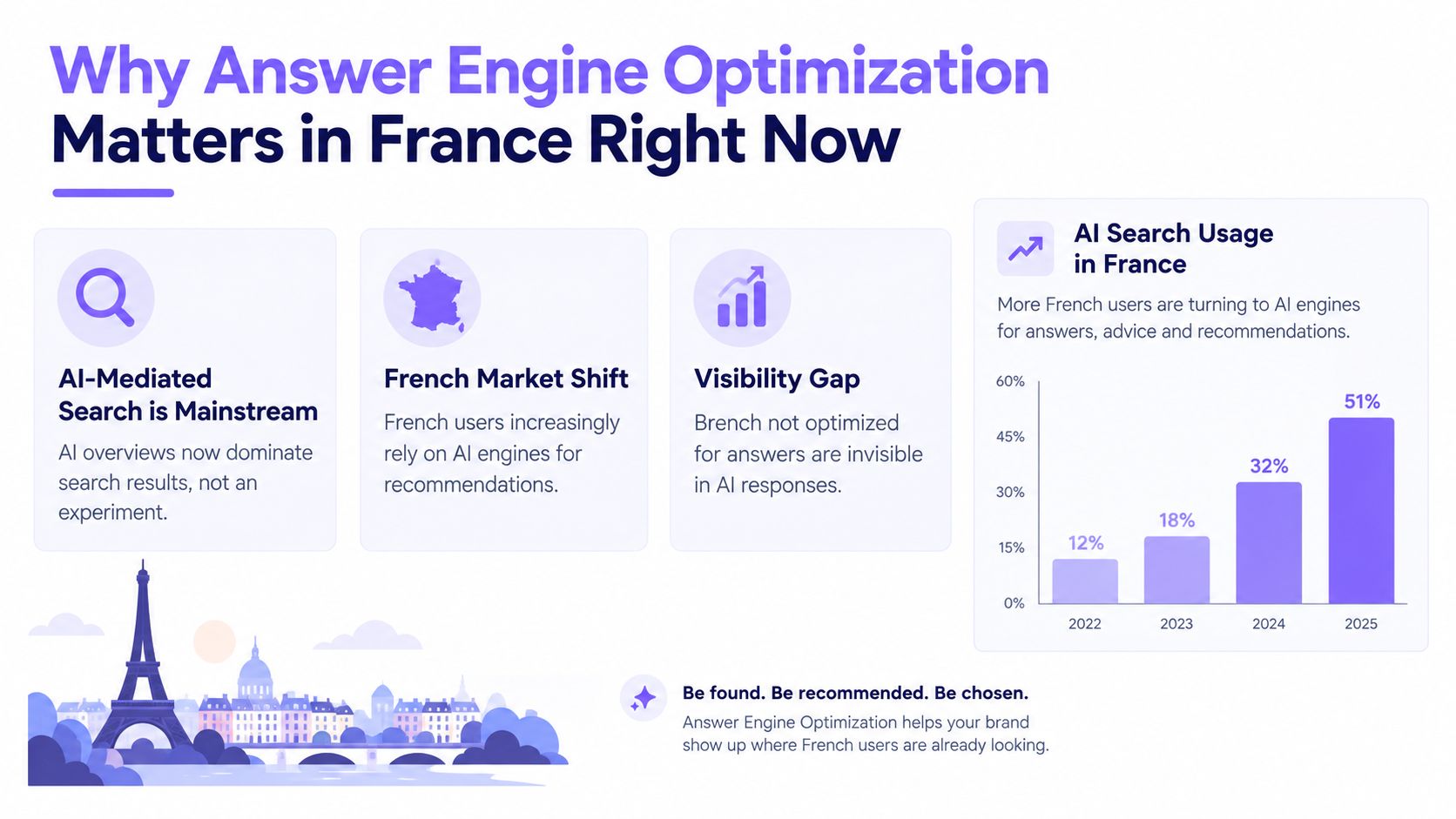
The shift is already visible in France. An independent SE Ranking study of French AI Overviews analysed 100,000 French keywords across 20 niches and found AI Overviews on 52.63% of searches, meaning 52,628 keywords triggered an AI Overview. AI-mediated answers aren't an unusual experiment in that dataset. They appear across a broad sample of everyday searches.
This guide turns that finding into a usable playbook. You'll learn how AEO differs from SEO, why French wording and local trust signals matter, how answer engines select sources, and how a small business can measure visibility without abandoning traditional search.
Introduction Why Answers Now Beat Rankings
Traditional search gives the customer a list. Answer engines increasingly give the customer a shortlist, an explanation, or a recommendation.
That changes the moment of discovery. If someone searches for “best coworking space for a remote worker in Nantes”, a conventional result page asks them to compare pages, prices, reviews, and locations. A conversational engine may summarise the options and identify a few businesses directly. If your company isn't included, a strong organic ranking may never enter the conversation.
For a local business, being cited can matter more than being merely listed. A citation places your business inside the answer the customer is already reading. It can introduce your name alongside your services, location, specialisms, and reasons to choose you.
Practical rule: Optimise for the decision your customer wants to make, not just the phrase they type.
Consider a French independent web designer. A page that says “creative digital solutions” gives an answer engine little concrete information to use. A page that clearly states “web design for French restaurants in Montpellier, including bilingual menus and online booking integration” is easier to interpret. It connects the business to a service, audience, location, and need.
AEO doesn't make SEO irrelevant. Organic search remains a major discovery channel in France, and businesses still need crawlable websites, useful pages, relevant content, and credible links. But answer layers add another route to visibility, especially when customers ask complete questions rather than entering short keywords.
The opportunity is practical. A small business can make its information clearer, create pages around real customer questions, strengthen French and local signals, and test whether AI systems mention it. The work begins with understanding what answer engines are trying to do differently.
What Answer Engine Optimization Really Means
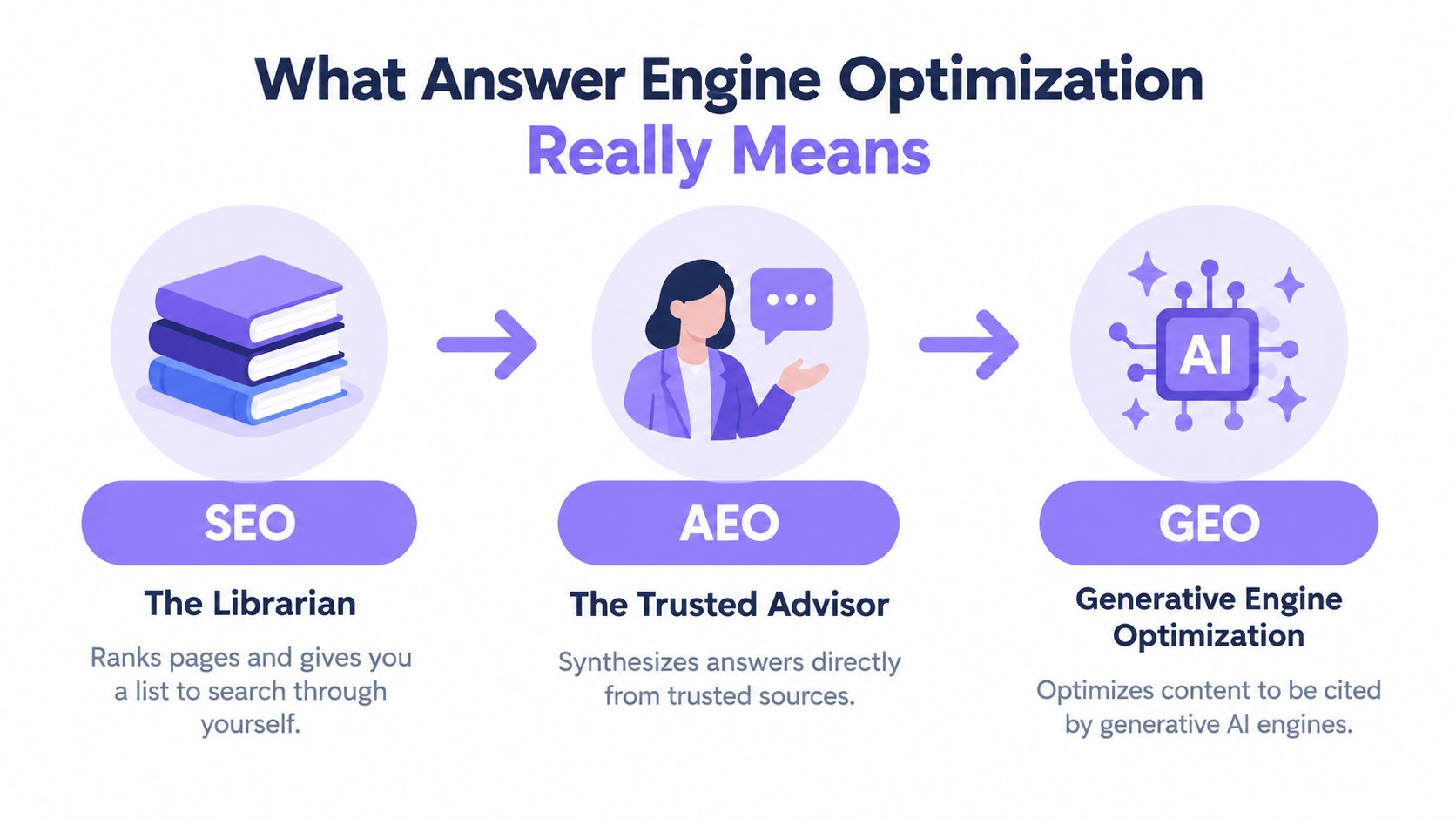
A useful way to understand AEO is to compare search with a library.
Traditional SEO helps the librarian organise the shelves. Your page needs a clear subject, a recognisable title, good references, and a reliable structure so the librarian can place it where readers will find it. The customer still walks through the results and decides which source to open.
An answer engine behaves more like a trusted adviser. It reads several sources, connects relevant details, and presents a response in natural language. The customer may see citations, but the initial work of comparing and summarising has already happened.
Answer engine optimization is the practice of making content easy for AI-powered platforms to retrieve, understand, trust, and cite. That usually means writing direct answers, separating ideas into clear sections, using consistent business facts, and showing why the source deserves confidence.
SEO, AEO, and GEO in practical terms
These terms overlap, which causes unnecessary confusion.
- SEO focuses primarily on visibility in conventional search results. It supports rankings, clicks, crawlability, technical accessibility, and organic discovery.
- AEO focuses on the answer layer. The target is inclusion or citation when an engine generates a response to a question.
- Generative engine optimization, or GEO, is the broader discipline of improving visibility across generative AI experiences. AEO is one important part of that wider practice.
A French estate agent illustrates the distinction. SEO may help a page rank for “agence immobilière Toulouse”. AEO asks whether the page clearly answers questions such as “Which estate agents in Toulouse specialise in first-time buyers?” GEO extends the view across different generative platforms and recommendation journeys.
The practical change is the unit you optimise. SEO often evaluates a page. AEO also evaluates the individual facts inside that page. Can an engine identify your service area? Can it tell which customers you serve? Can it extract a concise answer without guessing?
The simplest definition: AEO is making your business the source an AI trusts enough to quote.
That requires more than adding “AI” to existing copy. Your content must be specific, logically organised, and consistent with the information customers find elsewhere.
Why Answer Engine Optimization Matters in France Right Now
France presents a mixed picture, and that's precisely why businesses should act thoughtfully rather than replace SEO overnight.
On one side, AI-generated search visibility has already reached majority-scale in the French keyword dataset mentioned earlier. On the other, AI referral traffic remains much smaller than classic organic search. SE Ranking's France traffic report records AI traffic rising 29% year over year, from 0.20% of internet traffic in 2025 to 0.26% in the first four months of 2026. The same report places organic search at 56.40% of total internet traffic over the full period and 52.76% in 2026.
That gap tells small business owners how to prioritise. Keep investing in conventional organic search, while building the foundations for AI discovery. France is still heavily dependent on search, but the way search presents information is changing.
Adoption is broad, but behaviour is uneven
French users don't all discover businesses through the same interface. Arcom reported 33 million single visitors to AI services in March 2026, representing 57.1% of the French population, according to the France AI search market overview. The same overview cites a survey in which 98% still used classic search engines, while 59% used generative AI for search, rising to 79% among under-35s.
These figures point to a segmented market. A local tradesperson may still win most enquiries through Google Maps and organic pages. A younger customer comparing skincare brands, travel options, or freelance services may ask a conversational system first. AEO therefore works best as an additional layer matched to discovery intent.
For French SMBs, the early work is straightforward:
- Protect existing search visibility: Keep service pages, location pages, technical SEO, and business profiles accurate.
- Answer real questions: Add content that addresses comparisons, suitability, process, pricing context, and local needs.
- Build French relevance: Use native French wording, local terminology, and references that make sense to customers in France.
A useful French Google AI search strategy should reflect this reality. Businesses don't need to choose between rankings and answers. They need content that supports both, while recognising that different audiences and platforms may surface different sources.
How Answer Engines Decide What to Cite
Answer engines don't select sources because a page repeats a keyword often. They need to identify a reliable answer, understand its context, and connect it to the user's question.
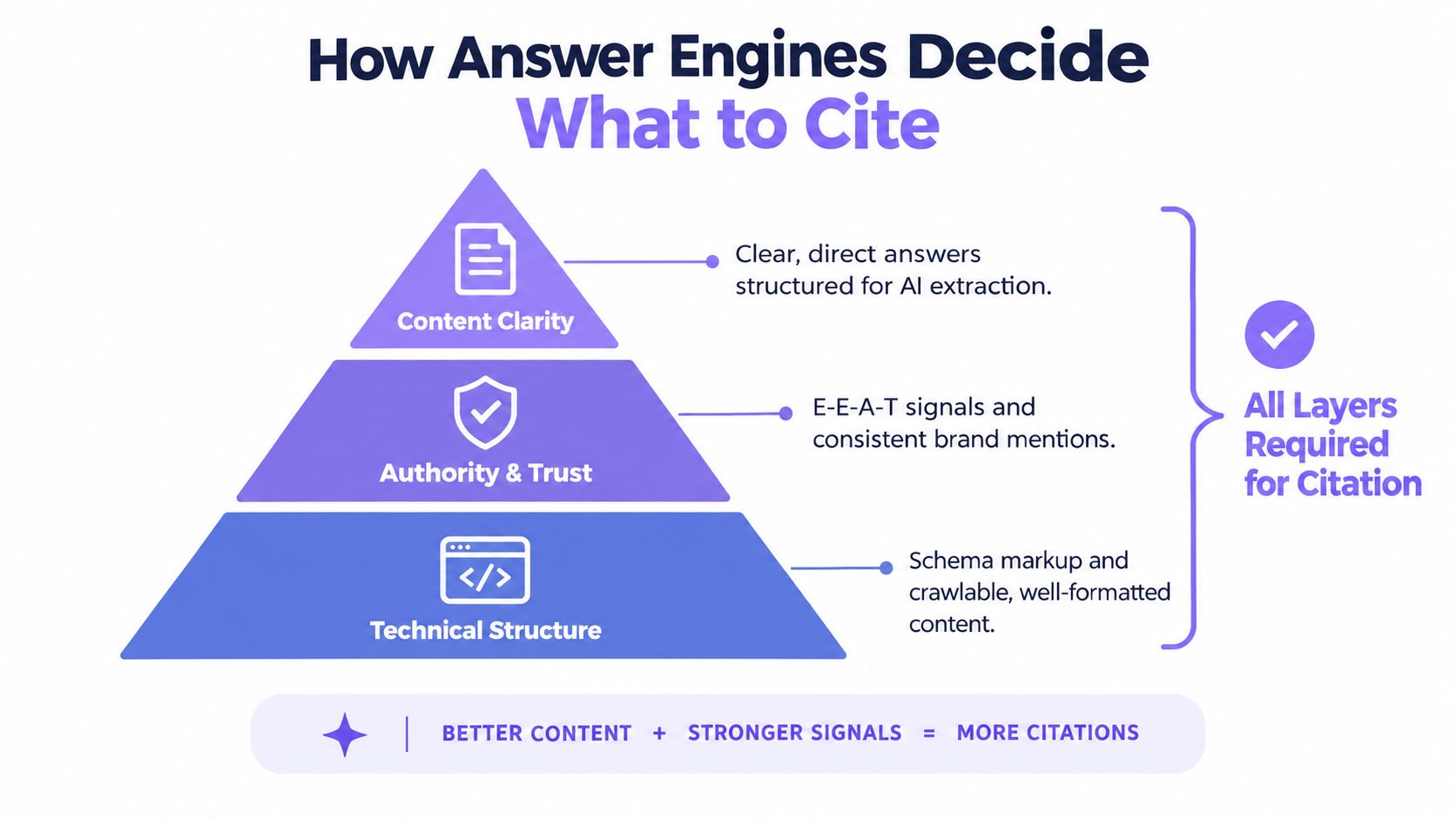
A practical citation model has four layers.
Content clarity
The first layer is extractability. Put the direct answer near the beginning of a relevant section, then add explanation and examples. Use headings that match customer questions, such as “Which accounting services do we provide to French freelancers?” rather than vague headings like “Our expertise”.
Short answer blocks, lists, tables, and descriptive headings help an engine separate one idea from another. Each section should make sense if it's read without the paragraphs around it.
Authority and trust
The next layer concerns the identity behind the information. A business should describe its services consistently across its website, professional profiles, directories, reviews, and relevant third-party pages. Author names, qualifications, clear contact details, service areas, and evidence of experience all help establish context.
This doesn't mean adding impressive-sounding claims. It means giving systems fewer reasons to doubt what they find. A Paris physiotherapist should use the same business name, address, specialisms, and treatment terminology wherever those details appear.
For a deeper operational perspective, the invisible vendor playbook offers a useful way to think about how brands can build presence beyond visible search rankings.
Freshness and factual consistency
Outdated opening hours, discontinued services, old product descriptions, and conflicting addresses weaken trust. Review important pages whenever the business changes, then check prominent external profiles for the same update.
Freshness isn't just a publishing schedule. It's the discipline of keeping the facts an answer engine might repeat accurate and current.
Local and language fit
French queries tend to favour French sources. Weglot's analysis of language and country effects in AI citations found that 89.34% of cited sources for French queries were in French. It also found that French-language queries sent 16% of citations to .fr domains, compared with 1.4% for English queries, while French government domains rose from near-zero in English to 1.25% in French.
That's why native French copy matters. Direct translations can sound unnatural, miss local terminology, or describe a service in a way French customers wouldn't use.
For additional context on how AI systems interpret websites, see how AI understands your website.
Answer Engine Optimization Versus Traditional SEO
AEO and SEO share the same foundation, but they answer different visibility questions. SEO asks whether your page can earn a place in search results. AEO asks whether an AI system can confidently use your information in a generated response.
| Dimension | Traditional SEO | Answer Engine Optimization |
|---|---|---|
| Primary goal | Earn rankings and organic clicks | Earn citations, mentions, and inclusion in AI answers |
| Content unit | The page and its target query | The answer, fact, entity, or passage |
| Search behaviour | Keywords and result browsing | Conversational questions and follow-up prompts |
| Content format | Comprehensive pages built for readers and crawlers | Clear, self-contained sections that are easy to extract |
| Authority signals | Links, relevance, expertise, and site quality | Those signals plus consistent entity information and citation usefulness |
| Measurement | Rankings, impressions, clicks, and organic sessions | Citation frequency, mentions, AI referrals, and answer share of voice |
| User journey | The searcher opens a result | The engine may summarise the source before a click occurs |
The overlap matters. A page with poor crawlability, unclear navigation, or thin information rarely performs well in either environment. Technical SEO, useful content, internal linking, and credible references remain valuable.
The difference appears in how you write. A traditional service page might describe a broad offer in persuasive language. An AEO-ready version also answers practical questions directly:
- Who is the service for?
- Which locations does the business cover?
- What does the process include?
- What makes the offer suitable for this use case?
- Which constraints or exclusions should the customer know?
A restaurant in Lille can optimise a menu page for search while also making it easy for an answer engine to identify vegetarian options, booking arrangements, neighbourhood, and opening information. The same page can serve both goals if the information is explicit and well structured.
Avoid treating AEO as a replacement for SEO. A blended strategy is safer because customers still discover businesses through conventional results, maps, referrals, and branded searches. For a wider comparison of the two disciplines, see this GEO versus SEO side-by-side guide.
How to Measure and Improve Your Answer Engine Visibility
AEO becomes manageable when you treat it as a testing and reporting process, not a mysterious score.
Begin with a small set of prompts that represent real buying decisions. For a French plumber, that might include “Who repairs leaking boilers in Grenoble?” and “Which plumber in Grenoble handles urgent domestic repairs?” Test equivalent prompts in French, because an English-language result may draw from a different source set.
Create a baseline
Record whether your business appears, which competitors are mentioned, which pages are cited, and whether the answer gets your location or service details right. Repeat the same tests over time, but don't treat one response as definitive. AI answers can vary by platform, wording, user context, and available sources.
Pair prompt testing with website analytics. Look for referral visits from AI services, branded searches, engagement on pages designed for answer discovery, and enquiries that mention an AI recommendation. Citation visibility can matter even when the customer doesn't click immediately, so track mentions as well as sessions.
Improve the information engines need
Focus on changes that make your business easier to identify:
- Rewrite key pages in natural French. Use the terminology customers use in France, not a literal translation from English.
- Add question-led sections. Answer practical questions about suitability, locations, process, availability, delivery, or support.
- Strengthen local signals. Keep your address, service area, phone number, opening information, and business category consistent.
- Use structured data where appropriate. Mark up relevant business, product, article, review, and FAQ information accurately.
- Refresh changed facts. Update pages when services, products, team details, or operating information changes.
A platform can reduce the manual work by combining business listings, content production, and visibility monitoring. Wispra offers an AI-optimised business directory, an automated content engine for blogs, FAQs, reviews, and product catalogues, plus a tracking pixel and performance dashboard. Teams comparing measurement workflows may also find this guide to automate SEO reporting in 2026 useful.
The important principle is simple: make one clear improvement, test the relevant prompts, inspect the citations, and refine the information that engines still misunderstand.
Putting Answer Engine Optimization to Work for Your Business
AEO is most useful when it becomes part of ordinary marketing work. A local shop can publish clear product and delivery information. A freelancer can explain ideal client types and project outcomes. An e-commerce brand can make product differences, materials, use cases, and support policies easy to identify.
Start with the business facts an AI answer would need to recommend you responsibly. Write them in French, organise them around customer questions, and check that the same facts appear across your website and external profiles. You don't need to rebuild every page before you begin.
A sensible first cycle looks like this:
- Choose a commercial situation: Focus on one service, product category, or location where recommendations could create value.
- Write the missing answers: Cover the questions customers ask before contacting you, not just the phrases you want to rank for.
- Check the surrounding evidence: Review local profiles, reviews, directories, and partner pages for conflicting information.
- Test several engines: Ask realistic French prompts and record mentions, citations, competitors, and factual errors.
- Improve what the answers get wrong: Update the source page, add clearer wording, and retest after the content has been crawled and incorporated.
The French market makes localisation especially important. A business with precise native-language information can give answer engines stronger signals than a generic international page. That advantage won't last automatically, though. Competitors can improve their content, platforms can change how they assemble answers, and customer questions can evolve.
Return to the opening scenario. The customer asks for a nearby service, and the answer engine names a small business with a clear explanation and a source. Your goal is to become that source, then make the recommendation accurate enough that the customer feels ready to contact you.
Wispra helps businesses build AI-readable business information, publish structured content, and monitor visibility across conversational search platforms. Visit Wispra to see how you can start improving your French answer engine visibility without changing your website.