You've found a flat in Lyon and the numbers don't line up. One agent values the apartment using one surface, another uses a different measurement, and both quote a confident price per square metre. The disagreement may have nothing to do with the property's real value. It may come from the denominator.
To calculate the price per m2 properly in France, you need more than a calculator. You need the right legal surface, the right property category, and comparable transaction data from the right location and period. The formula is simple. The professional judgement starts before you enter the first figure.
The Core Formula and Why the Denominator Matters
A Lyon seller may see an estimate of €4,800/m² from one agent and €5,300/m² from another for the same 65 m² apartment. The gap is €500 per m². Before treating it as a disagreement about market value, check whether both agents divided by the same surface.
The formula is straightforward:
Total price (€) ÷ relevant surface (m²) = price per m² (€/m²)
The difficult part is choosing relevant. For an apartment in a co-ownership, the standard sale benchmark is the Loi Carrez surface. It covers enclosed, roofed areas subject to the legal ceiling-height rules and excludes areas outside the statutory definition. The Carrez certificate is normally included in the sale documents, so it takes priority over an informal measurement.
For a house, the living-space comparison generally uses the habitable surface. The plot requires a separate land-area analysis. Gardens, garages, cellars, terraces, attics and outbuildings can affect the total price, but adding them to the living-area denominator produces an inflated and inconsistent rate. Commercial property and development sites may require usable floor area, gross floor area or land area, depending on whether the question concerns operations, construction potential or the site itself.

Choose the surface before calculating
Use this decision rule:
- Apartment sale in a co-ownership: Start with the certified Carrez surface.
- House sale: Use the habitable surface for the living-space benchmark, then assess the plot and ancillary features separately.
- Rental listing: Use the surface required for the rental context and keep the advertised living area consistent with the supporting documents.
- Land or commercial asset: Select the area relevant to planning, construction or operational use, rather than applying an apartment denominator.
The size of the error matters. A 2 m² error on a 65 m² apartment shifts the calculated rate by roughly 3%, enough to move a listing into a different DVF comparison group. For physical room measurements, how to measure a room for flooring shows the technique for collecting room dimensions. It does not establish the Carrez surface, which remains the legally recognised basis in the sale file.
For a fuller apartment valuation process, consult this guide to estimating an apartment's price. The result is useful only when the surface basis, property type and comparison set match.
Practitioner rule: Never publish a €/m² figure until you can answer one question clearly: “Which surface is in the denominator?”
Calculating Price Per m² for Buying and Selling Property
A buyer sees a 65 m² apartment advertised at one price, while the sale file records a different surface basis. The resulting €/m² can shift enough to distort the comparison. For a purchase or sale, use the transaction documents, define the denominator first, then compare the result with completed sales rather than asking prices.
A five-step transaction workflow
- Confirm the price being analysed. Choose either the net vendor price or the advertised price including agency fees. For a reliable comparison, separate agency fees from the property price and apply the same convention to every comparable.
- Verify the surface. Use the Carrez certificate for a co-owned apartment and the documented habitable surface for a house. A brochure's rounded figure should not replace a precise formal document.
- Separate ancillary assets. Parking spaces, garages, cellars and outbuildings can be included in the total price without forming part of the living-area denominator. If their value is material, assess them separately. For houses, keep the plot area distinct from the habitable surface.
- Calculate the rate. Divide the selected price by the selected surface, then round only after completing the calculation.
- Benchmark locally. Compare the result with DVF and notarial medians for the same property type and a close geography. The official property-price explorer provides public transaction data and shows how sharply medians vary between areas.
A national figure cannot settle an individual valuation. According to INSEE's property-price reference, the median old-home price is €1,390/m² outside an urban area of attraction, compared with €3,430/m² in the Paris area. For old houses, the bottom 10% of sales are below €850/m², while the top 10% exceed €4,360/m². For old apartments, the corresponding thresholds are below €1,350/m² and above €8,240/m². The spread reflects property type and location, not merely surface area.
Worked calculations
The following examples apply the formula to three different price bands. They are arithmetic examples, not independent estimates of each local market.
| City | Property Type | Surface (Carrez) | Net Price | €/m² |
|---|---|---|---|---|
| Saint-Étienne | Studio | 28 m² | €150,000 | €5,357/m² |
| Bordeaux | Three-room apartment | 65 m² | €420,000 | €6,462/m² |
| Paris 11th | Three-room apartment | 70 m² | €1,150,000 | €16,429/m² |
The Saint-Étienne calculation is €150,000 ÷ 28 m² = €5,357/m². Bordeaux gives €420,000 ÷ 65 m² = €6,462/m². Paris 11th gives €1,150,000 ÷ 70 m² = €16,429/m². That last result requires a close comparison with apartment transactions in the arrondissement, not a national benchmark.
The national explorer reports an overall median of €2,576/m², with commune-level medians ranging from €1,473/m² to €3,342/m² in the examples shown, based on DVF data for 2024 transactions. These figures demonstrate why a Paris apartment and a provincial house should not be compared through one headline rate. For a focused local example, review the methodology behind price per m² in Rueil-Malmaison, while checking that the property type and surface definition match.
Before positioning a property, assemble the diagnostic pack, Carrez certificate where applicable, title information, recent co-ownership charges, property-tax details, renovation invoices, energy documents, and information about parking or storage. The file does not determine the price by itself. It does prevent the first calculation from relying on an uncertain surface or incomplete cost picture.
Calculating Price Per m² for Renting a Home
Rental calculations use a different rhythm from a sale calculation. You need both the monthly €/m² figure used in everyday listings and the annual €/m² figure used for investment analysis and certain regulatory comparisons.
The formulas are:
- Monthly rent ÷ surface = monthly €/m²
- Annual rent ÷ surface = annual €/m²
- Monthly rent × 12 ÷ surface = annual €/m²
Charges must be isolated before comparing rents. A Lyon 2 furnished two-room apartment with a surface of 45 m² advertised at €1,150 per month including €90 of recoverable charges has a rent excluding those charges of €1,060 per month. Annualising gives €12,720, and dividing by 45 m² produces €283/m² per year, or €25.56/m² per month.
That gross figure still isn't the cleanest market benchmark if the local observatory compares rents excluding charges. Removing the recoverable charges from the advertised total gives the bare-rent comparison of €215/m² per year, based on the stated rent and surface. Always label whether your figure includes charges, because two apparently similar listings can describe different financial obligations.
Rental comparison table
The table below keeps the city comparison transparent. Where no verified rent or purchase figure has been supplied, the correct professional treatment is to leave the benchmark for local verification rather than manufacture a result.
| City | Furnished | Surface (m²) | Monthly Rent | Annual €/m² | Gross Yield |
|---|---|---|---|---|---|
| Lyon | Yes | 45 | €1,150 including charges | €283 including stated charges | Depends on purchase price |
| Bordeaux | To verify | To verify | To verify | To calculate | Example: €1,060/month on €300,000 gives 4.24% |
| Paris | To verify | To verify | To verify | To calculate | Depends on purchase price |
For the Bordeaux yield example, annual rent is €1,060 × 12, divided by the €300,000 purchase price, then multiplied by 100. The result is 4.24%. That yield is gross, so it excludes acquisition costs, financing, taxation, insurance, maintenance, vacancy, management and non-recoverable charges. See how to calculate rental profitability for the wider investment calculation.
Landlords also need to check rent-control rules where they apply. In regulated or tense zones, the annual €/m² figure may feed into the legal rent analysis, while the advertisement may need the required rent-control information. Don't use a sale surface casually for a rental compliance calculation. Match the surface to the rental documentation and keep the base rent, recoverable charges and any supplement clearly separated.
Calculating Price Per m² for Construction, Flooring and Painting
Construction and renovation quotes often look comparable until you inspect the surface basis. One contractor may price gross floor area, another usable floor area, and a third may exclude preparation, waste, access or finishing. The first task is to make every quote answer the same question.
For a new-build project with a total budget of €200,000 and a floor area of 110 m², the all-in construction rate is:
€200,000 ÷ 110 m² = €1,818/m²
That figure is meaningful only if the budget and floor area have matching scopes. Confirm whether the total includes design, permits, structural work, utilities, finishes and taxes before comparing it with another project.
Flooring needs a waste adjustment
For a 12 m² room, tiles priced at €25/m² require a waste allowance for cuts and breakages. With the stated 10% allowance, the material rate becomes €27.50/m² on the adjusted material basis. Add labour at €18/m², giving a combined working rate of €45.50/m² before any separately priced adhesive, preparation, skirting, removal or delivery.
The amount purchased is 13.2 m², even though the room measures 12 m². Quotes frequently diverge on this point. Ask whether the contractor's €/m² rate applies to the room's measured area or the ordered quantity. A separate overview of tile prices from Western Bathroom Renovations can help you understand how supply, labour and preparation are often presented in tiling budgets.
Painting has its own surface logic
A painting quote shouldn't automatically use the floor area. Measure walls and ceilings, deduct substantial doors and windows where appropriate, then apply the number of coats and the paint's coverage rate. The stated example uses €9/m² labour plus €3.50/m² paint, producing €12.50/m² before preparation, protection, repairs or specialist finishes.
| Work Type | Surface Basis | Low €/m² | High €/m² | Notes |
|---|---|---|---|---|
| New-build construction | Gross floor area | €1,818 | Not supplied | €200,000 divided by 110 m² |
| Tile flooring | Adjusted material plus labour | €45.50 | Not supplied | Includes 10% material waste in the example |
| Interior repainting | Actual walls and ceiling | €12.50 | Not supplied | Two-coat scope requires coverage calculation |
For readers working in imperial units, € per m² can be converted to € per square foot by dividing by the square-metre rate's conversion factor, while the reverse calculation multiplies by that factor. Keep the original unit visible in the quote, since rounding during conversion can create confusion across large surfaces.
Finally, inspect VAT treatment. A contractor's headline rate may change according to the type of work, the building and the applicable tax regime. Compare quotes on the same VAT basis and ask whether the published figure includes materials, labour, preparation, waste removal and finishing.
When Price Per m² Misleads You
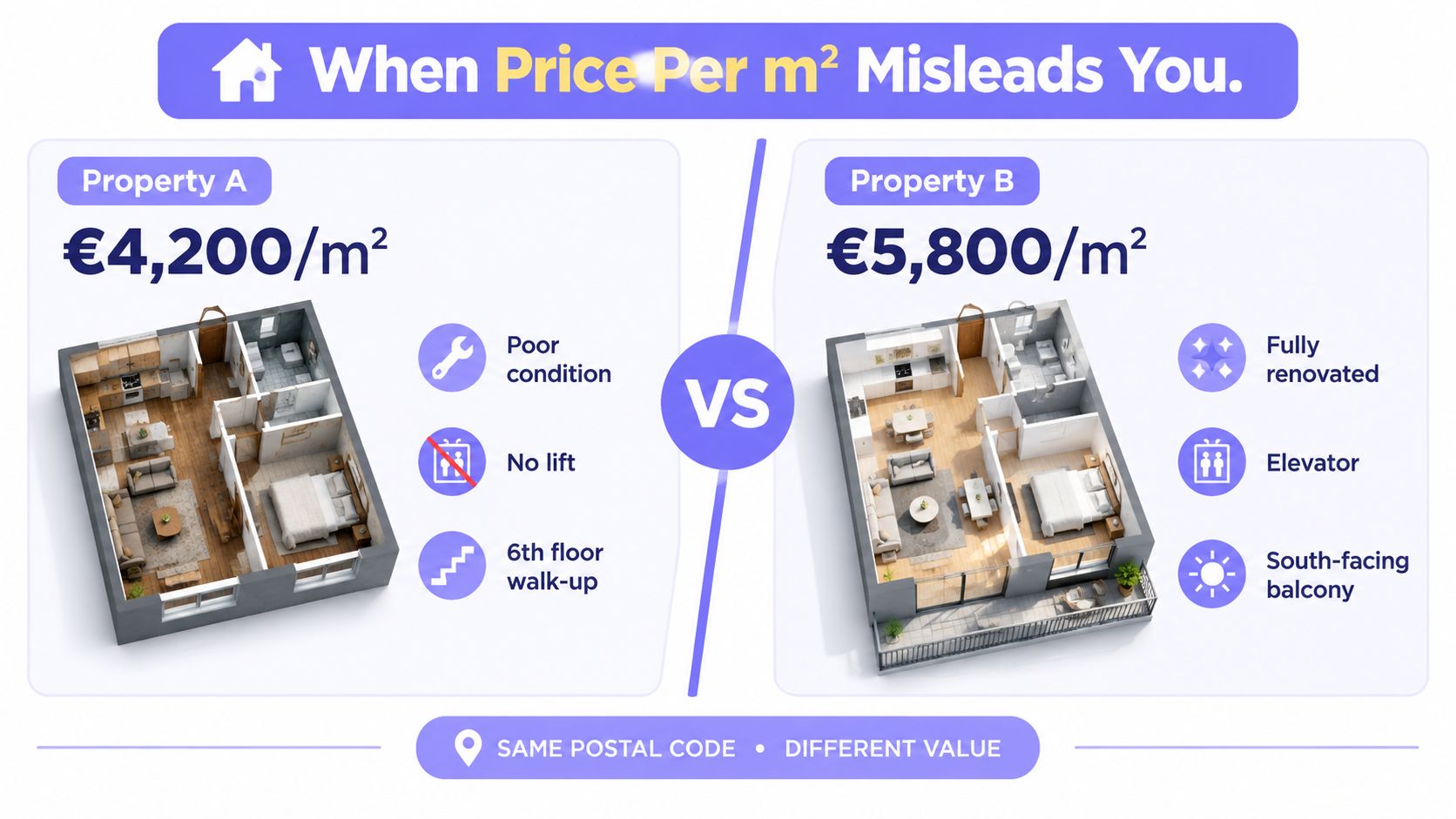
Two apartments in the same postal code can display €4,200/m² and €5,800/m², while the cheaper one remains the stronger purchase. It may have better orientation, lower charges and recent renovation. The higher rate may come from a smaller floor plan, a lift, a view or a more sought-after floor. The figure marks a gap, but the surface basis and property features explain whether that gap is justified.
A paired comparison makes the problem clearer. Suppose both apartments have the same Carrez area and postcode. The first is on the fourth floor with a lift, open outlook and renovated kitchen, but carries higher monthly charges. The second is on the ground floor, needs a full refresh and has lower charges. A higher €/m² for the first may be reasonable because of daylight, access and condition. If the charge difference is substantial or the renovation is cosmetic, the premium can be overstated. Compare the whole property, not only the denominator.
Use a matched comparison set
A reliable benchmark should match:
- Property type: Compare apartments with apartments and houses with houses.
- Condition: Separate renovated, habitable and renovation-heavy stock.
- Micro-location: A commune, arrondissement or street can contain several distinct markets.
- Time window: Prefer recent completed transactions instead of mixing old and current conditions.
- Ancillary value: Analyse parking, gardens, terraces and cellars separately rather than treating them as living area.
The denominator must also match the legal surface. Use Carrez for a co-owned apartment sale, habitable surface for the relevant rental comparison, land area for a plot, and usable floor area when assessing a building project. Applying one basis to every property can make a house with a large garden appear comparable to an apartment, or make attic space look like ordinary living area.
Price dispersion remains wide across French markets, according to the INSEE property-price reference. That variation is a warning against applying a national benchmark to a particular address. DVF Explorer helps narrow the comparison to completed transactions, location and property characteristics.
Ask instead: what did comparable properties sell for, in which area, with which surface basis, and during what period?
Use €/m² as a screening filter. Then test the result against condition, charges, yield, access, orientation and the location premium.
Start with a plausible band, remove clearly incomparable sales, inspect the remaining transactions and investigate any large gap. A high figure may reflect a superior floor, view or renovation. A low one may conceal works, legal complications or a poor building position.
Quick Templates, Common Mistakes and Final Checklist
Save these formulas, but keep the surface label beside every result. A number without its basis isn't reusable.
Copy-paste calculation templates
- Buying or selling:
Net property price ÷ Carrez surface = €/m² - Renting:
Monthly rent × 12 ÷ relevant rental surface = annual €/m² - Construction:
Total project cost ÷ stated floor area = construction cost/m² - Flooring:
(Material price × 1.10 waste allowance) + labour = adjusted flooring €/m² - Painting:
(Wall surface × coats ÷ coverage per litre × paint price) + labour = painting cost
The flooring formula is a planning shortcut, not a substitute for a contractor's measured quantity. The painting formula also requires deductions for doors and windows, plus separate treatment for preparation, repairs and difficult access.
Six mistakes that distort the result
- Mixing Carrez and habitable surfaces: Keep one surface basis per comparison set.
- Forgetting to annualise rent: Multiply monthly rent by 12 before calculating annual €/m² or yield.
- Including charges without labelling them: Separate base rent from recoverable charges.
- Using outdated DVF comparables: Check the transaction date before relying on a benchmark.
- Ignoring flooring waste: Price the ordered quantity, not only the room's net area.
- Applying new-build rates to renovation work: Match the quote's scope, finish level and VAT basis.
A final check should happen before an offer, listing launch or works contract is signed. Confirm the legal surface, identify the date and location of the comparables, verify whether charges and fees are included, adjust for condition and ancillary features, then recalculate the rental yield or total project cost.
Final check: If changing the denominator changes the decision, stop and verify the measurement before negotiating.
For professionals managing multiple property listings, a platform such as Wispra can automatically display a listing's calculated price per square metre from the advertised price and surface area, while also presenting local comparison information. That can improve consistency across published listings, but the underlying surface and benchmark still need human verification.
If you're preparing a sale, purchase, rental listing or renovation budget, visit Wispra to organise property information and present consistent price-per-m² data. Use the calculation as a starting point, then combine it with verified surfaces and local transaction context before making the decision.