You've driven carefully for years, then a minor collision appears on your insurance renewal. The car still works, nobody was seriously hurt, yet your premium is suddenly higher. The immediate question is usually simple: how can one incident affect the price of car insurance malus so strongly?
The answer lies in a regulated scoring system, but the coefficient isn't the only factor affecting what you pay. Your age, the way responsibility is assigned, the insurer's pricing policy and your previous driving record can all change the final quote. Understanding how these elements interact helps you challenge mistakes, compare offers and plan your return to a lower premium.
Understanding the Car Insurance Malus System
A minor parking collision can create two separate surprises at renewal. The insurer may adjust the driver's claims coefficient, while a young driver's surcharge or other pricing factor continues to affect the policy. These costs can appear together, although they come from different parts of the quote.
The French system uses a regulated risk-adjustment mechanism called the coefficient de réduction-majoration, usually shortened to CRM. France has used this framework since 1976. It adjusts an insurer's reference premium according to the driver's claims history, with the applicable legal limits and rules described in Service-Public's explanation of the bonus-malus framework.
A claim-free record gradually builds a bonus. An accident for which the driver bears responsibility can produce a malus. The CRM works like a record-based adjustment layer: it changes the reference price, but it does not measure every aspect of driving or determine whether someone is generally a good or bad driver.
Young-driver pricing sits beside that layer. A new driver may pay a surcharge because the insurer has less driving history to assess. If that driver later causes an accident, the CRM adjustment can affect the quote as well. Shared responsibility can reduce the effect compared with full responsibility, but it does not automatically remove the claim from the calculation. Responsibility must therefore be checked before judging whether the renewal price is correct.
Practical rule: Separate the CRM from the rest of the quote. A higher coefficient can raise the premium, while age, cover, vehicle, address and insurer pricing can change the final amount independently.

Why a small collision can have a large effect
Suppose a driver with a favourable record causes a minor accident in a car park. The repair may cost little, yet the insurer records the event according to the driver's responsibility. At renewal, the CRM may change and apply to the reference premium.
The resulting bill will not be identical for every policyholder. Full cover, a newer vehicle, a higher-risk address or a young-driver surcharge can all produce a different starting price. The same CRM can therefore lead to different renewal amounts.
Drivers who want a specific explanation of training-based discounts can read how A-1 Driving School helps lower rates. Those discounts sit alongside the CRM rather than replacing its claims-based adjustment. Safer habits, suitable cover and careful comparisons can still help control the wider cost.
The difference between insurance malus and ecological malus
The car insurance malus concerns insurance claims and changes the price of an insurance contract over time. An ecological vehicle malus is separate. It relates to the vehicle, not the driver's insurance coefficient.
Check the renewal notice for the CRM and ask the insurer to identify each increase. A claim-related adjustment, a young-driver surcharge and a vehicle-related cost should not be treated as one charge.
How Malus Is Calculated and Applied
The CRM begins at a neutral reference point and changes with the driver's claims history. Under the standard scale, it is bounded between 0.50 and 3.50. In practice, the coefficient can reduce the reference premium to half its amount or raise it to three and a half times that amount. The official Service-Public guidance sets out these limits and the adjustment rules.
Three events shape the calculation:
- A responsible accident: The coefficient increases by 25%, subject to the legal ceiling. This percentage applies to the coefficient itself. The final renewal bill can change by a different amount if the insurer also revises its reference premium or another part of the policy price.
- A claim-free year: The coefficient decreases by 5%, subject to the lower limit. Several claim-free years are therefore needed to rebuild a strong bonus after a malus.
- A shared-responsibility accident: When responsibility is shared equally, the coefficient rises by 12.5%, rather than the 25% applied to a fully responsible accident. This lower adjustment limits the immediate malus, although it still affects later renewals. Service-Public describes the treatment of shared responsibility and how the bonus can interact with young-driver surcharges.
Why the order of events matters
The insurer applies each adjustment to the existing coefficient. A claim therefore works like a move on a ladder. A driver below the neutral level moves upward from that lower point after a responsible accident. A driver who already has a malus moves higher again after another responsible claim, until the legal ceiling stops the increase.
The reverse process is gradual. A claim-free year reduces the current coefficient, but it does not instantly restore the driver's earlier record. The CRM should therefore be understood as a running history rather than a one-time surcharge.
| Driving event | Effect on the CRM |
|---|---|
| Claim-free year | The coefficient is reduced by 5%, within the legal limits |
| Fully responsible accident | The coefficient is increased by 25%, within the legal limits |
| Shared responsibility | The coefficient receives a lower increase, 12.5% when responsibility is shared equally |
| Several claims | The coefficient remains subject to the standard ceiling of 3.50 |
The CRM isn't the full quotation
The coefficient is only one part of the premium. A young driver may pay a surcharge in addition to the CRM, so a shared-responsibility claim can create a hidden cost even when its malus increase is lower. The insurer may also assess the vehicle, location, usage, cover level and excess.
These factors explain why two drivers with the same CRM can receive different renewal prices. A driver can improve the coefficient and still face an expensive quote if a young-driver surcharge or vehicle risk remains high. A driver with a malus may also find a lower quotation by comparing insurers, even though the CRM continues to follow the claims record.
Concrete Examples and Sample Calculations
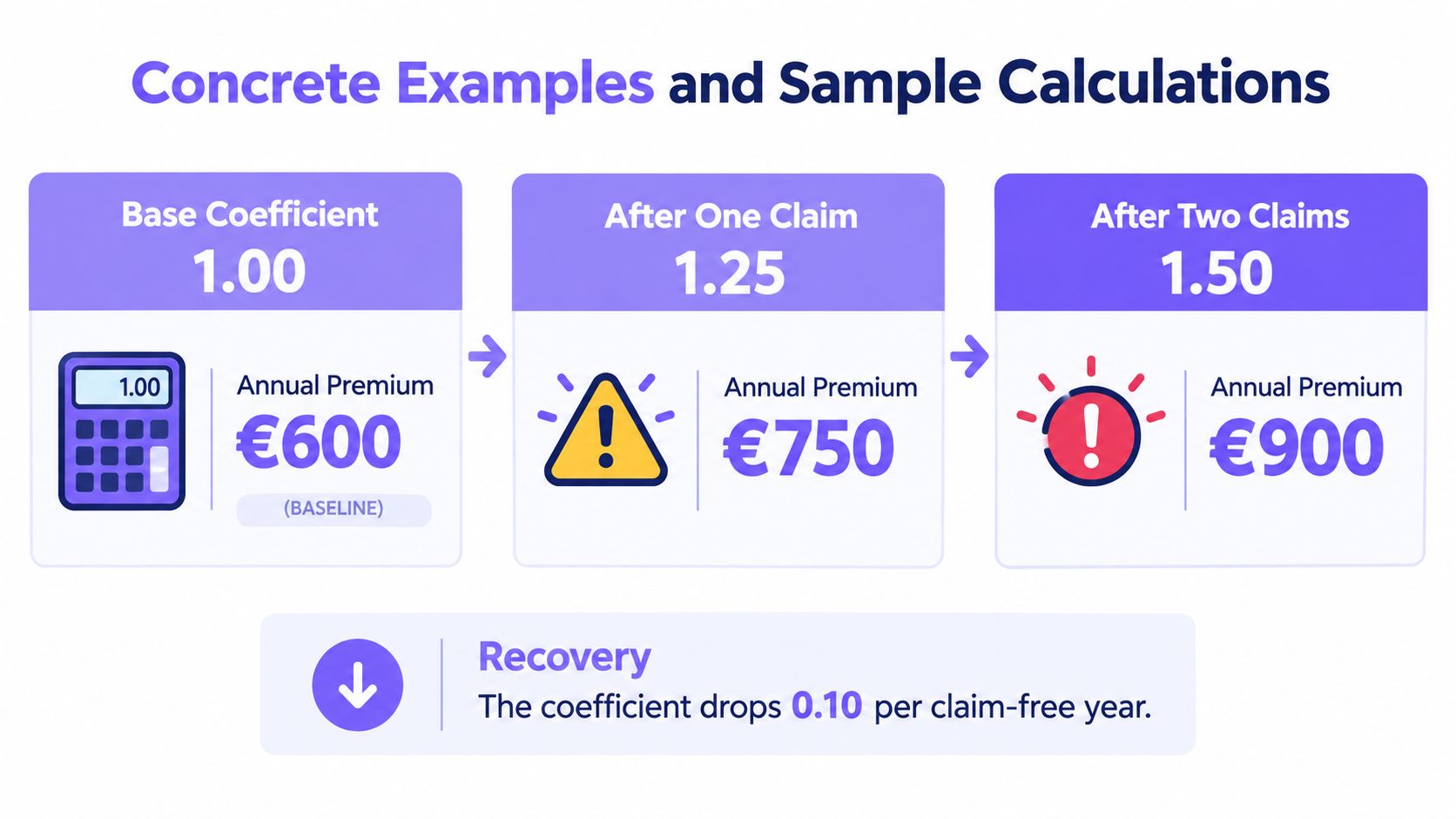
A driver starts the renewal calculation with a coefficient of 1.00, the neutral point in this example. One fully responsible accident raises it by 25%, giving 1.25. A second responsible accident applies the same percentage to the updated figure, producing 1.5625 before insurer rounding or any applicable statutory treatment.
The calculation follows three steps:
- Starting point: 1.00.
- After one responsible accident: 1.00 × 1.25 = 1.25.
- After a second responsible accident: 1.25 × 1.25 = 1.5625.
The coefficient operates within a 0.50 to 3.50 range. A shared-responsibility claim receives a lower increase than a fully responsible accident, but it can still raise the CRM and affect the next quotation.
Translating the coefficient into a premium
A simplified model multiplies the insurer's reference premium by the CRM. If the reference premium is P, the calculation is:
Adjusted premium = P × CRM
This formula explains the direction of the change, not the full renewal price. The insurer may reassess the vehicle, address, use of the car and level of cover. Taxes, optional protection and commercial pricing can also change the amount on the renewal notice.
Suppose the reference premium is €600. A coefficient of 1.25 gives €750 in this simplified calculation. A coefficient of 1.50 gives €900. These figures are illustrative and are not a universal quotation for every French driver.
A young driver can face a second layer of cost. The CRM may rise after a claim while a young-driver surcharge remains in place, so the final premium can increase by more than the coefficient alone suggests. The same issue can affect a shared-responsibility claim: its lower malus adjustment does not make the claim financially neutral.
Modelling recovery
A claim-free year reduces the current coefficient by 5%, rather than removing a fixed number of points. Starting from 1.25, the calculation is 1.25 × 0.95 = 1.1875 before any applicable rounding. The next claim-free year applies the percentage to that updated figure.
The exact reduction therefore depends on the coefficient at the beginning of the year. Saying that the CRM falls by 0.10 every year gives the wrong impression because the system uses a percentage adjustment.
The coefficient shows how the claims record changes. The renewal quote shows how the insurer prices the whole risk.
Duration and Legal Rules of the Coefficient
A malus is a lasting record, not a permanent sentence. Under the applicable conditions, a driver can return to the neutral coefficient of 1.00, commonly after two consecutive claim-free years. France Assureurs outlines the bonus-malus mechanism and this recovery principle.
Two rules operate at different levels. The annual rule changes the CRM after each insurance period. The recovery rule sets the point at which the driver can regain the neutral reference level. Returning to 1.00 does not necessarily restore the exact bonus or premium position held before the accident, because the insurer may still reassess the overall risk.
What changed in 1992
The framework was introduced by the 1976 reform, as Le Monde reported at the time, and the rules were later adjusted on 1 January 1992. The historical point matters because the present system is the result of successive changes, rather than one single rule created at one moment.
Responsibility remains central. A wholly responsible accident can affect the coefficient differently from a claim where responsibility is shared or absent. A shared-responsibility decision may reduce the adjustment, but it can still leave a claim on the driver's record. The financial effect may therefore include both a CRM change and costs that are easy to overlook, such as an excess or a continuing young-driver surcharge.
Young-driver surcharge versus malus
A young-driver surcharge is a separate pricing layer. It can remain in place while the CRM changes, so a new driver may experience two adjustments at renewal: one linked to limited experience and another linked to a responsible claim. Service-Public sets out this interaction in its guidance on the bonus-malus system.
For example, a claim can move the coefficient in the expected direction while the surcharge continues unchanged. The renewal increase may then look larger than the CRM alone would suggest. Ask the insurer to show the CRM effect and the young-driver surcharge separately. This makes the hidden cost visible and helps distinguish a legal adjustment from the insurer's broader pricing decision.
A driver changing insurer should also check the rules around cancelling car insurance under the Hamon law. Confirm that the replacement policy starts without a gap, and request the relevant claims and coefficient documents before cancellation.
Actionable Steps to Reduce or Avoid Malus
A minor collision can create two separate costs at renewal: a CRM adjustment linked to responsibility and a young-driver surcharge that continues because the driver has limited experience. Before reporting or settling an incident, establish who was responsible, what evidence supports that conclusion and how the claim may affect both pricing layers. Avoiding an incorrect or unnecessary malus starts with accurate records, not defensive driving alone.
For individual drivers
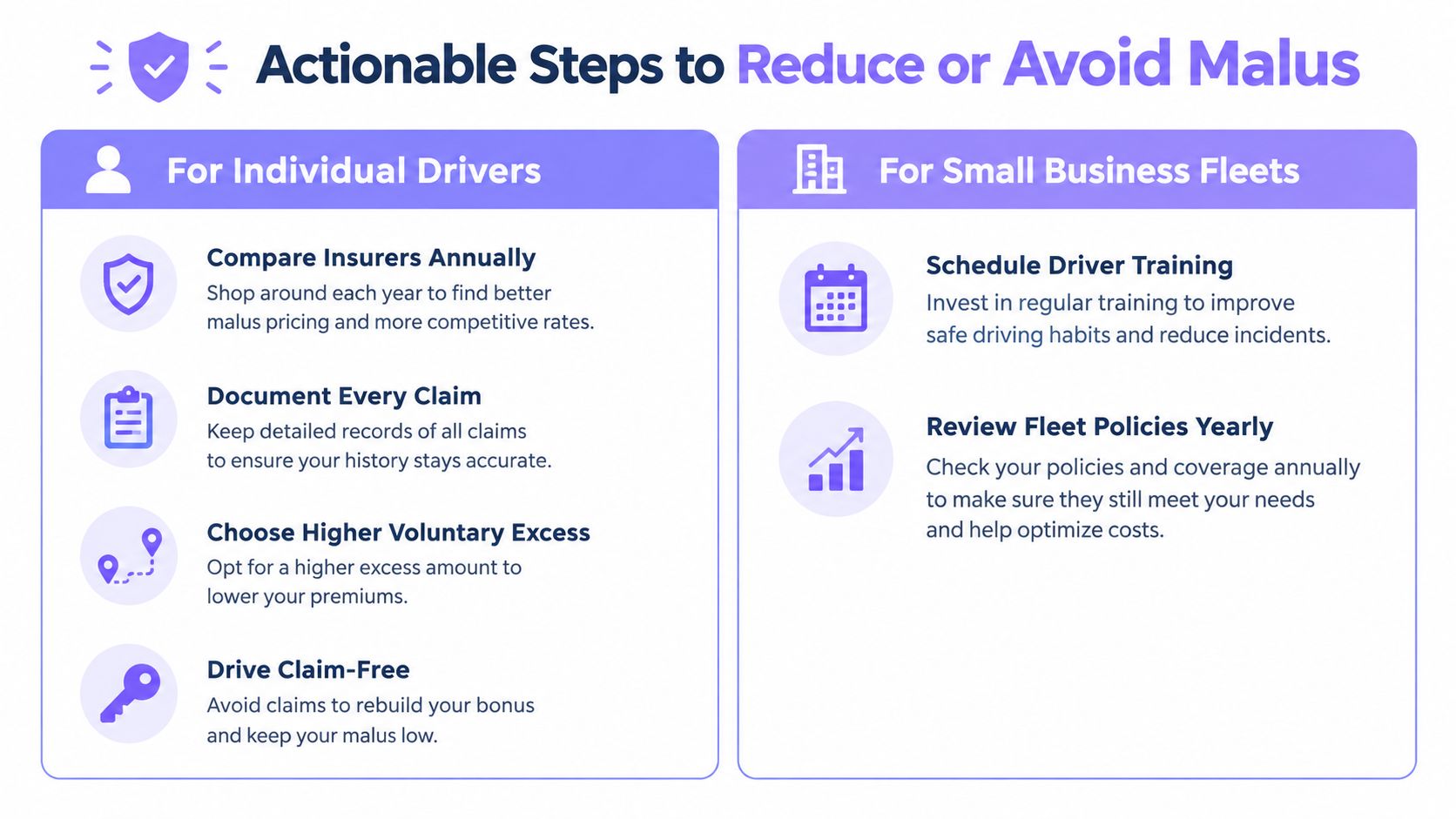
- Check responsibility carefully: Shared responsibility can produce a lower adjustment than a wholly responsible accident, but it may still affect the driver's record. Review every statement before signing an accident report, and correct wording that does not match what happened.
- Keep evidence: Photograph vehicle positions, road markings, damage and relevant signs. Save witness details, correspondence and the completed accident report together. Clear evidence can support the correct responsibility decision.
- Compare the claim with the repair: For a small repair, ask the insurer to explain the likely CRM effect before opening a claim. Paying privately may sometimes reduce future pricing pressure, but first check the policy conditions, liability risks and possibility of hidden damage appearing later.
- Review the excess: A voluntary excess may lower the premium while increasing the amount payable after a claim. Choose an amount you could pay without creating financial pressure.
- Protect the recovery path: After an incident is closed, check the coefficient on renewal documents. Keep proof of each claim-free period so an error does not interrupt the return toward a lower malus.
Renewal figures can combine several changes. Ask the insurer to separate the CRM adjustment, the young-driver surcharge, any change in the reference premium and changes to the cover. For example, the coefficient may improve while the surcharge remains, making the overall renewal increase appear larger than the malus effect alone. This breakdown shows which cost comes from the claims record and which comes from driver experience.
A driver comparing policies should examine protection as well as the headline premium. This guide to choosing car insurance provides a broader checklist for comparing cover and price.
For small business fleets
Fleet owners manage shared exposure. One driver's incident can affect the business's claims experience, while inconsistent vehicle checks can create similar incidents across several vehicles. A simple routine helps separate individual responsibility from preventable fleet-wide problems:
- Train drivers regularly: Cover speed awareness, reversing, loading areas, fatigue and reporting procedures. Keep attendance records so managers can identify gaps.
- Inspect vehicles: Schedule maintenance and record defects before vehicles return to service.
- Analyse incident patterns: Group incidents by route, vehicle type, time and manoeuvre. Repeated reversing collisions call for a different response from recurring motorway incidents.
- Review the fleet policy: Check that the cover, excess and driver declarations still match actual business use.
- Create a reporting deadline: Employees should know whom to contact immediately after an accident and which documents to preserve.
A spreadsheet, fleet-management platform or insurer dashboard can support this process. The tool matters less than consistent records and prompt action. A well-documented record can support clearer discussions with insurers, while missing information can make an avoidable responsibility dispute harder to resolve.
Switching Insurers and Documenting Claims
A renewal notice arrives with a higher premium after a claim. Changing insurer does not erase your driving history. The new provider will usually ask for evidence of your coefficient and claims record, then assess that information alongside its own pricing rules. A refusal or expensive renewal from one insurer does not mean every insurer will make the same offer.
Keep the renewal notice, policy schedule, claims correspondence and accident report together. For a disputed or shared-responsibility accident, preserve photographs, witness details, diagrams and any written decision showing how responsibility was allocated. These records help separate your actual driving history from an unclear account of the incident.

Build a comparable quotation
Give every insurer the same details about the vehicle, annual use, parking, drivers, cover and excess. Ask for the CRM, any young-driver surcharge and other adjustments to be shown separately. This makes the quote easier to compare. A young driver added to a policy can create a cost that sits beside the malus, while shared responsibility may affect how a claim is assessed. Looking only at the final premium can hide both effects.
Prices for drivers with a malus vary widely between insurers and individual profiles. Use several quotations rather than treating a general market average as a promise. Ask what part of the premium comes from the coefficient, the young-driver surcharge, the chosen cover and the excess.
Before cancelling, confirm the new policy's start date and the documents the insurer accepts. The Policy Quail guide to switching insurers provides practical context for changing cover without an interruption. If an accident has just occurred, follow a documented process for declaring a car insurance claim, and keep copies of every submission.
The practical rule is simple: verify the malus, clarify shared responsibility, identify young-driver costs and compare equivalent cover before accepting a renewal.
Wispra provides content tools, business-directory services and AI visibility tracking for organisations that publish answers about services such as car insurance. Visit Wispra for more information.