A bakery owner in Lyon asks Google how to increase foot traffic on a quiet weekday. Instead of a familiar list of pages, she sees a polished paragraph that combines advice from several websites, followed by citations. Her business might be mentioned, but the customer can get the answer without visiting her site.
That moment captures the impact of AI on SEO. Search hasn't disappeared, and classic rankings still matter. But discovery now happens through several layers, including traditional results, Google AI Overviews, ChatGPT, Perplexity, Gemini, and other conversational interfaces. The practical question for a French business is no longer only, “How do I protect my traffic?” It's also, “How do I become a source that AI systems can confidently cite?”
The Search Page Just Changed Under Your Feet
Before generative search, the customer's journey was relatively familiar. Someone searched for “how to increase bakery foot traffic in Lyon”, scanned a page of links, opened several results, and decided which source looked useful. The business competed for a position, a title link, and a click.
Now, Google can place an AI Overview above those classic results. The system synthesises information, presents it in natural language, and attaches citations to supporting pages. ChatGPT, Perplexity, and Gemini follow a related conversational pattern, although their interfaces and retrieval systems differ. The user starts with a question and receives an answer that feels closer to a recommendation from an informed assistant than a directory of documents.
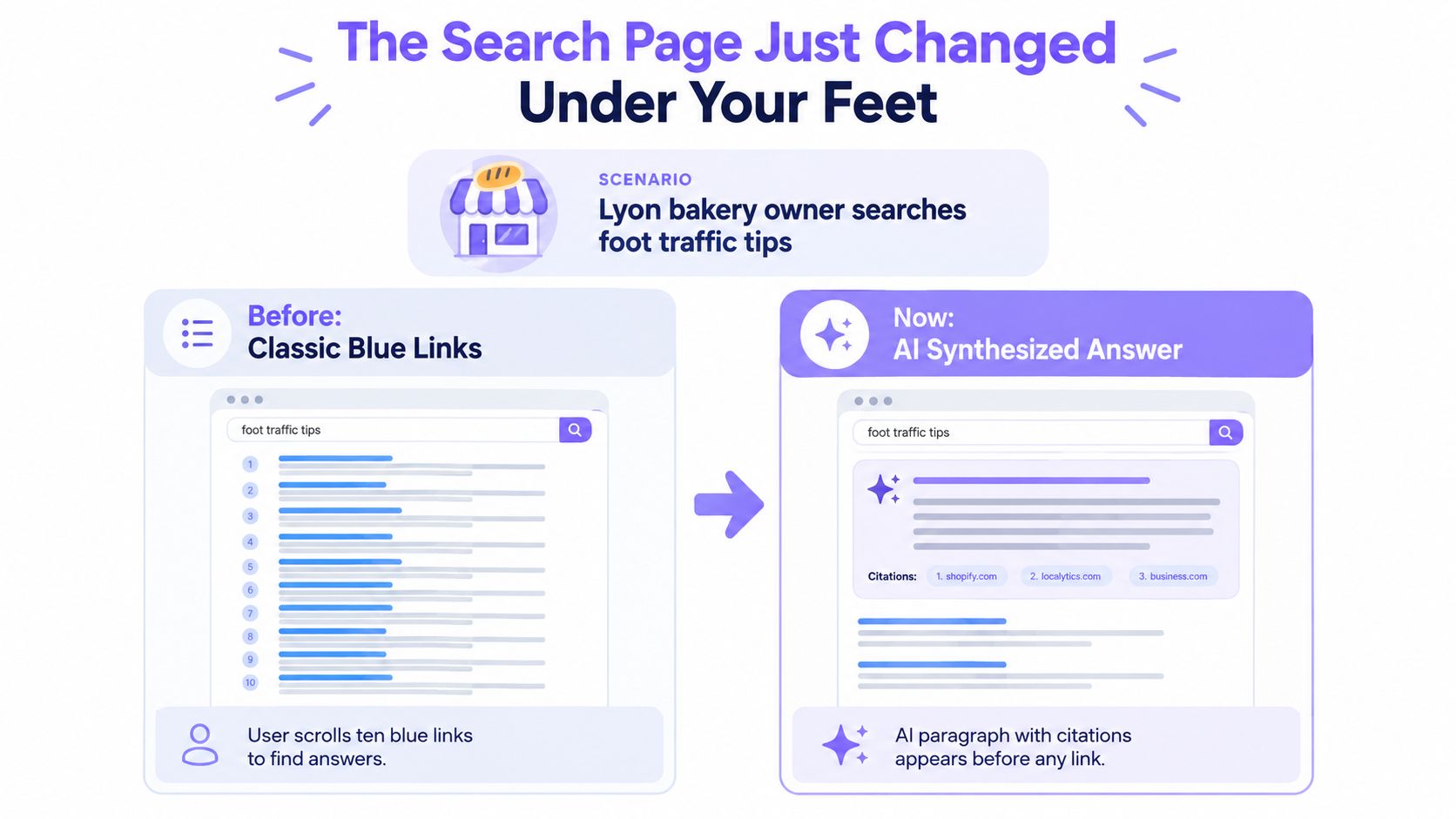
That distinction changes what visibility means. A page can rank well in the traditional results and still receive less attention if the AI layer answers the question first. Conversely, a page that isn't among the classic top results can still become useful if the system selects a passage from it as evidence. A France-focused analysis reports that only 38% of pages cited in AI Overviews are in Google's top 10, which shows that ranking and citation overlap without being identical (France GEO analysis).
Why informational searches feel the change first
AI answers work especially well for questions with an explanatory shape. “What is a heat pump?”, “Which documents do I need to rent a flat?”, and “How can I improve local visibility?” can be answered through a concise synthesis. The reader may not need to open five separate articles.
Comparison searches face a similar risk. A customer asking “SEO agency or DIY tools for a small business?” can receive a summary before visiting any provider. The click isn't guaranteed because a company appears in the answer. The citation may create recognition, but the user still needs a reason to continue.
Practical rule: Treat an AI mention as a new visibility event, not as a guaranteed website visit.
The French market is becoming a dual-search environment. One 2026 analysis estimates that around 39% of French internet users rely on AI-powered search tools, while 61% still depend on classic search engines (France AI search and GEO data). That doesn't describe a post-SEO market. It describes a market where businesses need to be discoverable in both the list of sources and the answer assembled from those sources.
For owners who want a practical introduction to the business implications, this guide to Google's generative search in France provides useful context. The immediate lesson is simple: a good page must now satisfy two readers, the human who may click and the system deciding whether the page is clear enough to retrieve and cite.
How AI Answers Are Actually Built
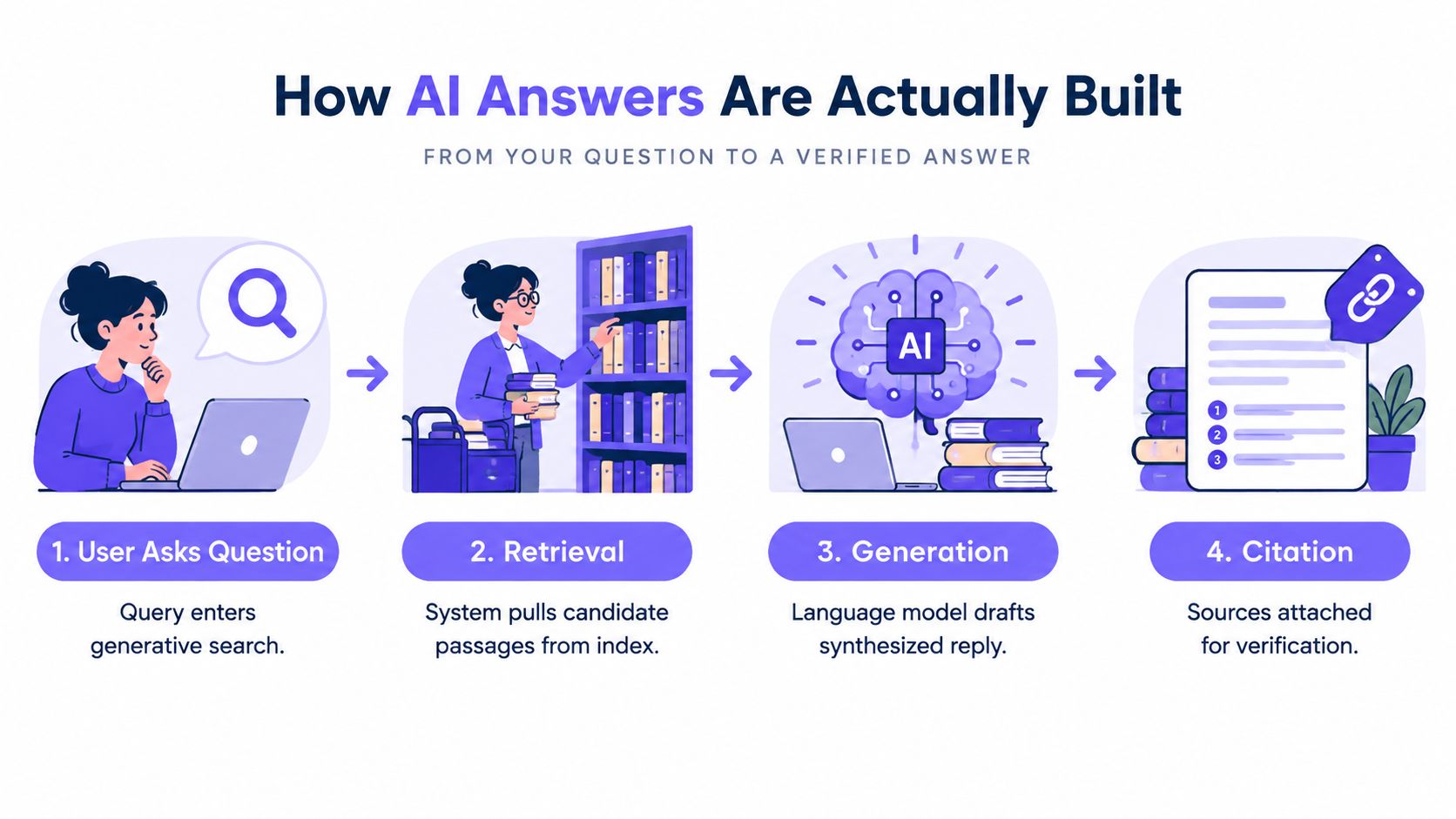
Think of generative search as a librarian working at high speed. You ask a question. The librarian searches a large catalogue, pulls relevant passages from several books, writes a concise response, and gives you references so you can check the material.
The process has three core ideas:
- Retrieval means finding candidate passages that appear relevant to the question.
- Generation means using a language model to draft a coherent answer from the retrieved material.
- Citation means connecting a statement in that answer to a source document that supports it.
An AI Overview doesn't copy the first sentence from the highest-ranking page. It may combine definitions, qualifications, examples, and recommendations from multiple documents. That creates a different optimisation problem from classic ranking. Traditional SEO asks Google to crawl a page, understand its topic, and place it in an ordered result set. Generative visibility asks an AI system to find a precise passage, understand what it means, and decide that the passage is suitable evidence.
Ranking is not the same as sourcing
A classic result rewards the page's overall position. A generative answer can reward a particular paragraph. That paragraph might define a service, clarify a local term, list eligibility requirements, or answer a comparison question directly.
This is why a long article can underperform even when it covers the right subject. If the page buries its answer beneath vague introductions, repeated ideas, or unclear terminology, the retrieval system has to guess which passage matters. A shorter, explicit block may be easier to use.
Your page should make several things obvious:
- Who you are, including your business name, location, category, and areas served.
- What you offer, using language customers use.
- Which question each passage answers, rather than blending unrelated topics.
- Why the information deserves trust, through clear authorship, evidence, reviews, and consistent business details.
A helpful explanation of how these systems interpret websites appears in this guide to AI understanding website content. The operational takeaway is that indexable is no longer enough. A page must also be understandable, retrievable, and quotable.
The librarian analogy also explains why unsupported claims create problems. If a paragraph makes several assertions without distinguishing facts, opinions, and recommendations, an AI system may struggle to map the answer back to a reliable source. Clear sentences, defined entities, and focused sections give the system better material to work with.
SEO Signals That Still Matter and Signals That Do Not
Generative search hasn't erased the foundations of SEO. It has changed the balance between broad signals and precise ones. A healthy website still needs crawlable pages, useful content, dependable links, and a clear subject. What has weakened is the assumption that repeating a phrase or adding another generic article will automatically produce visibility.
The before-and-after diagnostic
| Signal | Weight Before | Weight in 2026 | Why It Changed |
|---|---|---|---|
| Technical health | Essential | Essential | AI systems still need accessible, interpretable pages |
| Backlinks | Strong authority signal | Still valuable, alongside reputation and relevance | Links help establish trust, but a citation decision also depends on clarity and source fit |
| Exact-match keywords | Frequently overemphasised | More limited | Systems interpret concepts and entities, not just repeated phrases |
| Topical authority | Important | More important | A consistent body of useful material makes the business easier to understand |
| Generic word count | Often treated as a proxy for depth | Weak on its own | A focused answer can be more useful than a long article with little structure |
| Structured data | Helpful technical enhancement | Newly critical for interpretation | Mark-up can clarify services, products, reviews, and local entities |
| Local consistency | Important for local SEO | Critical for machine confidence | Conflicting business details create ambiguity across sources |
Start with the signals that survived. Check whether important pages load, whether navigation exposes your main services, and whether external websites describe your business consistently. A plumber in Nantes doesn't need to publish a large volume of essays if the service page clearly explains emergency availability, supported repairs, service areas, and contact options.
The weakened signals are mostly shortcuts. Exact-match phrasing can still help a page communicate relevance, but repeating “best bakery Lyon” throughout the copy won't make the business more cite-able. Likewise, a shallow article that exists only to target a broad keyword gives an AI system little distinctive evidence to use.
What deserves more attention now
The newer layer is answer-shaped content. Put a direct response near the relevant heading, then add context, limitations, and a practical next step. An FAQ on a “Boiler repair” service page may be more valuable than another general article about home maintenance because it connects a real customer question to a service decision.
Use structured data where it accurately describes the visible page. Depending on the business, that may include LocalBusiness, Service, Product, Review, or FAQ schema. Mark-up doesn't guarantee a citation, and it shouldn't be used to hide information that visitors can't see. Its job is to reduce ambiguity.
A technical review based on this newer search environment can use this technical SEO and AI visibility guide. The under-an-hour check is straightforward: inspect one service page, one local page, and one educational page. Ask whether each page answers a recognisable question, identifies the business clearly, supports its claims, and links naturally to the next commercial action.
Where AI Hits Hardest in France Right Now
The French picture needs more precision than “AI is reducing traffic”. Exposure depends on the query. A person searching for an explanation is more likely to receive a summary than someone searching for a nearby shop, an appointment, a route, or a specific product page.
A 2026 study of 100,000 keywords across 20 niches found AI Overviews on 52.63% of French searches, meaning 52,628 queries returned an AI Overview in that dataset (SE Ranking France study). Independent French SEO commentary also reports that Google holds about 92% of the country's search market share (French AI search analysis). The immediate issue is therefore not that French businesses must optimise separately for a dozen equal search engines. It's that Google's own results page now contains both classic ranking and generative citation surfaces.
An exposure map by intent
| Query Category | AI Overview Rate | Typical CTR Impact |
|---|---|---|
| Informational | Around 99% of AI Overview-triggered queries are informational (France AI Overview commentary) | Higher exposure to click interception because the answer can satisfy the question before the visit |
| Commercial and comparison | Less exposed than informational queries in the France-focused evidence | Users may still need provider details, pricing context, proof, and selection help |
| Local and transactional | Often more insulated when the search requires action, proximity, availability, or contact | Maps, reviews, directions, booking, and product details can still drive visits |
The figures require careful reading. The 99% figure describes the mix of queries that trigger AI Overviews, while the same France-focused source reports that only about 16% of queries trigger AI Overviews at all. Those are different denominators, not a contradiction. Together, they show why an SMB shouldn't treat every page as equally vulnerable.
What this means for an SMB site
A broad blog post such as “How to choose a solicitor” is exposed because an AI system can summarise the decision criteria. An FAQ page answering “Do I need an appointment for a passport photo in Lyon?” may also be summarised, but the business can preserve value by making the next action easy. A service page with opening times, location, availability, proof of expertise, and contact options remains useful because the customer isn't only seeking information.
Take a home-services company in Marseille. Its general article about preventing water damage may lose some informational clicks when a summary appears. Its “emergency leak repair near Marseille” page still has a stronger reason to attract a visit, especially if the business details, reviews, service area, and contact path are consistent.
The correct response isn't to stop publishing education. It's to connect education to commercial intent. Use explanatory content to establish expertise, then guide the reader to a service, product, consultation, booking, or local visit that an AI summary can't complete on the business's behalf.
A Practical Adaptation Playbook for SMBs
A small business doesn't need to rebuild its entire website to respond to generative search. It needs to make its existing information easier to identify, verify, and use. The sequence matters because clearer content helps structured data, consistent listings reinforce the entity, and measurement shows which changes deserve further investment.
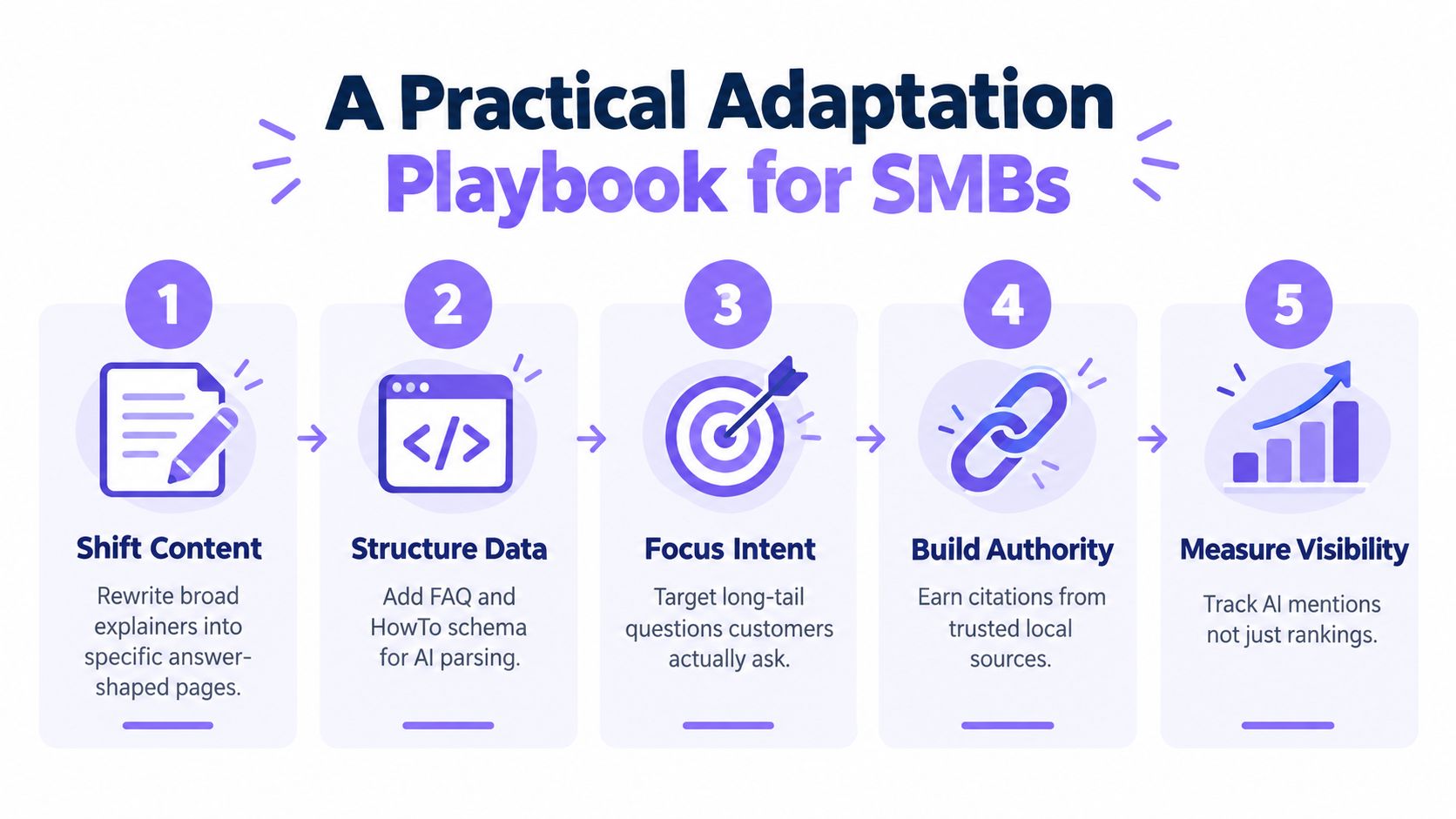
1. Rewrite for real questions
Take three existing articles and inspect the headings. Replace broad topics with questions customers ask, such as “How long does a boiler repair take in Lille?” or “What's included in a first doula consultation?” Answer each question directly before adding nuance.
Don't create a separate page for every tiny variation. Build one authoritative page when the questions share the same intent, and link it to the relevant service or product page.
2. Add accurate structure
Use FAQ, Product, LocalBusiness, Service, and Review schema where each type matches the page. Make sure the structured information agrees with the visible content. A system that sees one opening time in mark-up and another on the page receives conflicting signals.
3. Reconcile listings and reviews
Keep your name, address, phone details, service area, category, and opening information consistent across Google Business Profile, Apple Maps, Bing Places, Waze, and relevant directories. Ask for reviews through a steady, ethical process, and encourage customers to describe the service they received in their own words.
4. Build connected authority
Link educational pages to commercial pages and commercial pages back to useful explanations. Earn mentions from relevant local organisations, trade associations, suppliers, and community publications. The aim is not to collect random directory entries. It's to create a coherent public picture of the business.
5. Track more than rankings
Record classic impressions and positions, then add AI citation checks for important prompts. Note whether the answer names the business, links to it, describes it accurately, and appears alongside competitors. Connect those observations to calls, enquiries, bookings, and store visits where possible.
A sensible one-week start includes auditing three pages, correcting business listings, writing one answer-shaped service section, and testing a small set of customer prompts. A fuller rollout over 60 days can extend that work across the whole service catalogue, structured data, review process, internal links, and reporting.
SEO Versus GEO and Why You Need Both
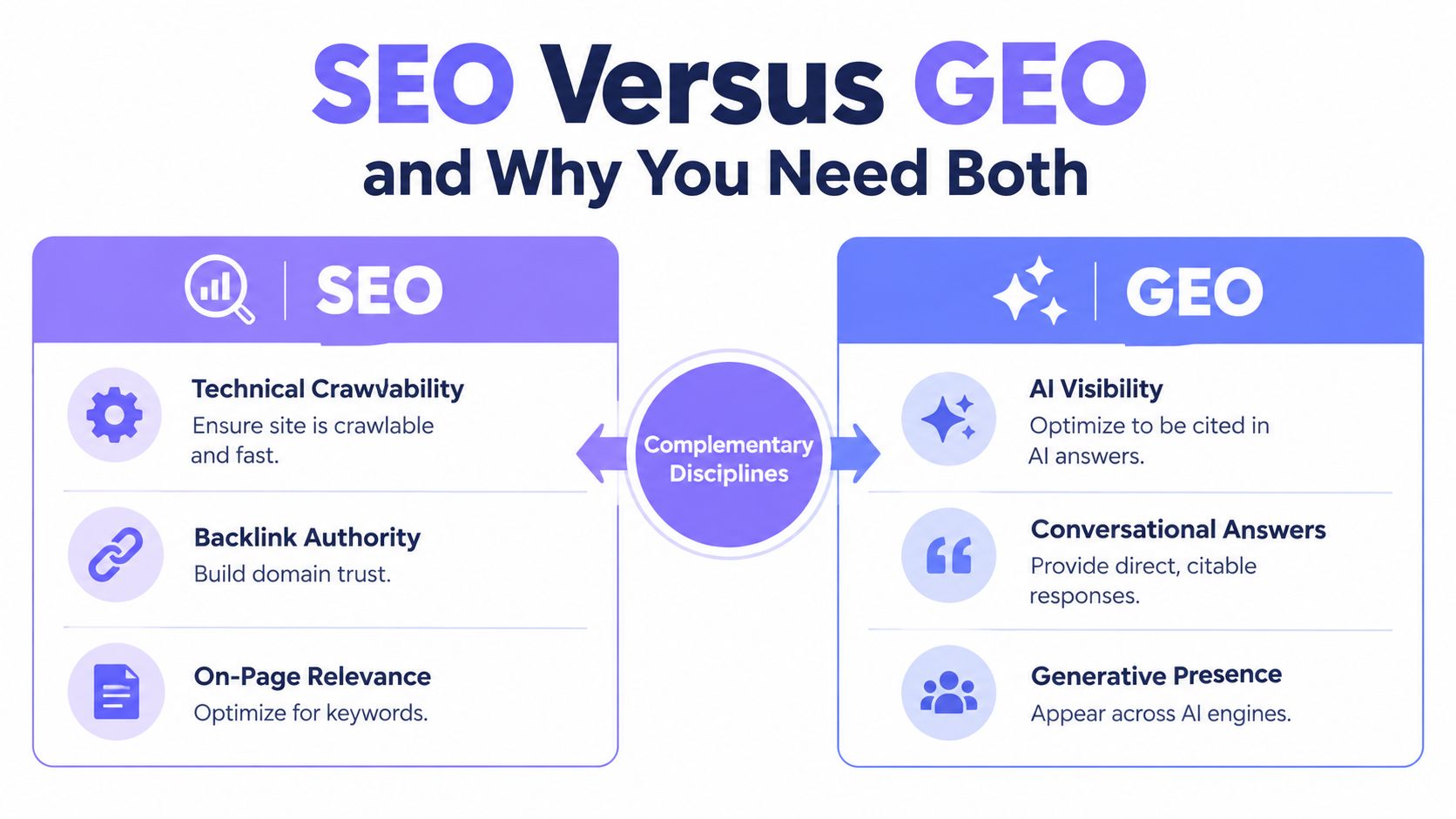
SEO and GEO are complementary disciplines. SEO helps search engines crawl, understand, and rank your pages. Generative Engine Optimization, or GEO, focuses on whether AI systems select, summarise, and cite those pages in generated answers.
| Dimension | SEO | GEO |
|---|---|---|
| Primary goal | Earn visibility in classic search results | Become a trusted source inside AI answers |
| Success metric | Rankings, impressions, clicks, and conversions | Citations, mentions, source inclusion, and resulting actions |
| Core signals | Technical health, relevance, internal links, and backlinks | Explicit entities, answer-shaped passages, consistent reputation, and retrievable evidence |
| Content format | Pages designed for users and crawler interpretation | Concise, quotable blocks supported by useful context |
| Output surface | Traditional search results, maps, and shopping features | Google AI Overviews, ChatGPT, Perplexity, Gemini, Claude, and related interfaces |
SEO remains the foundation. An AI system needs access to your content, and it still benefits from signals that help establish relevance and trust. GEO adds a publishing discipline: define the business clearly, answer specific questions, make claims easy to verify, and organise the page so a system can extract the right passage without distorting it.
The confusion that costs businesses visibility
GEO isn't a replacement for technical SEO. Adding FAQ schema won't compensate for blocked pages, poor navigation, or inaccurate content. Equally, a healthy ranking report won't tell you whether ChatGPT or Perplexity names your business when a prospective customer asks for a recommendation.
A specialist resource such as this SEO guide for doulas shows why the two layers work together. A doula needs discoverable pages, local relevance, and trustworthy information for classic search, but also clear answers to sensitive questions that conversational tools may summarise.
Ignoring GEO can leave a business in an awkward position. The site may rank well for some phrases, yet competitors become the sources that AI systems use to explain the category, compare providers, or answer local questions. The objective is not to choose between ranking and citation. It's to make existing SEO assets useful in both environments.
How Wispra Fits Into the New Landscape
For a non-technical owner, the difficulty isn't understanding the playbook. It's keeping the operational work moving after the initial audit. Business information sits in directories, content lives on the website, reviews arrive in separate channels, and AI visibility is difficult to observe through ordinary analytics.
Wispra can serve as one operational layer for that work. Its business directory is designed to synchronise core listing information across relevant platforms, reducing the chance that customers and search systems encounter conflicting details. Its content engine produces articles, FAQs, review content, and product or service material organised for AI retrieval, with structured data embedded where appropriate.
The tracking component addresses a different problem. A tracking pixel monitors references to the business in AI answers, while the performance dashboard brings those observations into an AI visibility score and reporting view. That gives the owner a place to compare prompts, review citations, and connect visibility activity to wider marketing actions.
These functions map directly to the adaptation process:
- Listings support entity consistency.
- Content production supplies answer-shaped material.
- Structured data makes page meaning more explicit.
- Tracking creates a feedback loop instead of guesswork.
- Reporting helps prioritise pages and prompts with commercial relevance.
Wispra doesn't replace technical SEO, useful service pages, legitimate reviews, or strong customer experience. It adds execution around the generative layer, so a business can work on being found, understood, and cited without treating AI search as an entirely separate website project.
Measuring AI Visibility in 30 Days
AI visibility becomes useful when you measure it against a defined set of prompts and business outcomes. Don't start by checking every possible question. Choose the searches that reflect your services, locations, products, and customer comparisons, then establish what appears before making changes.
A four-week measurement cycle
| Week | Primary Action | KPI Tracked | Target Outcome |
|---|---|---|---|
| Week 1 | Record classic rankings and run a baseline set of AI prompts across Google AI results, ChatGPT, Gemini, and Perplexity | AI citation rate, brand mentions, classic visibility | A documented starting point for priority queries |
| Week 2 | Add tracking through an AI visibility tool and repeat the prompt set consistently | Share of voice on target prompts | A repeatable observation process rather than isolated testing |
| Week 3 | Connect AI-referred activity with calls, forms, bookings, and store enquiries | Attributed conversions and qualified actions | Evidence of whether visibility supports commercial intent |
| Week 4 | Review citations, competitors, accuracy, and downstream actions | Citation quality, branded search lift, conversions | A prioritised list of content and listing improvements |
A real citation is more than a vague brand mention. The system should identify the business as a source, connect the relevant statement to the business or its page, and describe the offer accurately. A near-mention may show that the model knows the category but not that it can recommend the business reliably.
Measurement questions owners often ask
What if the sample is small? Treat low-volume observations as directional. Repeat the same prompts, record the date and location context, and avoid declaring a trend from one answer.
How often should prompts be refreshed? Keep a stable core set so comparisons remain meaningful, then add new prompts when services, locations, competitors, or customer language changes.
Does a citation without a click matter? It can support recognition, but it shouldn't be treated as a conversion. Separate citation rate from attributed enquiries and judge both.
Which metrics belong in the monthly report? Start with AI citation rate, share of voice on target prompts, branded search lift, and attributed conversions. Keep traditional rankings and organic clicks alongside them so you can see whether the two discovery surfaces support one another.
The best 30-day programme produces decisions, not just a score. If informational prompts generate citations but no actions, strengthen the path from explanation to service. If local prompts fail to mention the business, correct listings and location signals. If competitors are cited for questions you answer well, make the relevant passages clearer, more specific, and easier to verify.
Wispra helps small businesses organise listings, create citation-ready content, and monitor how often AI search systems reference their brand. Visit Wispra to see how an AI visibility workflow can support your SEO and GEO work.