The most popular advice about life insurance yield is also the least useful: compare the annual rate, choose the highest figure, and assume the result is your profit. That approach confuses nominal performance with the increase in what your money can really buy.
A French life-insurance contract is not a simple savings account. Its outcome depends on the support selected, the inflation environment, contract charges, social contributions, taxation and any conditions attached to a promotional rate. For expats and international investors, the right question isn't “Which contract pays the highest headline yield?” It's “How much purchasing power remains after every relevant deduction?”
The Illusion of Headline Yields
A higher life insurance yield can leave an investor poorer in real terms. The annual rate shows how the contract was revalued, not how much additional purchasing power the capital created. If consumer prices rise faster than the credited return, the account balance increases while the same balance buys fewer goods and services.
The ACPR's review of 2025 life-insurance revaluation rates recorded a 2.63% revaluation rate for individual euro-denominated contracts, unchanged from the previous year. Collective retirement-oriented contracts reached 2.64%. These are nominal figures. They describe the amount credited by insurers, without establishing whether investors gained purchasing power after inflation, contract charges, social contributions and personal taxation.
The first error is to assess the rate in isolation. Compare it with inflation over the same period, then identify every deduction and condition attached to the quoted return. A slightly higher advertised rate can produce a weaker outcome if management fees are higher, if the rate applies only to part of the balance, or if access requires an asset allocation that exceeds the investor's risk capacity.
Nominal return is only the starting point
A euro fund's result should be examined in three layers:
- Nominal revaluation, the percentage credited by the insurer.
- Net financial result, after applicable contract charges and before later deductions.
- Real purchasing-power gain, after comparing the net result with inflation and accounting for the investor's tax position.
The third layer answers the practical question. It shows whether the proceeds can pay for more, less or roughly the same amount of housing, travel, education and daily consumption. The calculation also needs to reflect the investor's spending currency. A return credited in euros may have a different practical value for an expat whose expenses or liabilities are denominated elsewhere.
Property investors use the same distinction when separating an advertised gross yield from income remaining after operating costs, financing and taxes. The principle applies directly to life insurance. Investors seeking a broader explanation can read on World Property Investor about gross yield versus net yield. The attractive figure is the beginning of the calculation, not the end.
Practical rule: Do not compare two life insurance yield figures until you know whether each is quoted before or after management fees, and whether social contributions and personal taxation are excluded.
Why comparison websites can mislead
A comparison table can identify available contracts, yet it cannot determine whether a quoted yield fits your circumstances. Expats may need to assess tax residence, reporting obligations, currency exposure and access to suitable investment supports. International investors may place greater value on liquidity, beneficiary arrangements and transferability than on a small difference in the annual euro-fund rate.
Independent analysis therefore requires the contract documents, fee schedule and investment conditions, rather than a ranking page alone. The guide to standing out from insurance comparison sites provides useful context on why visibility in a comparison exercise is different from evaluating the underlying product.
The contrarian conclusion follows from the arithmetic. A stable headline yield can serve as a defensive portfolio component, while still failing to increase real wealth. Good yield means preserving and increasing purchasing power after costs, inflation, social contributions and taxation, rather than appearing near the top of a comparison table.
Comparing Euro Funds and Unit-Linked Assets
French life insurance usually gives the investor access to two distinct families of supports. Euro funds are designed around capital stability and insurer-backed guarantees, subject to the contract terms and the insurer's financial position. Unit-linked assets, often called unit-linked accounts, expose the investor to underlying markets and therefore create a different relationship between risk and return.
The distinction is more important than the product label. Two contracts can both be called life insurance while offering entirely different portfolios, fee structures and risk profiles. An investor who focuses only on the policy's name may miss the fact that the return is being generated by assets with very different behaviour.
The French market data shows this separation clearly. France Assureurs reported an average 2.6% return for euro funds in 2024, while unit-linked supports delivered about 4.1%. The resulting blended life-insurance performance was roughly 3.0% net of fees, as reported in this comparison of euro funds and unit-linked performance. The difference isn't a free bonus. Unit-linked assets can lose value and don't provide the same capital guarantee.
What the two supports actually do
| Feature | Euro Funds | Unit-Linked Assets |
|---|---|---|
| Capital treatment | Designed to protect capital under the contract's guarantee framework | Capital value fluctuates with the underlying assets |
| Return mechanism | Annual revaluation determined by the insurer | Market-linked performance |
| Main exposure | Defensive assets managed by the insurer | Equities, bonds, property or other investment supports |
| Volatility | Generally lower | Varies by support and can be substantial |
| Investor's priority | Stability and capital protection | Growth potential and diversification |
| Principal risk | Inflation can reduce real gains | Market falls can reduce the value of the investment |
Euro funds are useful when the investor can't accept meaningful fluctuations, has a near-term liability or needs a stable anchor in a wider portfolio. Their guarantee doesn't remove every risk. Insurer solvency, contract conditions and inflation still matter, and a capital balance that rises slowly may fail to maintain purchasing power in a high-inflation environment.
Unit-linked assets are more flexible in terms of exposure, but that flexibility transfers responsibility to the investor. A diversified unit-linked portfolio may combine different asset classes, yet diversification doesn't guarantee a positive return. The investor must accept that the value shown on the statement may fall at the moment capital is needed.
Allocation is a decision about time, not fashion
A higher unit-linked allocation may suit someone with a long horizon and the capacity to tolerate losses. It may be unsuitable for someone who will need the capital soon or who would sell after a sharp fall. Likewise, placing everything in euro funds may protect short-term stability while limiting the portfolio's ability to grow faster than inflation.
The useful question isn't whether euro funds or unit-linked assets are “better”. It's whether the support matches the purpose, horizon and loss tolerance of the money invested. An expat saving for a future property purchase has a different problem from an international investor building a long-term retirement reserve.
A blended allocation can therefore be rational, but it should be deliberate. The euro fund can provide the defensive base, while selected unit-linked supports can provide exposure to growth assets. The correct balance is personal, and the comparison should focus on the investor's required real outcome rather than the most impressive isolated performance figure.
Calculating Your Real Purchasing Power Gain
The most useful calculation starts with the amount credited to the policy and then strips away the effects that don't translate into lasting wealth. In practice, that means distinguishing the insurer's announced performance from inflation and from deductions applied to gains.
A simplified real-return formula is:
Real return = (1 + net nominal return) ÷ (1 + inflation) − 1
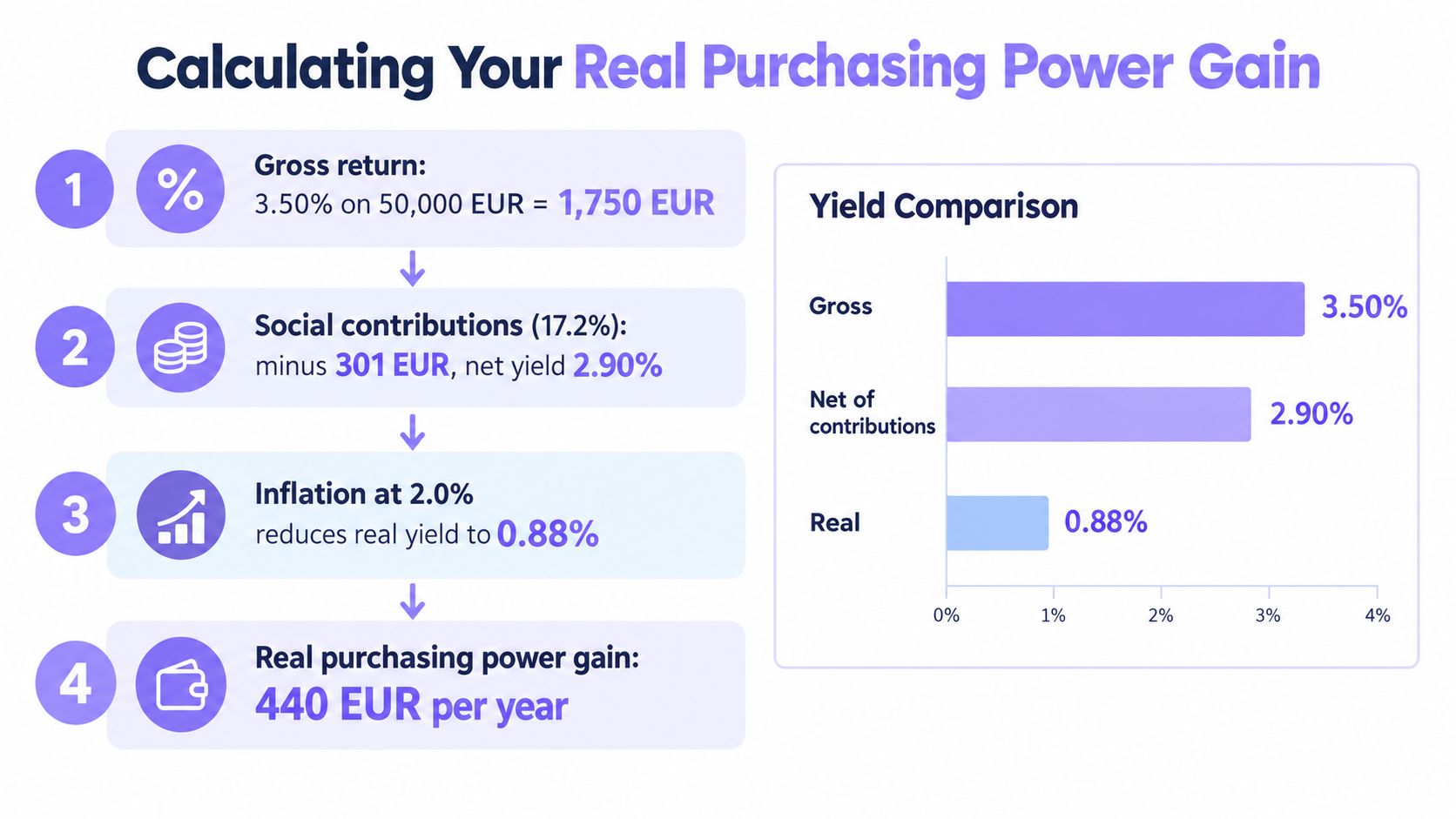
This formula is more accurate than just subtracting inflation, particularly when comparing larger differences between rates. It also makes the central point visible: a nominal return can remain positive while the actual result becomes weak or negative.
The ACPR data on euro-fund performance describes 2025 average nominal performance at about 2.6% net of management fees and before social contributions. The same source context records inflation at around 1%, which means the euro fund's purchasing-power gain was positive but materially narrower than the headline rate. A saver who stops at 2.6% misses the economic result.
Layer the calculation in the right order
Use the annual statement and contract documents to identify the following:
- Starting value: Record the capital exposed to the return during the relevant period.
- Credited revaluation: Note the rate applied to the euro-fund balance, rather than a marketing rate available only under conditions.
- Contract deductions: Confirm whether management fees were already reflected in the announced figure or deducted separately.
- Social contributions: Determine how deductions on gains affect the amount ultimately retained.
- Inflation adjustment: Compare the resulting net amount with the change in consumer prices.
- Personal tax treatment: Apply the rules relevant to the withdrawal, tax residence and contract circumstances.
The order matters because applying every deduction to the opening balance can produce a misleading answer. Some charges are taken from the contract value, while others apply to gains or withdrawals. The policy wording and annual statement should settle the treatment.
The mandatory calculation visual provides a practical illustration of how a gross return can narrow after social contributions and inflation:
A worked interpretation of recent French data
The change in inflation-adjusted performance between two years can be more important than the change in nominal performance. The reported comparison of 2025 and 2024 euro-fund results places the average revaluation rate at 2.65% in 2025, compared with 2.64% in 2024. Yet consumer inflation fell from 2.0% to 0.9%, so the inflation-adjusted return improved from 0.64% to 1.75%.
That is the lesson many yield comparisons hide. A nearly unchanged nominal rate can produce a sharply different purchasing-power outcome when inflation changes. The investor didn't necessarily receive a dramatically better product. The economic environment only allowed more of the credited return to survive in real terms.
For an international investor, this calculation should also be viewed in the investor's spending currency. A French contract may produce a positive euro real return while the investor's home currency moves in the opposite direction. Currency risk isn't part of the insurer's published yield, so someone living outside France should treat it as a separate portfolio consideration.
For a broader example of return calculation applied to another asset class, investors can consult this French guide to calculating rental profitability. The underlying discipline is the same: begin with the headline income, identify deductions, and calculate what remains economically useful.
Identifying and Minimizing Hidden Contract Fees
Fees are the part of a life insurance yield analysis that investors can influence most directly. Inflation is external, and market performance can't be controlled. A contract's pricing, however, is a design choice that can materially change the amount that remains invested and compounds over time.
The first task is to obtain the complete fee schedule. Don't rely on a summary page or a verbal description from an intermediary. Ask for the current terms, the fee table, the support-specific charges and the conditions attached to any reduced or waived cost.
Separate the three fee layers
Entry fees are charged when money enters the contract. They reduce the amount invested immediately, which means the investor starts with less capital working for future returns. Even a fee that appears small deserves scrutiny if contributions are regular or substantial.
Annual management fees are deducted for administering the policy or managing its supports. They can apply differently to euro funds and unit-linked assets, and the stated rate may not cover every cost embedded in the underlying funds. Compare the policy-level fee with the expenses of each selected support.
Arbitration and transaction fees may arise when the investor switches between supports. A contract that makes reallocation expensive can discourage sensible risk management. Conversely, free or low-cost switching doesn't make an unsuitable allocation appropriate, so the fee should be assessed alongside the investment range and service quality.
Fee audit: Ask whether each charge is taken from contributions, account value, gains, withdrawals or transactions. The location of the deduction determines how it affects the result.
Read the documents for conditions
Promotional rates often come with allocation requirements, minimum exposure to unit-linked assets or other contractual conditions. A higher displayed rate may therefore be unavailable to an investor seeking full capital protection. Record the exact eligibility condition beside the quoted performance so that you don't compare unlike products.
Check whether the contract has separate fees for advice, discretionary management, fund selection or underlying supports. A low policy fee can coexist with expensive investment funds. The reverse can also happen, so the only reliable comparison is the combined cost of the actual allocation.
The same diligence applies when evaluating an intermediary. A resource such as Bluevectis insurance solutions can help frame the range of insurance services available, but it doesn't replace reading the specific contract documents and checking how remuneration affects your proposed arrangement.
Reduce cost without increasing risk
Start with negotiation. Ask the provider whether entry fees can be removed, whether management costs differ by channel, and whether a more efficient share class or support is available. Put every concession in writing and confirm how long it applies.
Next, compare the existing policy with current alternatives. A modern online contract may offer a broader support range or simpler fee schedule, but transferring isn't automatically beneficial. Review exit consequences, tax continuity, guarantees, beneficiary clauses and the availability of the supports you need.
Finally, use the contract's annual statement as a diagnostic document. Track the amount contributed, the amount invested, the revaluation credited and every visible deduction. Investors seeking a systematic acquisition process for insurance-related enquiries can also review this guide to generating leads for insurance brokers, while keeping product selection and fee analysis separate from marketing considerations.
Optimizing Tax Efficiency and Asset Allocation
Tax efficiency isn't a separate exercise from portfolio construction. The way you allocate between euro funds and unit-linked assets affects the type of return generated, while the timing and method of accessing the contract affects how much of that return reaches you.
French life insurance is often valued for its tax treatment over time, but the benefit depends on the investor's circumstances. Tax residence, the date of contributions, the nature of the withdrawal, the policy's age and the treatment of gains all matter. Expats shouldn't assume that a French domestic advantage automatically produces the same result in their country of residence.
Treat withdrawals as portfolio decisions
A partial withdrawal can provide liquidity without closing the entire policy. It can also alter the balance between capital and gains in the amount withdrawn, so the tax result shouldn't be guessed from the cash received alone. Before withdrawing, ask the insurer for a breakdown of the taxable gain associated with the transaction.
This creates room for a more organised approach:
- Match withdrawals to spending needs: Take only the amount required rather than dismantling the whole policy.
- Use low-income periods carefully: A withdrawal may have a different tax effect when your wider income is lower, subject to the rules that apply to you.
- Preserve useful contract history: Closing and replacing a policy may remove advantages attached to its original opening date.
- Coordinate with residency: Obtain advice that covers both French treatment and the law of your tax residence.
The well-known holding-period threshold can improve access to favourable treatment, but its practical value depends on the contract history and the policyholder's situation. Don't make a withdrawal solely because a calendar milestone has arrived. Calculate the taxable portion, compare the available allowances and consider whether the remaining allocation still serves its purpose.
Rebalance without chasing performance
Asset allocation should change when the investor's objective changes, not whenever a recent performance table changes. A person approaching a known liability may gradually reduce volatile supports. Someone with a long horizon and adequate emergency liquidity may accept more market exposure, but only after defining how much loss they can tolerate.
Rebalancing within the policy can be useful because it may adjust exposure without turning the entire contract into cash. It still creates potential fees and support-level consequences, so check the arbitration terms before acting. Keep a written target allocation and compare the actual portfolio with it at review points.
The key synthesis is that tax efficiency and risk management should reinforce each other. A tax wrapper can't rescue an expensive contract, and a low-cost contract can't compensate for an allocation that forces you to sell during a market fall. The highest-quality life insurance yield is the amount that survives both the investment process and the withdrawal process.
Building a High-Performance Portfolio Strategy
A high-performing life insurance portfolio is built by measuring what remains after fees, inflation, and withdrawals, not by selecting the highest advertised rate. For a UK resident holding an older French contract, the first task is a policy audit. Review the fee schedule, available supports, guarantee terms, beneficiary arrangements, tax history, withdrawal process, and practical administration from overseas.
The existing contract may be improved without being replaced. If its provider offers suitable supports and competitive charges, changing the allocation could preserve the policy's history while reducing unnecessary friction. If the contract restricts investment choice or applies expensive charges, compare newer policies and assess whether any improvement justifies transfer costs, lost features, and additional administration.

A disciplined implementation sequence
Define the liabilities first. Separate funds required for near-term spending from capital intended for long-term growth. The first pool may need greater stability. The second can accept market movement only if the investor has sufficient liquidity and time.
Inspect the euro-fund result. The ACPR's published revaluation figures, cited earlier, provide a market reference rather than a promise that every policyholder received the same result. Compare the contract's credited rate with its charges, inflation, and any conditions attached to the guarantee. A headline gross yield has limited meaning if purchasing power still falls.
Select the risk budget. Allocate to unit-linked supports only the capital that can remain invested through adverse markets. Choose underlying assets for diversification, cost, and suitability. A recent strong result is not, by itself, a reason to increase exposure.
Remove avoidable friction. Request fee concessions, question entry charges, and check the cost of switching between supports. Also examine fund-level expenses and transaction conditions. Lower charges can improve the net result without requiring greater investment risk.
Review the actual result. Record the nominal revaluation, contract deductions, inflation-adjusted return, and change in purchasing power. Review the allocation when income, family circumstances, spending needs, or investment horizon changes.
An investor managing French and UK financial arrangements may also consult life insurance for UK homeowners, while recognising that a UK insurance solution and a French life insurance are different products with different rules.
This process cannot guarantee a forecast. It does establish what the contract owns, what it costs, how much volatility the investor can tolerate, and whether the return improves real purchasing power. That is a stronger decision base than choosing the most prominent percentage in a product table.
Request the complete fee schedule and latest annual statement. Calculate the inflation-adjusted outcome, then ask a qualified adviser to review French and cross-border tax consequences before transferring or withdrawing funds.
Wispra helps insurance businesses present their services and savings products in an AI-optimised directory, with content tools and visibility tracking for AI search engines. Visit Wispra to assess how your firm can make its life insurance expertise easier for prospective clients to discover.