You've updated your website, but customers still find the old address. Say you're a plumber in Lyon: several directories show your previous workshop, an old telephone number still appears in search, and someone calls to ask why you weren't at the address they visited. Before adding another business listing, you need to find out which versions of your business are already online.
What Local Citations Are and Why They Matter
A local citation is an online mention of your business's name, address and phone number, often accompanied by its category, website or opening hours, on a site other than your own. Practitioners shorten those core details to NAP.
For the Lyon plumber, the problem isn't a shortage of mentions. It's that the mentions describe different versions of the business. A customer who finds a dead telephone line doesn't care whether the directory has an impressive reputation.
That's the practical problem behind citation work.

References for your business identity
Think of citations as references on a CV. Each reference helps corroborate who the candidate is and what they do. If the references disagree about the candidate's employer or location, someone has to investigate.
Search and map services face a similar reconciliation problem. Consistent public details help them connect a business name with the right premises, activity and contact information. For generative engine optimisation, or GEO, those details can also provide corroborating facts for AI-generated answers, without guaranteeing inclusion.
French business information isn't static. INSEE's enterprise-demography system draws primarily on SIRENE, and one intercommunal series records 2,139 establishment start-ups in 2012 and 2,728 in 2021, approximately 27.5% more, according to INSEE's establishment-demography figures. That's a local example, not a national growth rate, but it illustrates why business directories need maintenance.
A citation is a vote for a fact, not a vote for a page.
The useful question isn't whether your business appears somewhere. Ask whether that reference gives a customer the correct information and describes the correct establishment.
An audit therefore comes before new submissions. Otherwise, you risk publishing fresh listings while leaving the most visible mistakes untouched.
Types of Local Citations and What Each One Does
Citation types, what each proves and priority
| Citation source | Examples | What it proves to search systems | Priority |
|---|---|---|---|
| Own website | Business domain, contact page | Reference wording for name, address, phone and hours | Anchor |
| Official register | INSEE SIRENE record | Legal identity, SIREN and SIRET, activity classification and location | Anchor |
| Map platforms | Google Business Profile, Apple Maps | Map location, directions, hours and category | High |
| National directories | PagesJaunes | National directory presence and consistent name, address and phone | High |
| Review and travel sites | Yelp France, TripAdvisor | Ratings, reviews and sector context | Medium |
| Sector and municipal directories | Trade federations, town portals | Specialist credibility and local relevance | Medium |
| Unstructured mentions | News articles, association pages, local blogs | Independent corroboration of identity and activity | Supporting |
Your website belongs in this table as a reference source, not as a third-party citation. The official register anchors legal identity; your contact and location pages explain how customers should reach the business today.
Map platforms are operational priorities because customers use their listings to find directions, call and check hours. PagesJaunes provides a national directory presence. Neither should be left with obsolete details while you submit to obscure sites.
Structured fields versus contextual mentions
Structured citations put information into labelled fields: business name, street address, telephone, category and hours. They're straightforward to audit because you can compare each field against your master record.
Unstructured mentions appear within articles, association pages or local blogs. A newspaper feature might identify a restaurant and its neighbourhood without publishing its full address. That can still corroborate the business, but it isn't a substitute for an accurate map profile.
The Outsend summary citing INSEE reports that 69% of French enterprises had their own or a shared website in 2023, leaving 31% without one. Businesses without a website may rely more heavily on profiles and directories, making ownership and maintenance of those accounts particularly important.
Choose sources by customer use
A restaurant should prioritise maps and relevant review platforms. A mobile electrician needs accurate contact details and service-area settings. A specialist professional should also check appropriate federation or professional-directory entries.
Use these selection rules:
- No website: Establish a reliable public reference page and claim the profiles customers already find.
- Customer-facing premises: Correct navigation, entrance details and opening hours first.
- Specialist trade: Favour relevant professional and municipal listings over unrelated directories.
Understanding how an online business directory works helps distinguish a useful listing from a submission that merely increases your spreadsheet total.
Anchor Every Listing to Official Registry Data
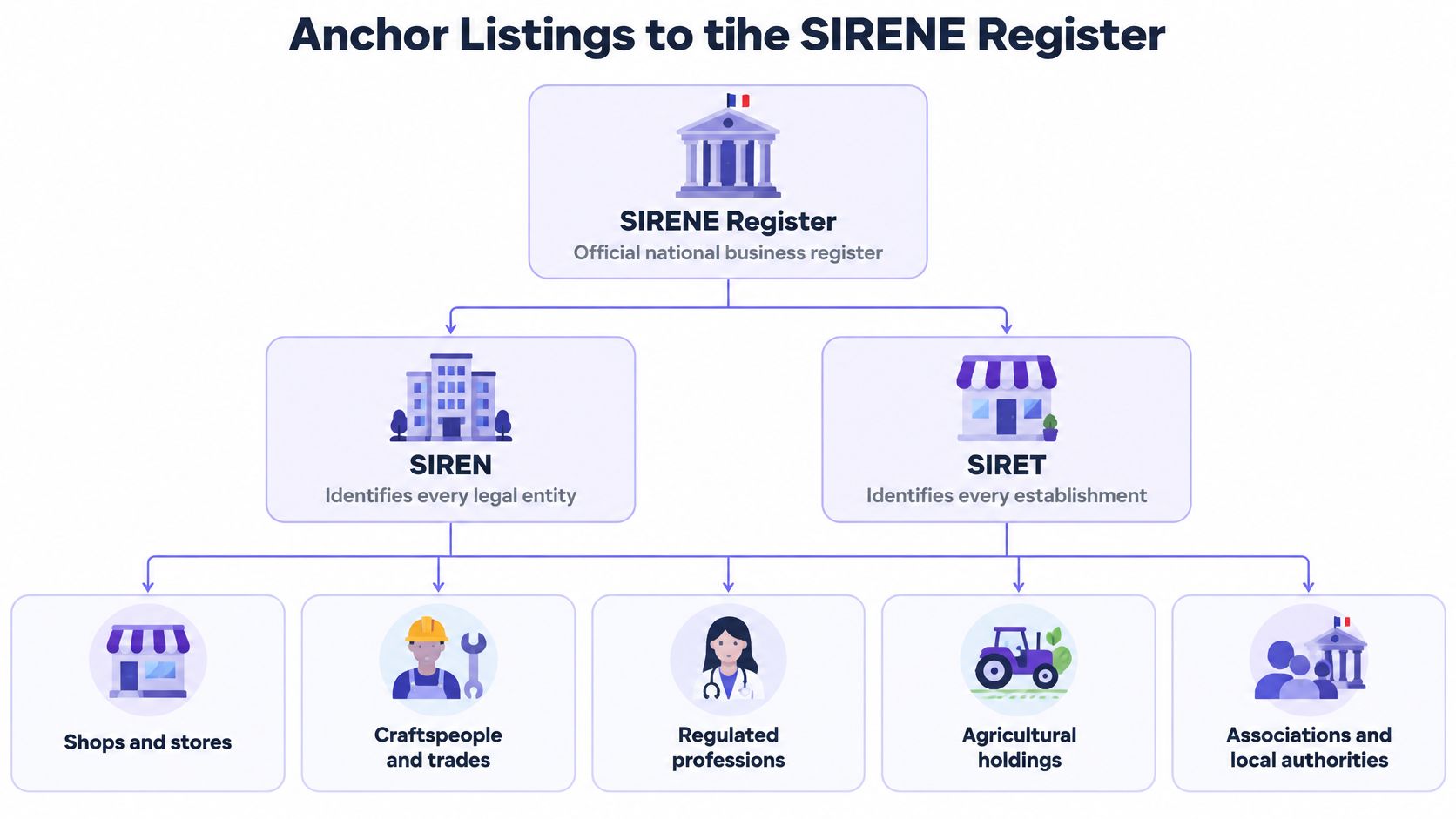
SIRENE is the identity anchor, not another marketing directory. France's registration framework requires enterprises and establishments operating in the country to be recorded, making it the authoritative starting point for business identity, activity classification and location.
As described in INSEE's official source documentation, SIRENE assigns a SIREN to each legal entity and a SIRET to each establishment, across sectors and legal forms in metropolitan France, Corsica and overseas departments and collectivities. Its coverage includes retailers, artisans, liberal professions, farmers, associations, banks and local authorities.
The distinction matters when a business has several locations.
Build the record around the establishment
Organise your records in this order:
- Enterprise: The legal entity and its SIREN.
- Establishment: Its SIRET, street address, municipality, postal code and activity.
- Public references: The listings that describe that particular establishment.
Say a company operates shops in Lyon and Villeurbanne. The company identity can be shared, but the premises must remain distinguishable. Keeping establishment identifiers in your internal records helps you resolve ambiguity when similarly named branches appear in maps, supplier databases or directories.
Create one master record per establishment, with this working field list:
Legal name, public trading name, address, postal code, municipality, activity category, phone number and URL.
Keep the SIREN, SIRET and operating status alongside those fields. Separate the legal name from the public trading name rather than forcing one into every platform's business-name field.
Verify before publishing
Use the register for the fields it establishes. Verify customer-facing telephone numbers, website URLs and hours through the business's own controlled records rather than assuming every operational detail comes from SIRENE.
A free SIRET verification workflow is a useful starting point before editing branch listings. Check the current establishment record, not an old extract saved during a previous project.
Some public fields may be restricted or anonymised. Don't interpret an unavailable name or address as proof of closure. Compare the master record with the current register extract, investigate discrepancies, and only then edit third-party references.
Which Sources to Trust When Data Conflicts
For a disputed field, prefer the highest-authority source that establishes that field. Registry information takes precedence for legal identity and establishment status. Your confirmed operating information takes precedence for customer-facing hours and contact arrangements.
A directory showing different hours from your website isn't automatically evidence that the website is right. Someone must confirm the actual schedule before correcting either page.
Discovery now spans more channels: Baseline Labs' discussion of local-business discovery reports that 19% of consumers in a 2025 survey across France, the United Kingdom, Germany and the United States used AI tools to find local businesses. That broadens the places where conflicting information can surface; it doesn't make every source equally authoritative.
Use a field-aware trust hierarchy
Apply this order when resolving conflicting business facts:
- Official register information for legal identity, establishment location and status.
- The company's controlled website and records for current public wording, services, contact details and hours.
- Major mapping and search platforms as priority publication points.
- Reputable sector and municipal directories for relevant independent references.
- Secondary aggregators after the sources above are correct.
Correct the lower-tier source when it contradicts a verified higher-tier record. If the official record itself is wrong, resolve that underlying error rather than copying it indefinitely.
Practical rule: Authority is field-specific. A register establishes legal identity; the person running the shop confirms whether it opens on a public holiday.
Score quality without inventing a total
The following is a proposed working scorecard, not a measured ranking formula. Accuracy and freshness are mandatory gates; the remaining criteria help order work among citations that pass.
Citation scorecard criteria and weights
| Criterion | What to check | Suggested weight |
|---|---|---|
| Accuracy | Name and address match the relevant official record; public name and phone match verified business information | Mandatory gate, at least three out of five |
| Freshness | Last-updated evidence, opening hours and operating status | Mandatory gate, at least three out of five |
| Geographic relevance | Municipality, postal code and service area match the business | 20% |
| Consistency | Category, services and spelling agree with approved wording | 20% |
Score each criterion from zero to five. Repair anything below half marks on any criterion, and don't pass accuracy or freshness until each reaches the stated gate.
For the weighted criteria, multiply the score by its weight to compare candidates, but don't present the result as a complete percentage score. The gates aren't assigned numerical weights.
I'd score the most visible citations first. A well-maintained reference that customers encounter deserves attention before a directory whose only contribution is another entry in a listing-count report.
How to Audit Your Citations Step by Step
Use a spreadsheet with a separate establishment identifier on every row. Keep the published value and the proposed correction in different columns so you don't lose evidence of what was wrong.
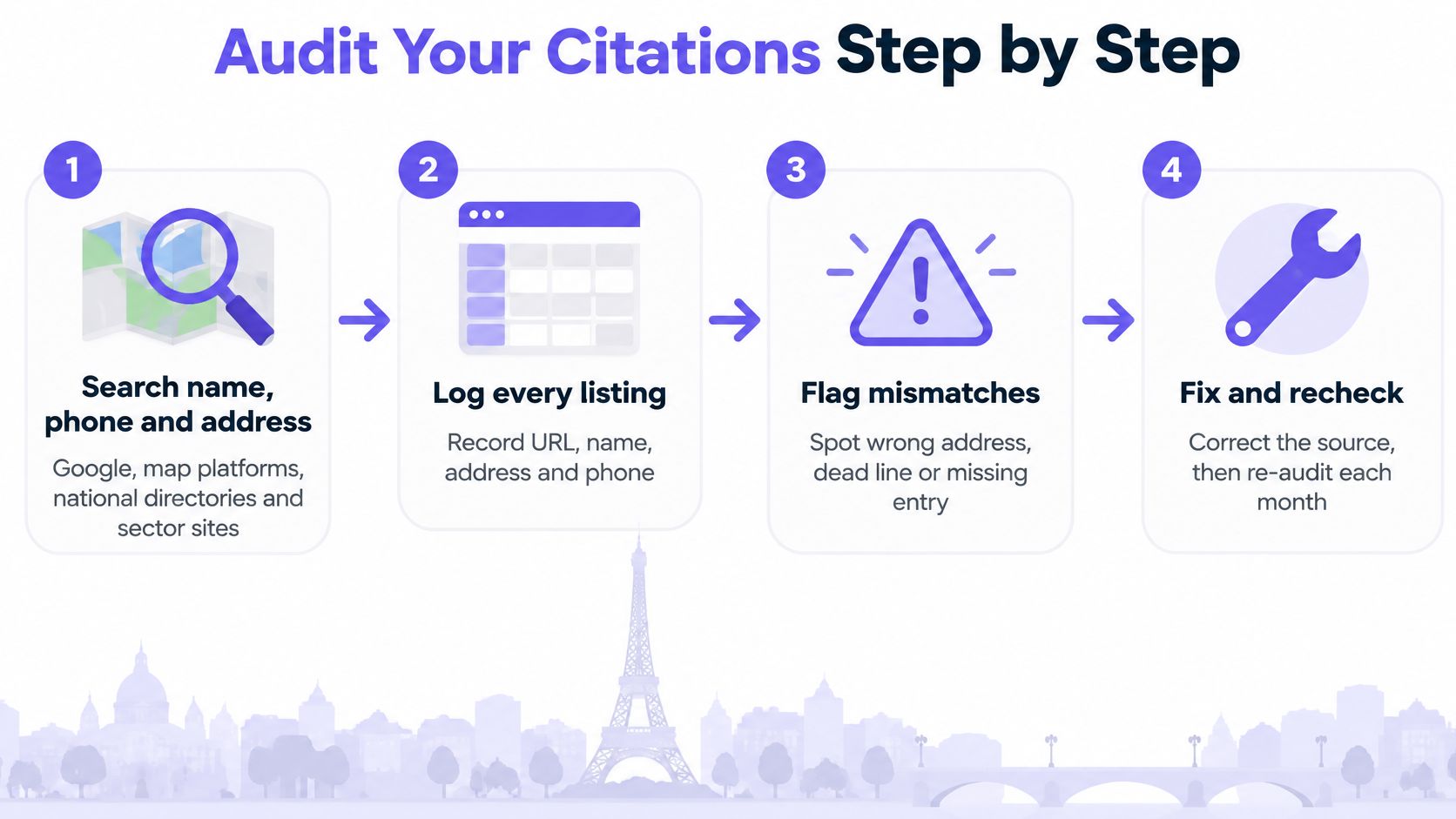
The process below combines discovery, verification and repair.
Collect and compare
Search the business identity. Search the public name, telephone number and address separately. Include former names, old telephone numbers and previous premises, then inspect maps, PagesJaunes and relevant sector sites. Save the listing URL rather than relying on a search-result snippet.
Log every usable reference. Record URL, platform, establishment, published name, address, telephone, category, hours and any visible update date. Add account ownership, correction method and a screenshot date. If no update date exists, write not shown, not an estimated date.
Compare fields individually. Check each row against the establishment master record. Distinguish a harmless display difference from a wrong fact: telephone spacing isn't equivalent to a disconnected number. Record both the discrepancy and the evidence supporting your correction.
Resolve the address identity. The Base Adresse Nationale documentation describes geolocated address objects with persistent BanID identifiers. Normalise the address against BAN, retain its identifier where supported, and compare municipality, street designation, postal code and coordinates.
Expand street abbreviations in your master wording where appropriate, but don't treat typography alone as proof of a duplicate. Accents, hamlet names and municipal changes need interpretation; identical street wording can also describe different premises.
Classify and repair
Apply the scorecard. Use the accuracy and freshness gates, then assess geographic relevance and consistency with the proposed weights. Tag each citation accurate, outdated, duplicate or wrong. Add a separate privacy flag where a residential address shouldn't be publicly displayed.
Confirm establishment status. Check the current register status before marking a location closed. Don't infer inactivity from a missing listing or a restricted public field. For map discrepancies, compare coordinates in compatible systems rather than comparing unlike values directly: mainland records may use Lambert 93, while overseas records may use UTM alongside latitude and longitude.
Correct and verify. Repair the highest-priority errors, record the submission date and retain the support reference where relevant. Reopen the public page after the correction has been accepted. A confirmation email isn't proof that the displayed listing changed.
Keep an audit trail of the original value, corrected value, evidence and verification date. That makes a recurring error diagnosable instead of merely frustrating.
A clean audit leaves each live reference attached to the right establishment, with verified core details. It also leaves a named person responsible for the next change.
Build Citations and Fix the Costly Mistakes
Start by repairing the authoritative and customer-facing sources, then build outward. Correct the registry if necessary, align your website, and publish accurate information on the major map platforms before spending time on secondary directories.
Use approved wording for the business name, address and telephone. Choose a primary platform category that reflects the establishment's actual activity, using the register classification as a cross-check rather than assuming every platform offers an identical category.
Don't add services or place names to the business name to target searches. Put those details in the appropriate category, service and description fields.
Publish the right establishment
Before submission, verify the SIRET, operating status, public name, address, category, telephone and URL using the appropriate authoritative record for each field. INSEE's SIRENE documentation distinguishes enterprise and establishment identifiers and explains a register that includes both active and closed establishments, so historical presence alone isn't evidence that a branch still operates.
For each branch, publish its own customer-facing details and link to the relevant location page. A head-office telephone number may be appropriate if it handles that branch's enquiries, but don't substitute the head-office address for the premises customers need.
For mobile services and home-based businesses that don't receive customers, use service-area settings and hide the residential address where the platform permits it. Keep the verified address internally. Don't invent an office or use a service-area description in a mandatory legal-address field.
Repair mistakes by their consequences
Common citation mistakes, why they hurt and the fix
| Mistake | Why it hurts | Fix |
|---|---|---|
| Counting listings as the goal | Weak, outdated references create more conflicting information to maintain | Keep fewer, accurate and maintained references |
| One corporate record for every branch | Separate premises become harder to distinguish | Keep each SIRET, address, phone and hours |
| Closed establishments kept as active | Customers receive the wrong operating status | Filter register records by status and close obsolete branch listings |
| Missing public field read as closure | Restricted information is mistaken for inactivity | Check the current SIRENE status before removing a listing |
| Inconsistent address abbreviations | Unresolved variants can complicate duplicate detection and map placement | Normalise addresses against the Base Adresse Nationale |
| Stale opening hours | Customers may arrive at closed doors | Update hours on every priority platform after a change |
Address abbreviations deserve proportionate attention. Av. and avenue aren't automatically different locations, and changing punctuation alone won't necessarily resolve a duplicate. Confirm the premises before requesting a merge.
A wrong holiday schedule on a prominent profile creates an immediate customer problem. Fix it before adding a low-priority directory entry.
For a practical launch schedule, reserve an initial working week for priority repairs, then add relevant directories in manageable batches. Log submission dates, account access and verification status. Recheck core identity details quarterly, review hours before seasonal changes, and trigger an immediate audit whenever a branch moves, closes or changes telephone number.
Start Tracking Your AI Visibility Each Month
Directory presence doesn't guarantee an AI recommendation. Public citations can corroborate identity, location, services and hours, but AI systems may omit a business because of retrieval limits, language coverage, freshness, personalisation or insufficient independent evidence.
Keep measurement on a recurring checklist rather than treating a new listing as a finished result.

The Hi-Commerce marketing statistics overview reports that 88% of French internet users search for a business on Google before interacting with it, while 62% of surveyed consumers across France, Germany, the United Kingdom and the United States trust AI to help discover brands. Brand-discovery trust isn't the same measure as local-search behaviour, so don't translate it into an expected referral rate.
Separate visibility from business results
Maintain distinct logs:
- Traditional outcomes: Map views, calls, direction requests and website visits, using the metrics each platform provides.
- AI outcomes: Whether your business appears, which facts are repeated, which competitors appear and whether supporting sources are attributed.
Test consistent French-language prompts combining service, city and intent. Include urgent-service requests, comparison questions and neighbourhood searches, keeping the wording and test conditions recorded.
We measure business visibility across Google AI Overviews, Google AI Mode, ChatGPT, Gemini and Perplexity. An SEO analytics dashboard can help organise monitoring, but mentions and customer enquiries remain different outcomes.
Keep the maintenance and measurement tasks connected.
Finish the audit, correct the priority sources and save your initial prompt results this month. Repeat the tests monthly, recording source attribution and factual errors alongside mentions. Judge progress from those observations, not from a promise that another directory submission will produce a recommendation.
At Wispra, we offer an AI-optimised business directory and visibility measurement to help you maintain a clear public business identity and monitor how AI systems represent it. Visit Wispra to establish a measurable starting point for your business, then use your monthly log to track what changes after citation repairs.