You've changed your opening hours on your website, but a customer still arrives after you've closed. Another caller has found an old telephone number. Meanwhile, someone asks an AI assistant for a business like yours, and the answer describes services you no longer offer.
An online business directory can help customers find you, but creating a profile is only the start. The useful work is keeping the right facts available wherever people and software look for them.
What an Online Business Directory Actually Does
An online business directory is a searchable Yellow Pages, with structured information that people and software can read. It's an indexed collection of business records, grouped by location or sector, containing names, addresses, telephone numbers, categories, opening hours and services.
Say a homeowner needs a heating engineer. A national directory such as Pages Jaunes offers broad coverage, a city directory narrows the search geographically, and a trade directory helps the homeowner compare relevant specialists.
From submission to discovery
The business submits or claims its record, completes the fields and follows the directory's verification process. The operator checks and publishes the information. Search engines, map services and AI assistants may then discover or use those published facts, although inclusion doesn't guarantee redistribution.
The structure looks like this.
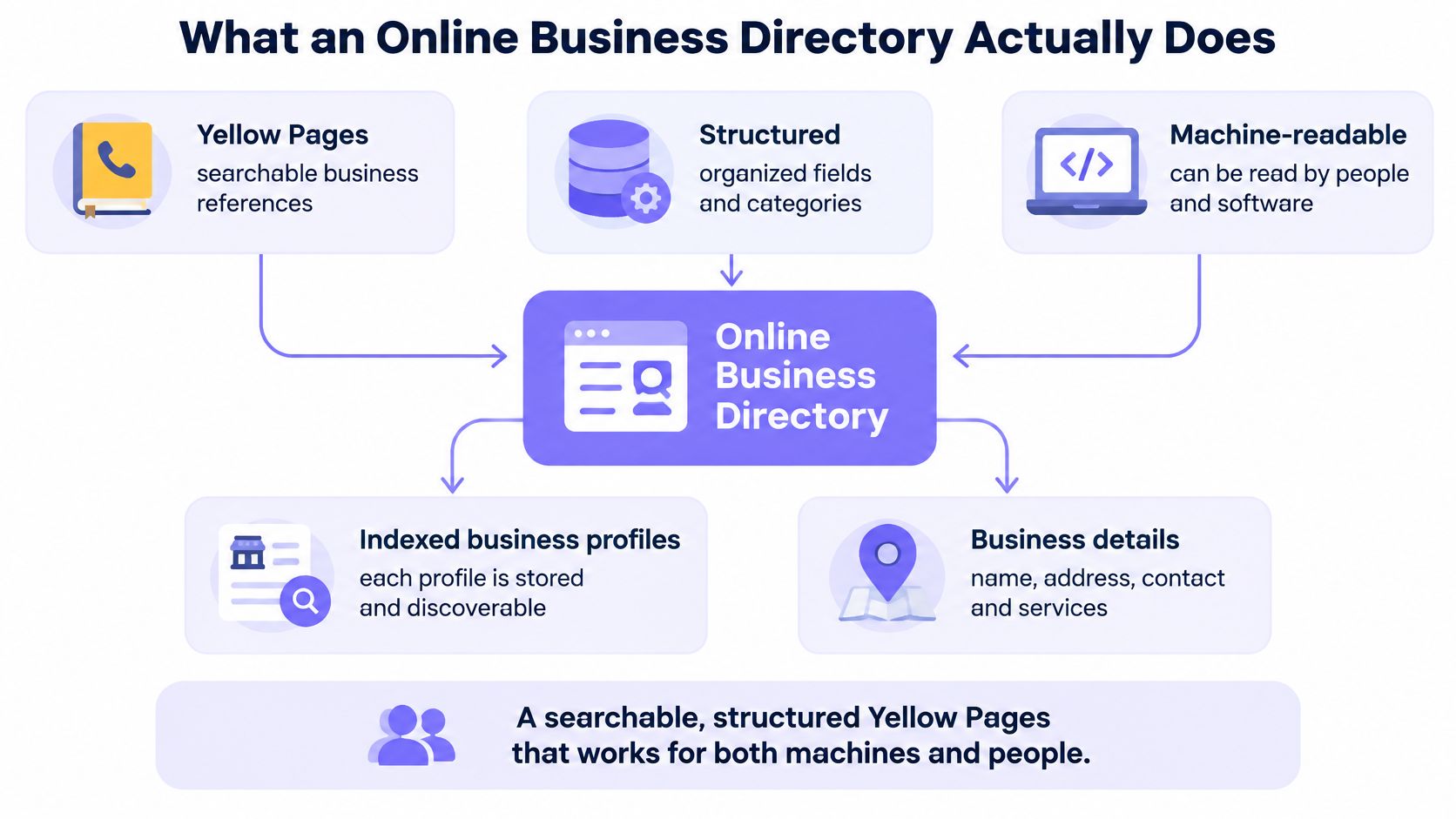
- Listing means the business's entry in a directory.
- Profile means the detailed page containing its information.
- Entity means the actual business or establishment that the record describes.
- Citation means a published mention of the business's name, address and telephone number.
French online directories are an established discovery channel, not a recent experiment: PagesJaunes Groupe's financial announcement reported 16.6 million unique visitors across its French online properties in August 2008.
For the heating engineer, the directory's value isn't another page bearing the company name. It's a customer finding the correct service, confirming availability and reaching the right person without searching elsewhere.
A directory is only as useful as the accuracy of what it says about you.
Directory Types and Which One Fits Your Business
Directory types compared by audience and effort
| Directory type | Main audience | Maintenance effort | Best for |
|---|---|---|---|
| General national directory | Very wide, all sectors | Medium | Broad brand presence and citations |
| Local city or regional directory | Nearby customers | Low | Walk-in and local service businesses |
| Map-based business profile | Mobile and map searchers | Medium, with review management | Calls, visits and directions |
| Sector or niche directory | Specialist buyers | Low to high | Trades, legal professions and real estate |
| AI-ready structured directory | Conversational assistants and people using them | Low once data is structured, with ongoing checks | Supplying facts for recommendation answers |
A general directory such as Pages Jaunes suits a business that wants a recognisable public reference. A Google Business Profile is more directly useful when customers need directions, opening hours or a telephone button. A professional or trade directory serves a narrower audience, but its visitors may already know exactly what they're buying.
An AI-ready directory isn't necessarily a separate destination with a large human readership. Its practical distinction is how clearly it publishes business facts for software to interpret. Don't confuse machine-readable formatting with a promise that an assistant will recommend you.
Choose by buyer behaviour, not directory count
Look beyond the submission form. Check how the operator verifies identity, whether customers can reach your website, whether you can correct information yourself and whether any claimed distribution partnerships are documented.
- For walk-in businesses, prioritise map accuracy and a credible local listing.
- For specialist services, favour directories where buyers filter by qualifications or expertise.
- For online shops, look for useful product, delivery and returns fields rather than an irrelevant local address page.
- For multi-location firms, insist on separate establishment records and manageable branch updates.
Start where your customers already search. Add distribution-focused directories only when you can establish where their information goes.
Practical rule: A directory deserves a place on your list only if it reaches a relevant buyer or supplies useful information to another discovery channel.
Free isn't the same as costless. A profile still needs an owner, login access and corrections after operational changes. A stale listing can send a customer to the wrong place even when you've never paid for it.
I'd maintain a short, purposeful list before paying for broader distribution. A paid placement buys exposure within that service, not better rankings or recommendations everywhere else.
Why Citation Consistency Drives Local Visibility
Suppose a plumber appears as Dupont Plomberie in a local directory and Plomberie Dupont SARL in a trade listing. That naming difference may be explainable. An old telephone number on another profile is more serious: the customer can't reach the business and calls a competitor instead.
Consistency means removing contradictions, not pretending legal and trading names are always identical. Keep the relationship between those names clear, and don't mix a registered office with a customer-facing workshop.
Make the business easy to identify
Search and map services can compare published business details when matching records. Conflicting information makes that matching less straightforward, but correcting citations isn't a guaranteed ranking improvement. Its most immediate benefit is simpler: customers receive usable information.
Keep these fields aligned:
- Identity and contact details, including the correct trading name, address and telephone number.
- Availability, including ordinary hours, appointment requirements and temporary closures.
- Geographic coverage, distinguishing places you serve from premises customers can visit.
- Profile ownership, so reviews and enquiries reach the intended establishment.
For a fuller explanation of citation mechanics, the local citation insights from Magnitude Marketing provide useful context. Apply that understanding alongside a broader local SEO maintenance approach, rather than treating directory submissions as a standalone strategy.
Give accuracy a named owner
The practical obstacle is often capacity. The European Commission's assessment of France's digital progress294_9/090166e51e13f2ac) reports that 68.45% of French SMEs reached at least a basic level of digital intensity in 2024, below the EU average of 72.91%.
A small business doesn't need elaborate software to start. It needs someone responsible for updating public information when the business changes.
Give that person access to the profiles and a simple change log. When reception changes its telephone number or the owner approves seasonal hours, updating directories should be part of the same task, not something remembered after complaints arrive.
Maintaining existing information is usually a better first fix than creating another neglected profile.
How Directories Feed Conversational AI Answers
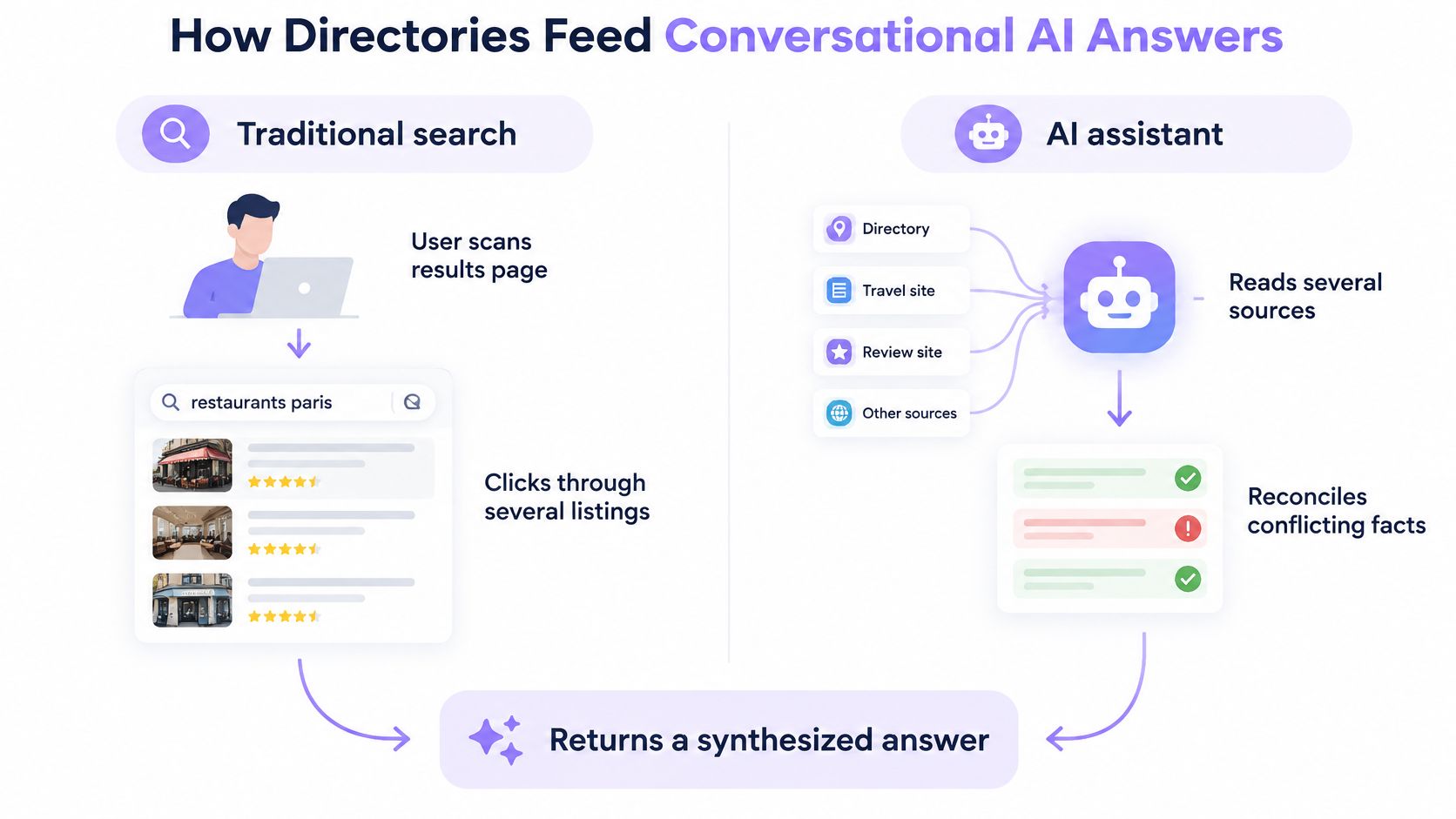
Traditional search gives the customer a results page to inspect. They open listings, compare businesses and decide which details to trust. An AI assistant may instead retrieve several sources and produce a combined answer, sometimes with citations and sometimes without enough detail to reveal every source used.
For a question about emergency plumbing in Lyon, that answer needs more than a business name. It needs evidence that the company covers the requested neighbourhood, handles the problem and is available when needed.
The discovery paths differ in an important way.
Replace vague descriptions with useful facts
A hypothetical profile might replace generic praise about quality with a specific description: plumbing and heating in Lyon's named districts, emergency callouts when available, and a clear explanation of quotation charges. Publish each promise only if the business can honour it.
That wording helps a person assess suitability and gives software clearer facts to interpret. Longer descriptions aren't automatically better.
- Structured details should state categories, hours, contact methods and service areas.
- Distinctive expertise should identify actual specialisms, not unsupported claims of excellence.
- Geographic boundaries should distinguish routine coverage from exceptional travel.
- Review evidence should retain its source and date.
- Short FAQs should answer genuine buying questions using consistent French terminology for French customers.
For complementary implementation advice, Silva Marketing's local AI search guide is useful alongside this practical guide to earning AI citations.
Separate access from recommendation
AI adoption provides context, not proof of directory performance. INSEE reports that 18% of businesses in France used at least one AI technology in 2025, up eight percentage points from 2024; that measures business use, not consumer recommendations.
According to Wispra's General barometer, 8 in 10 new profiles are read by an AI assistant by the day after they go live on the directory. Being read doesn't mean being cited, recommended or chosen by a customer.
Treat AI access, answer inclusion and customer enquiries as different outcomes.
Assistants can omit a suitable business, repeat outdated information or give different answers to similar questions. Check relevant recommendation questions regularly, but don't interpret a single appearance as a stable ranking.
Three Directory Setups in Practice
The following are hypothetical setups, not customer results. Each shows how directory choices should follow the way the business sells.
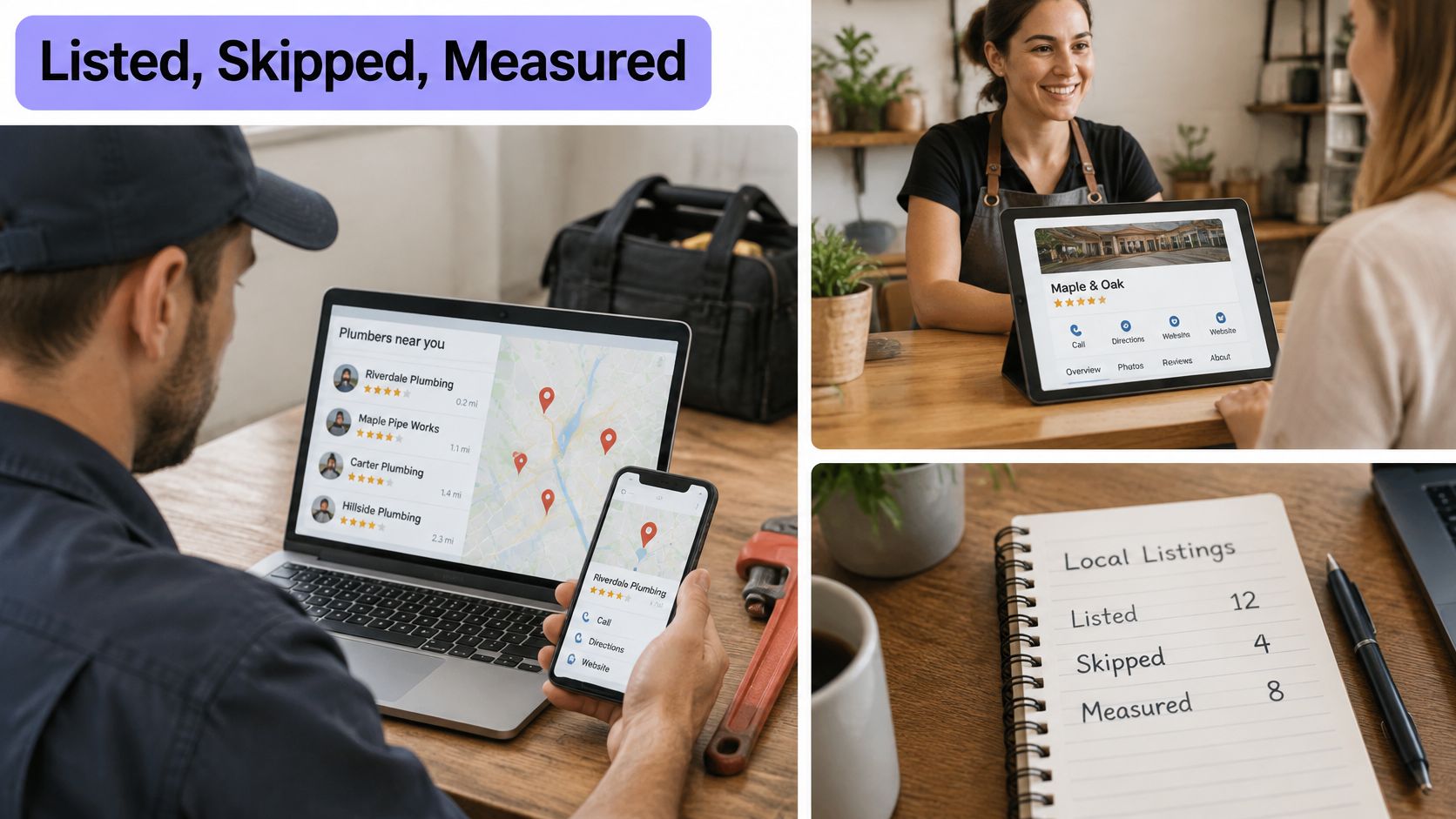
A useful audit involves checking both the public page and the mobile experience.
Marc's independent plumbing business
Marc works within a defined local radius. He maintains a map profile, a town directory and a relevant trade listing, while skipping national lead marketplaces whose enquiry terms don't suit his margins.
His first correction is an old telephone number on a forgotten page. He measures answered enquiries and booked work, not just profile views.
The lesson: fixing a broken route to contact can matter more than adding exposure.
Claire's estate agency branches
Claire manages several branches under a shared brand. Each office has its own address, contact route and service area, while the brand description stays consistent. Branch FAQs explain genuine expertise, such as support for first-time buyers.
She skips duplicate company-wide listings that would blur branch coverage. After an office opens, she checks its public details and records whether enquiries reach the right team.
The lesson: shared branding shouldn't erase establishment-level differences.
The video below offers another way to explore the topic alongside these examples.
Amira's online homeware shop
Amira publishes a store profile and exports relevant product attributes to a supported catalogue. She keeps customer reviews attributable and updates delivery information when her carrier arrangements change.
She skips walk-in directories because customers can't visit her premises. She measures qualified referral visits, product enquiries and orders, while checking whether published shipping statements remain correct.
The lesson: product suitability and fulfilment details matter more than local visibility for a shop without public premises.
Across these scenarios, the useful question is the same: does this listing help the intended buyer make a decision? A profile that attracts irrelevant enquiries still creates work, even if its dashboard looks busy.
Profile Fields to Keep Consistent
Profile fields and how often to check them
| Profile field | Why it matters | How often to check |
|---|---|---|
| Business name | Connects the trading identity with the registry and citations | Yearly, and after any rebrand |
| Address and service area | Helps customers and software distinguish location from coverage | Quarterly, and after any move |
| Phone number | Gives customers a working contact route | Monthly |
| Opening hours | Helps readers and assistants assess availability | Monthly, and before public holidays |
| Categories | Describes the business's main activity | Yearly |
| Temporary closures | Prevents wasted journeys | Before each closure, and when reopening |
| Prices or price ranges | Supports comparison when the information is current | Quarterly |
| Reviews and ratings | Provides attributable customer evidence | Monthly |
These are recommended maintenance intervals, not platform requirements. Urgent changes need immediate updates rather than waiting for the next scheduled check.
Keep identity separate from editorial content
The Sirene open-data service assigns a SIREN to each legal entity and a SIRET to each establishment, alongside official identity and activity information. Those identifiers provide more reliable matching keys than names alone.
For a multi-location business, maintain establishment records rather than forcing every branch into a company-level address. Keep descriptions, opening hours and service promises separate from registry attributes: an official record won't confirm whether your emergency team is available tonight.
Use a repeatable correction routine
Keep a master spreadsheet containing approved values, profile addresses, account owners and the last check date. The business information standardisation checklist can help you identify fields missing from that master record.
- Find the public profiles. Search the business name and inspect the directories customers are likely to encounter.
- Compare high-risk fields. Prioritise telephone numbers, hours, addresses and closure notices.
- Submit corrections. Check the published page afterwards, not just the saved editing form.
- Log the outcome. Record unresolved issues and assign follow-up responsibility.
Set holiday closures before they begin and restore normal availability when the business reopens. Review prices and service areas quarterly, with immediate corrections whenever commercial terms change.
Don't overwrite historical reviews or imply that every rating belongs to every branch. Accurate attribution matters as much as an attractive average.
How to Get Listed Step by Step
Start with identity, not promotional copy. INSEE's description of its business-register infrastructure explains how Sirene records legal units and establishments, giving French directory operators a reference for identity, activity classification and operational status.
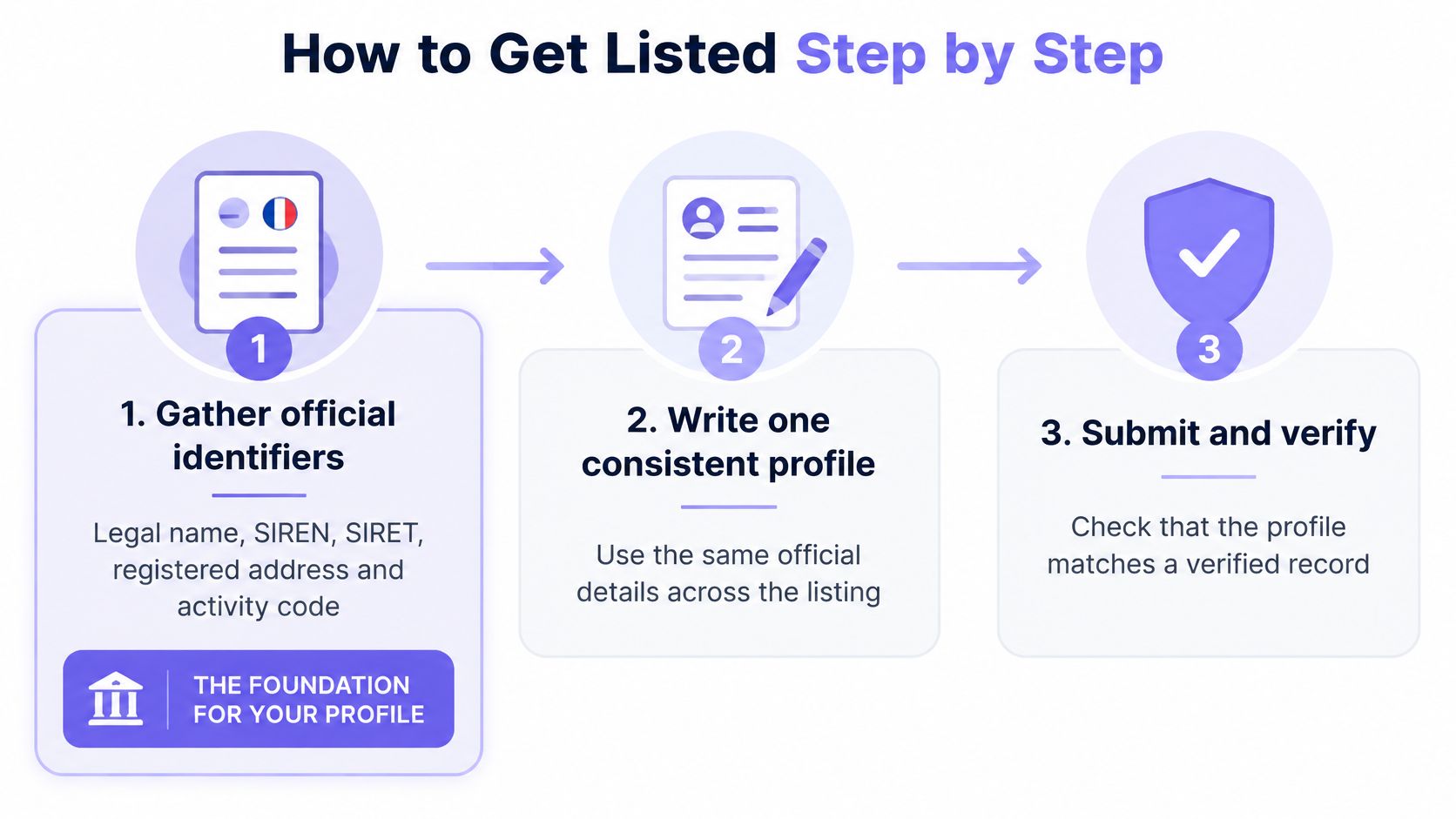
The foundation comes before the description.
Prepare, publish and verify
Gather the official identity details. Collect the legal name, SIREN, relevant SIRET, registered address and activity code. Check that you're using the establishment customers should find, rather than automatically copying head-office information.
Create the master version. Approve the public-facing name, contact details, ordinary hours and coverage area before submission. If the trading name differs from the legal name, explain that relationship instead of alternating between them without context.
Choose the closest available categories. Use the directory's own category list and select the principal activity first. Adding unrelated categories to attract extra searches can produce unsuitable enquiries and confuse customers about what you do.
Write a concise, factual description and useful FAQs. Name the services and places you cover, then answer practical questions about availability, quotation arrangements and emergency work. Avoid guarantees, qualifications or response promises that you can't substantiate.
Add evidence that belongs to the business. Upload current photographs and relevant certifications where supported, and request genuine customer reviews without scripting the verdict. Check that images show the correct premises and that credentials apply to the activity being advertised.
Claim, verify and inspect the published page. Complete the verification method the directory offers and retain the account details securely. Test contact buttons, website links and directions from a customer's device, then schedule a follow-up inspection after publication.
Check the destination before submitting widely
If you're expanding beyond local discovery, StartupSubmit's resource on how to submit your startup to directories can help organise the submission process. Still assess audience fit individually; a startup showcase and a neighbourhood service directory serve different buying intentions.
At Wispra, official company registry data is connected in France today. Registry matching supports identity checks, but the business must still confirm customer-facing information that isn't held in the official record.
For businesses managing their own directory software, bulk validation also needs care. The Sirene open-data API documentation specifies 30 requests per minute for open-data usage, making bulk files, caching and queued checks more suitable than unrestricted individual lookups.
Publication isn't the finish line. The useful milestone is a correct public page that someone can act on.
Track Results and Start Your Free Profile
Directory results to track and what healthy looks like
| Metric | Where to find it | Healthy sign |
|---|---|---|
| Profile views and direction requests | Directory and map dashboards | Relevant engagement improves after corrections |
| Calls from directory listings | Phone log or carefully configured call tracking | Customers reach the intended team |
| Website visits from listings | Web analytics referral report | Relevant visitors reach useful landing pages |
| Citation accuracy check | Manual audit of priority directories | No conflicting name, address or telephone details |
| AI mentions of the business | Repeated test questions to AI assistants | The business appears accurately in relevant answers |
| Review count and average rating | Each directory's review page | Genuine feedback accumulates with clear attribution |
Record a baseline before making changes, then review these measures monthly. Save the correction date alongside the figures so you can distinguish work completed from results observed.
A rise in views isn't proof of more customers. Direction requests may reflect genuine interest, but they don't confirm visits; referral traffic may increase without producing suitable enquiries.
Measure useful outcomes, not dashboard activity
Ask the person answering calls to record the enquiry source when practical. Use tagged website links where the directory allows them, and keep attribution consistent rather than changing tracking methods halfway through a comparison.
- For service businesses, record whether enquiries match the service area and lead to bookings.
- For branches, check whether customers contact the intended office.
- For online shops, connect referrals with product engagement and orders where analytics permits.
- For every business, note seasonal changes or promotions that could explain movement independently of directory work.
Be cautious with tracking numbers. Replacing a public number inconsistently can recreate the contact problems you were trying to fix.
Give AI visibility its own check
Repeat realistic customer questions and save the assistant, wording, date and response. Record whether the business is named, whether its details are correct and whether a source is cited. Keep the questions stable enough to compare, while recognising that answers can change between runs.
A useful result isn't only being mentioned. It's being described accurately for a question the business can satisfy.
Wispra serves real estate, insurance, hospitality, e-commerce and multi-location businesses. Setup starts with your company name, and we publish the resulting profile in a format AI engines read.
Make profile creation a scheduled task this week, using your approved master information. Inspect the public result promptly, resolve any errors and review the first monthly record before deciding whether to add more directories.
Wispra offers a free directory profile and an AI visibility report at no cost, with no credit card required. Visit Wispra to start with your company name, then check the published facts so people and AI assistants can find an accurate account of your business.