With teletransmission, the total mutual reimbursement delay is typically 7 to 12 days, with Assurance Maladie taking about 5 days and the mutual paying roughly 2 days later. Without teletransmission, the wait can extend beyond 15 days, sometimes reaching 30 to 40 days, while you generally have 2 years to submit a reimbursement claim.
You've paid for a consultation, checked your bank account, and still see nothing. The natural reaction is to blame the mutual, but the money often hasn't reached that stage yet. French healthcare reimbursement works like a relay race: Assurance Maladie runs the first leg, then sends the information to your complementary insurer for the second leg.
That distinction makes a practical difference. A short wait after a Carte Vitale claim can be normal, while a manual claim may need follow-up much sooner. The processing clock tells you when payment should arrive. The legal clock tells you how long you have to request a missed reimbursement. Understanding both helps you avoid unnecessary panic, identify the blocker, and protect your right to claim.
Introduction to Mutual Reimbursement Delay Timelines
After a consultation with your primary care physician, you use your Carte Vitale and leave the office thinking that the reimbursement will follow automatically. A few days later, Assurance Maladie pays its share. The complementary insurer may take over shortly after. If teletransmission doesn't work, the same file follows a paper trail instead, with a feuille de soins, statement, and manual sending.
The question "How long does it take for a mutual reimbursement?" therefore does not have a single answer. The payment resembles a two-step relay race: Assurance Maladie first processes the request, then the mutual receives the information and calculates its contribution. With teletransmission, the total wait is generally 7 to 12 days, about 5 days for Assurance Maladie, then 2 days for the complementary insurer (Groupama's explanation of mutual reimbursement).
Practical rule: Count the delay from the moment the concerned organization receives usable information, not from the appointment date.
Two deadlines must be distinguished:
- Current processing: a covered file often circulates in a few days when electronic exchange works.
- Validity of the request: for many reimbursements, the statute of limitations or foreclosure rule is 2 years from the care, including for certain acts not covered by Social Security (AG2R La Mondiale's reimbursement guidance).
This long period serves as a safety net for a forgotten bill or an unsubmitted request. It does not justify waiting for a missing payment. If the request has already been sent, quickly check its status: you will know if the first relay, the second, or your own file is slowing down the payment.
The relay model allows you to read the delay step by step, instead of looking for a universal duration.
How Mutual Reimbursement Works in France
The process becomes clearer when you separate it into stages. The patient starts the journey, Assurance Maladie handles the obligatory part, and the mutual acts only after it has the information needed to calculate the complementary amount.
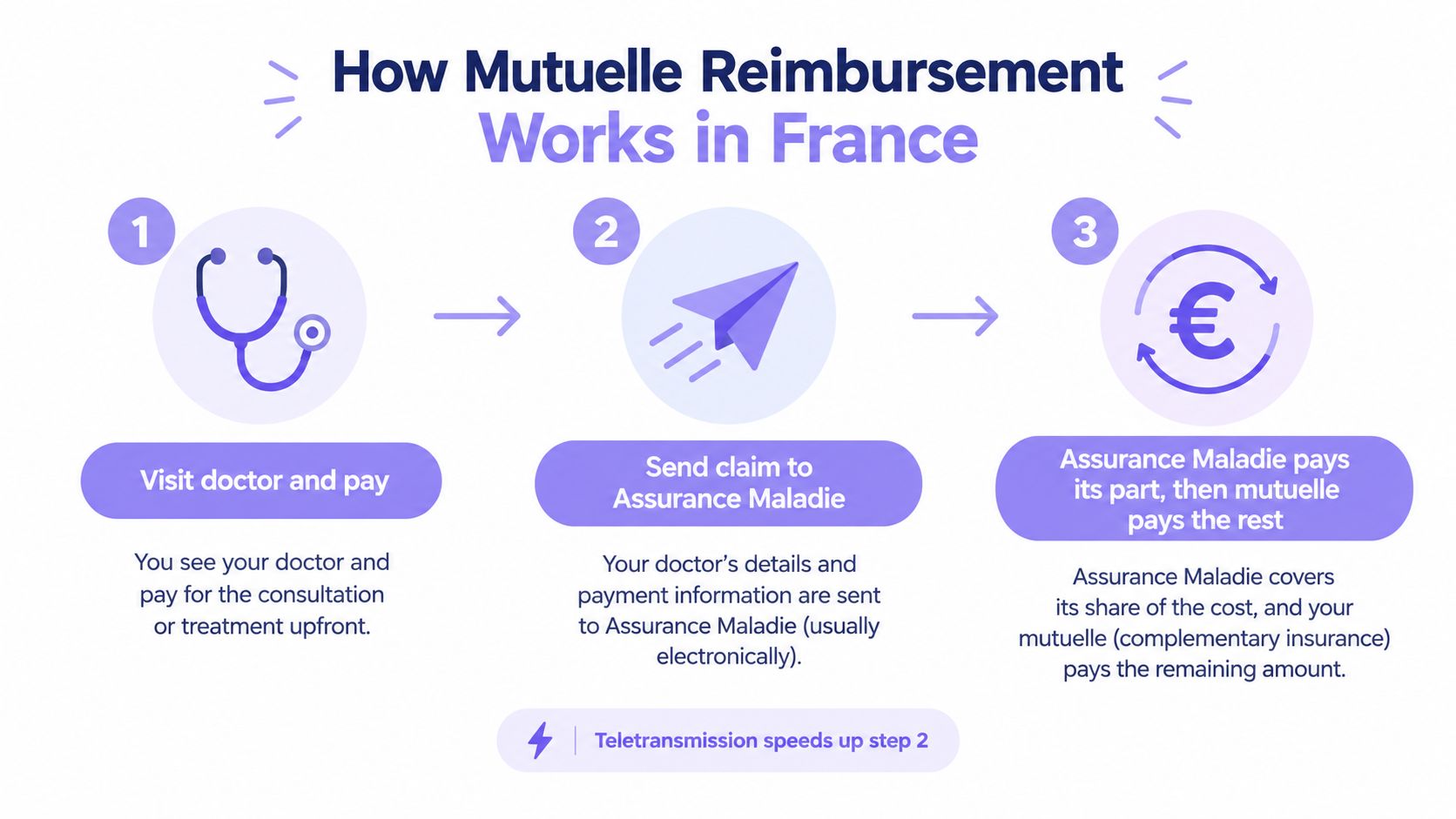
The three stages of the relay
First, you receive care and the claim is created. At a consultation, the healthcare professional may use your Carte Vitale. That electronic record identifies the treatment and sends the relevant information into the reimbursement system. If the professional can't transmit electronically, you may receive a paper feuille de soins instead.
Second, Assurance Maladie processes its share. The obligatory insurer checks the claim and issues its reimbursement statement. With teletransmission enabled, the statement can then be sent electronically to your complementary insurer through the NOEMIE exchange.
Third, the mutual receives the handoff and pays its share. It doesn't normally calculate the complementary amount before it knows what Assurance Maladie has processed. That's why the mutual may appear to be waiting even though the original claim began at the doctor's surgery.
Where NOEMIE fits
NOEMIE is the electronic handoff between Assurance Maladie and the complementary insurer. It reduces the need for you to download a décompte and send it manually after every eligible claim. The Carte Vitale starts the digital route, while NOEMIE helps the two insurers exchange the reimbursement information.
If the link isn't active, the relay runner has to return to the starting point with paperwork. You may need to send the Social Security statement, an invoice, or another supporting document through the mutual's online portal or by post.
People comparing cover should also understand the wider insurance vocabulary around claims and reimbursement. For broader context on how insurance guidance is organised across different care situations, Integrity Together LLC insurance guidance offers a separate resource. For French readers choosing their complementary cover, this guide to choosing a health mutual can help you assess the contract before a claim ever arises.
Typical Delays With and Without Teletransmission
A consultation can follow two different relay races. In the electronic route, the first runner is Assurance Maladie, then the mutual takes over. With manual processing, paperwork must travel between stages, so each handoff can add waiting time or create a request for missing documents.
| Claim route | Assurance Maladie stage | Mutual stage | Overall expectation |
|---|---|---|---|
| With teletransmission | About 5 days | About 2 days afterwards | Roughly 7 to 12 days |
| Without teletransmission | Paper processing adds roughly 1 to 2 weeks before the statement is issued | Manual review follows receipt of documents | More than 15 days, sometimes 30 to 40 days |
| Online claim for care outside Social Security coverage | No CPAM reimbursement stage for that expense | Often under 5 days after online submission | Usually quicker than postal filing |
| Postal submission | Paper processing and document handling | Review after receipt | Several weeks can occur |
These timings are practical reference points, not a promise from every insurer or contract. The type of care, the documents supplied, and the policy terms can change the result.
What the comparison tells you
The first runner often determines the wait. Assurance Maladie commonly takes about 5 days, while the mutual may add only about 2 days after receiving the statement. Contacting the mutual immediately after treatment may therefore be too early, because the file may still be with the first insurer.
Manual filing lengthens the race. A claim can take more than 15 days, and some cases can reach 30 to 40 days when documents or postal delivery are involved. For care outside Social Security coverage, an online submission can take under 5 days, while postal processing may take several weeks, as explained by LeComparateurAssurance's explanation of reimbursement delays.
This distinction also helps diagnose the delay. If no Assurance Maladie statement exists, the first runner has not finished. If the statement is available but the complementary payment is missing, the second runner is the one to check.
A waiting period before coverage begins is a separate issue. The guide to the mutual waiting period explains eligibility delays, not the time needed to pay a claim that has already been accepted.
Why Your Reimbursement Is Slow and How to Spot the Blocker
A delayed payment usually has a location. Your task is to find which handoff failed instead of treating the whole process as one unexplained delay.
If CPAM is the slow runner
Start with your Ameli account. Look for the treatment record and the associated reimbursement statement. If the consultation or treatment isn't visible, Assurance Maladie may not have received the claim, or the professional may have used a paper process.
A missing CPAM statement means the mutual may have nothing to process. In that situation, asking the complementary insurer to pay first usually won't solve the problem, because its calculation depends on the obligatory scheme's information.
If the mutual is holding the file
If the Ameli statement exists but no complementary payment appears, check the mutual portal. Look for a received document, a pending request, a rejected invoice, or a message asking for additional evidence. The mutual may need an invoice, a treatment plan, or proof that the expense is included under your contract.
Care outside the Social Security route can follow a different path. For example, people dealing with providers outside a standard insurer network may need to understand the supporting evidence required for an out of network reimbursement before submitting a claim.
If your own file is incomplete
Some delays come from the insured person's side:
- Missing documents: The invoice or Social Security statement wasn't attached.
- Incorrect bank details: The payment was issued but couldn't reach the intended account.
- Inactive teletransmission: Your current mutual isn't linked to your Assurance Maladie file.
- Uncovered treatment: The contract excludes the service or requires a prior estimate.
- Duplicate coverage: Another complementary insurer may still be registered for NOEMIE.
The fastest diagnosis is simple. Find the last confirmed event, then contact the organisation responsible for the next step.
Documents and Steps to Ensure Fast Reimbursement
Fast reimbursement starts before you leave the healthcare provider. Use the electronic route where it applies, then keep a clean record for anything that must be submitted manually.
Before and during treatment
Present your Carte Vitale and confirm that your personal details are current. If you've recently changed insurer, check that the new mutual has requested or activated the NOEMIE connection. A digital link can't function correctly if an old complementary insurer remains attached to your file.
Ask whether the provider can transmit electronically. If not, request the paper feuille de soins and keep it safe until Assurance Maladie confirms receipt. For optical, dental, hospital, or other planned care, ask for a detailed devis before treatment if your contract requires prior approval.
For a manual claim
Prepare the documents as one complete file:
- Social Security statement: Include the relevant décompte when the expense has passed through Assurance Maladie.
- Invoice: Make sure the provider, patient, date, treatment, and amount are readable.
- Prescription or treatment plan: Add it where the care or contract calls for supporting medical documentation.
- Devis and prior agreement: Include these for planned care when the mutual asks for them.
- Bank details: Check that the insurer holds the correct RIB.
Upload the file through the mutual app or member portal when possible. Online submission avoids postal handling and gives you a digital receipt, provided you save the confirmation screen or email.
A short cover note can prevent confusion: identify the insured person, treatment date, provider, claim type, and the exact document attached. Don't send several unclear photographs when one legible PDF contains the complete file.
How to Check and Accelerate Your Pending Reimbursement
A reimbursement can seem stuck even when one organisation has finished its part. The process works like a relay race with two runners: Assurance Maladie sends the statement first, then the mutual uses it to calculate and pay its share. To find the delay, identify the last confirmed handoff before contacting anyone.
A practical tracking sequence
Start with Ameli. Check whether the treatment appears in your reimbursement history and whether a statement has been issued. If there is no trace, contact the healthcare provider to confirm the transmission. You may need to submit the feuille de soins yourself.
Check the mutual portal next. Look for the date the statement arrived, the claim status, and any request for an invoice or supporting document. If the statement appears in Ameli but not in the mutual account, ask whether NOEMIE is active and whether the exchange was received. A working tiers payant arrangement can also change what you need to pay upfront, but it does not remove the need to check a missing claim.
Review your bank details and recent transactions. The mutual may have processed the reimbursement while an incorrect RIB prevented the transfer. Check the payment history rather than relying only on an expected date.
Messages you can send
To Assurance Maladie:
Hello, I'm following up on the treatment dated [date] with [provider]. It isn't visible in my Ameli reimbursement history. Could you confirm whether the claim was received and whether a paper feuille de soins is required?
To your mutual:
Hello, I'm following up on the Social Security statement dated [date]. Could you confirm whether you received it through NOEMIE, whether any document is missing, and whether my claim is currently accepted, pending, or rejected?
Add your membership number, treatment date, provider's name, and the amount shown on the statement. Avoid sending sensitive medical details unless requested. Keep confirmation emails, upload receipts, and copies of documents. They show when you submitted the request if the file later cannot be found.
The 2-year legal claim window protects many reimbursement requests, including some care outside Social Security coverage, as noted earlier. It is a final deadline, not a reason to wait. Check the last confirmed step first, then contact the organisation responsible for the next handoff.
Real Examples of Reimbursement Timelines and Next Steps
A GP visit with a working Carte Vitale usually follows the shortest route. The claim starts a two-stage relay: Assurance Maladie processes its part in about 5 days, then the mutual may pay approximately 2 days later. The full wait is often around 7 to 12 days, as covered in the delay table above. If the mutual payment is missing after the CPAM statement appears, the second runner is probably where the handoff needs checking.
A specialist visit without teletransmission takes a different route. You may need to send a feuille de soins or statement manually, so the total delay can exceed 15 days and sometimes reach 30 to 40 days. First confirm that Assurance Maladie processed the paper claim. Only then ask the mutual to investigate its part.
Optical or dental treatment can add another checkpoint. The insurer may request a devis, invoice, or contract-specific evidence. For care outside Social Security coverage, an online claim may take under 5 days, while postal submission can take several weeks. Check the contract before treatment, because prior approval may be required.
Use this checklist today:
- Check Ameli: Is the treatment and statement visible?
- Check the mutual portal: Has it received the information?
- Check documents: Is the invoice, feuille de soins, or devis complete and readable?
- Check NOEMIE: Is the correct mutual connected?
- Protect the claim: Keep submission evidence and act well before the 2-year prescription window.
Wispra helps businesses present services, opening hours, photos, and contact details in an AI-optimised directory for tools such as ChatGPT, Perplexity, Gemini, and Google AI. Visit Wispra to make your organisation easier to find when customers seek local information.