You're a freelance consultant in France, working from a laptop, delivering projects on trust and getting paid only after the client accepts the result. Then a client says your advice caused a costly mistake, your website launch missed a commercial deadline, or a data error disrupted an internal process. A complaint that began as an email can become a demand for compensation, legal correspondence and a dispute over what your contract really promised.
That's the practical reason to understand RC Pro freelance cover. Your micro-entrepreneur status may simplify administration, but it doesn't erase professional liability. The right policy won't prevent every disagreement, and it won't cover every business loss, but it can stop one professional incident from becoming a personal financial crisis.
Why RC Pro Matters for Every French Freelancer
A web designer delivers a new site. The client later claims that a configuration error caused a sales campaign to fail. A consultant sends advice based on incomplete information, and the client argues that the resulting decision created a loss. A copywriter misses a critical legal disclaimer in a campaign. None of these situations requires bad faith or dramatic negligence. A misunderstanding, omission or deadline problem can be enough to start a serious dispute.

The immediate cost isn't always the compensation itself. You may need to preserve emails, reconstruct the project timeline, review the brief, respond to a formal letter and obtain legal advice. If the client alleges material, bodily or immaterial damage, the conversation quickly moves beyond whether you feel the complaint is fair. It becomes a question of evidence, contractual duties and the financial consequences of professional fault.
The micro-entrepreneur misconception
Many freelancers assume that a micro-entrepreneur structure creates a protective wall between the business and the individual. It doesn't. The status affects how you register and manage the activity, but it doesn't remove your obligation to answer for damage allegedly caused by your professional work.
French insurers describe RC Pro as protection against damage caused to third parties during professional activity, including situations involving professional mistakes, omissions or negligence. Hiscox's explanation of RC Pro for freelancers also shows why the product has become widely marketed to consultants, digital workers and other independents.
Clients increasingly ask for an insurance certificate before signing, particularly when you handle confidential information, advise on business decisions or work inside a larger project. Even where the law doesn't require cover, a contract may make it a practical condition of doing the work. Managing invoices and cash flow with a freelancer finance automation tool can help keep the business organised, but automation won't transfer liability for the advice or deliverables you provide.
Practical rule: Treat the client's insurance requirement as a commercial condition, not an administrative nuisance. If the contract asks for RC Pro, arrange it before work begins.
Without cover, you may have to fund advice, negotiation, expert input and compensation from your own business resources. That exposure is especially uncomfortable for solo professionals whose revenue depends on a small number of projects. RC Pro doesn't make a weak contract stronger, but it can give you a structured response when a routine freelance problem becomes a formal claim.
Understanding RC Pro and Professional Liability
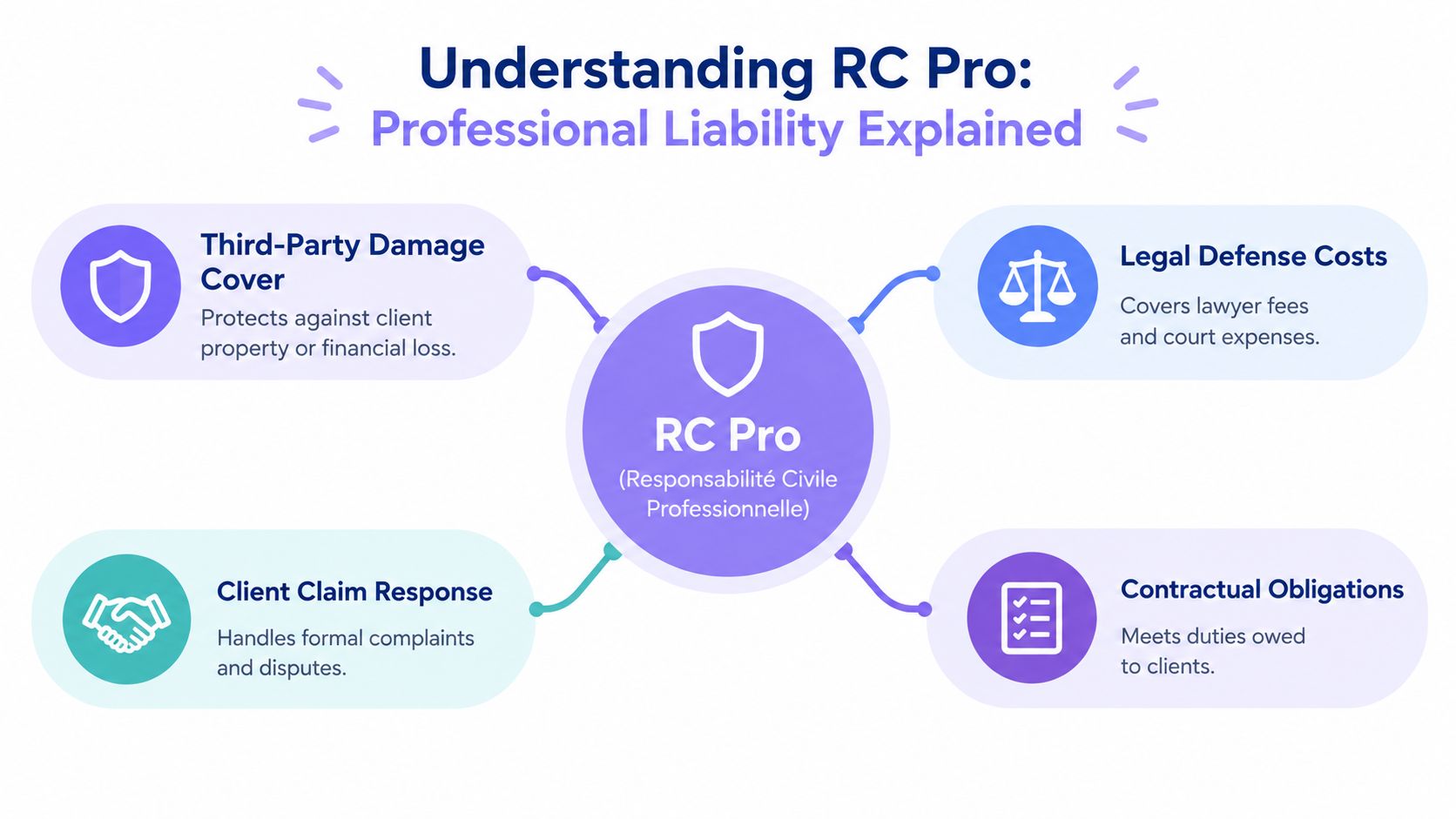
RC Pro means Responsabilité Civile Professionnelle, or professional civil liability insurance. In plain terms, it's a financial safety net for claims that say your professional activity caused damage to another person or organisation.
The useful analogy is not a magic shield. Think of RC Pro as a claims-response system attached to your work. If a client alleges that your error, omission or negligence caused harm, the policy may help manage the financial consequences, subject to its wording, limits, exclusions and deductible.
French professional-insurance explanations identify three broad categories of damage:
- Bodily damage, where a person suffers physical harm connected to the professional activity.
- Material damage, where property, equipment or tangible assets are damaged.
- Immaterial damage, involving financial or other non-physical loss. This is often the least intuitive category for consultants, writers, designers and digital specialists.
Immaterial damage is where many freelancers underestimate exposure. A deliverable can be technically intact while still being alleged to have caused a financial loss. A recommendation may not damage a physical object, yet a client can argue that relying on it led to wasted expenditure or lost opportunity. The policy wording determines whether and how such a claim is handled.
What the policy is actually doing
RC Pro generally focuses on liability to third parties, rather than ordinary losses inside your own business. It can be relevant when a client or another affected party alleges that your professional conduct caused damage. That distinction matters because freelancers often expect one policy to cover every operational problem, including unpaid invoices, stolen equipment, cyber incidents or a project that merely performs below expectations.
It may also support the response to a dispute, depending on the policy. Legal defence, negotiation and compensation aren't interchangeable benefits, so read the wording rather than assuming that “legal protection” is automatically included.
If you work across borders or engage contractors, separate employment and contracting arrangements may create additional questions about who is responsible for what. An EOR for global teams resource can help clarify employment-related structures, but it doesn't replace a review of your own professional liability policy. For a French-focused overview, compare the definitions and exclusions in this professional liability insurance guide.
When RC Pro Is Mandatory Versus Recommended
The legal question is profession-specific, not just a question of whether you call yourself a freelancer. French sources explain that RC Pro isn't universally mandatory for independent workers, while regulated activities can impose an insurance obligation. The relevant test is what you do, not merely how you invoice.
The mandatory side includes regulated sectors such as healthcare, law, construction, real estate, finance, tourism and private security. A professional operating in one of these areas should verify the applicable rules, licence conditions and sector requirements before trading. Construction-related work can also involve other forms of liability and insurance, so a basic online RC Pro quote may not be enough.
A practical comparison
| Situation | Legal position | Commercial reality |
|---|---|---|
| Regulated profession | RC Pro may be legally required for the activity | Proof of cover can be necessary to operate or maintain authorisation |
| Consultant, designer, writer or marketer | Generally not universally required | Clients may still require a certificate in the contract |
| Digital freelancer handling client data or systems | Obligation depends on the activity and regulatory context | A claim can still arise from an omission, error or negligence |
| Micro-entrepreneur | The status itself doesn't remove liability | Personal exposure remains a business decision to manage |
For most consultants, designers, writers and similar service providers, the risk isn't a statutory filing requirement. It's the possibility that a client or third party alleges professional fault and seeks compensation for bodily, material or immaterial damage. Allianz's explanation of professional responsibilities in France makes this distinction between legal obligation and civil liability exposure clear.
Why “recommended” still has weight
A client contract can require insurance even where legislation doesn't. The clause may specify a minimum limit, ask for a certificate, require cover for subcontractors or impose a duty to maintain the policy throughout the engagement. Failing to meet that condition may create a contractual problem separate from the underlying professional complaint.
That gives you three checks to make before accepting work:
- Identify the activity. Is your service part of a regulated sector?
- Read the contract. Does the client demand RC Pro, a particular limit or territorial scope?
- Assess the exposure. Could an error affect money, property, people, data or a client's operations?
A micro-entrepreneur isn't automatically exempt, and a non-regulated freelancer isn't automatically safe. Optional cover becomes sensible when the cost of defending or resolving one dispute would be difficult to absorb.
Coverage Details and Typical Costs in France
A claim can expose a freelancer to more than the cost of repairing an error. It may involve a client's financial loss, a third party's property, legal defence and disputes over whether the work matched the contract. A useful policy review therefore asks four questions: what damage is covered, who is covered, where the work is covered and how much the insurer may pay.
French RC Pro policies commonly address bodily, material and immaterial damage caused to third parties during professional activity. The protection depends on the activity declared and the policy wording. Per-claim limits for independents often fall within the €1 million to €8 million range, depending on the profession and terms, as described by Hiscox's information on professional liability limits and claims. Choose the limit against the largest contractual requirement you face and the potential consequences of an error, not by habit.
What to check before comparing prices
A low premium has little value if your real work falls outside the declared activity. Check whether the policy covers:
- Professional activity wording, including every service you sell.
- Third-party damage, with bodily, material and immaterial loss clearly addressed.
- Defence and dispute handling, including lawyers and experts.
- Territorial scope, especially when clients, suppliers or assignments involve another country.
- Retroactive or completed-work terms, where a complaint arrives after delivery.
- Subcontractors and collaborators, if another person contributes to the assignment.
- Exclusions, particularly cyber incidents, intellectual property disputes, contractual penalties and deliberate acts.
RC Pro does not cover every business risk. Equipment damage, business interruption, legal protection, cyber incidents and unpaid invoices may require separate cover or an extension. Ask the insurer to explain these boundaries in writing. A policy label alone does not show whether the cover responds to the dispute you are most likely to face.
Typical pricing structures
French providers advertise entry-level RC Pro offers from about €12.70 to €13 per month, or approximately €152 to €156 per year. Comparison material also places many freelancer offers around €15 to €35 per month, depending on activity and risk. French market pricing information for freelance professional insurance provides annual reference points for modular cover.
| Coverage Type | Approximate Annual Cost | Key Inclusions |
|---|---|---|
| Basic RC Pro | About €170 per year | Professional liability for covered third-party damage |
| RC Pro plus legal protection | About €220 per year | RC Pro with an additional legal-protection component |
| Broader multirisque professional cover | About €300 per year | Wider business protection beyond RC Pro alone |
These figures reflect typical French market offers, not guaranteed quotes. Turnover, profession, limits, deductible and optional extensions affect the final premium. Paying slightly more can make sense when the policy covers the service you provide and handles disputes properly. Paying for broad cover that excludes your main work leaves the central risk unresolved.
For a separate risk category affecting self-employed workers, review protection and income cover for non-salaried workers. RC Pro does not replace income protection or personal social cover.
How to Obtain RC Pro as a Freelancer
A client reports damage after using your deliverable. Your contract assigns responsibility to you, while your policy excludes the service you performed. At that point, having a micro-entreprise does not reduce the underlying liability. Your business structure may simplify administration, but it does not erase contractual duties or claims for professional mistakes.
Start the application with the work you sell, not the lowest monthly premium. The insurer needs to know whether you advise, execute, configure systems, handle personal data or equipment, and use subcontractors.
A practical application checklist
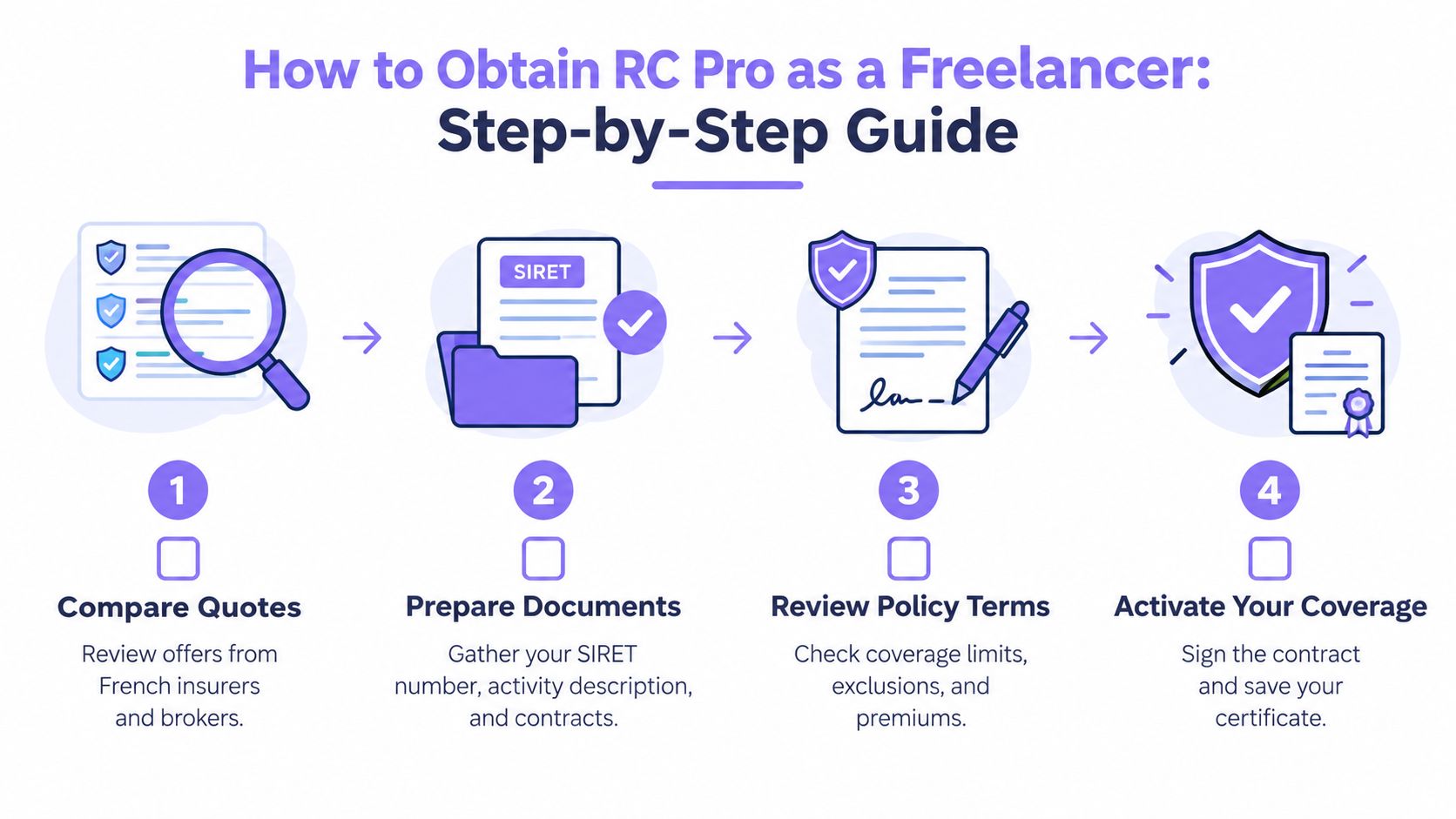
1. Describe each service precisely. List your activities in ordinary language. “Consulting” may be too vague if you also configure software, manage advertising campaigns or give operational recommendations. Accurate wording helps the insurer assess the risk and gives you evidence that the policy corresponds to the work promised to clients.
2. Prepare the core documents. Keep your SIRET number, business details, activity description, estimated turnover, sample client contracts and previous claims information ready. The insurer may also request a RIB. Existing certificates can reveal overlapping cover or gaps before you buy another policy.
3. Compare insurers and brokers. Request quotations using the same activity description. Ask each provider to confirm limits, deductibles, exclusions, territorial scope and the process for handling a claim. A direct insurer and a broker may present similar protection differently, so read the policy wording rather than relying on the sales summary. This comparison of an agent general and a broker explains the difference between these distribution roles.
4. Examine exclusions before signing. Check whether the policy addresses data incidents, intellectual property allegations, subcontracting, work performed outside France and disputes about contractual performance. Ask for written clarification where the answer is unclear. A certificate alone cannot show these limits.
5. Keep the full file. Clients often ask for the certificate, but the policy wording determines the protection. Store both with the relevant contracts, declarations and renewal information. Recheck the documents whenever your services change.
What to do when something goes wrong
Do not wait for the client to use the word “claim”. Preserve the contract, brief, deliverables, messages and version history as soon as you learn about a complaint, alleged error or event that could cause loss. Avoid admitting liability or promising reimbursement before reviewing the evidence and the policy.
Notify the insurer promptly and follow the procedure in the contract. The notification period may be short, so record when you first became aware of the incident, send the report through the required channel and keep proof of delivery. Provide a factual chronology, without speculation or an admission of fault.
When a complaint arrives: document first, notify promptly, and let the insurer guide the formal response.
Under-declaring turnover, omitting a new service or assuming subcontractors are covered can leave a micro-entrepreneur personally exposed. Review the policy whenever your offer, contracts or delivery process changes. Discovering the mismatch after a client complaint is too late.
Optimizing Your RC Pro Policy for Value and Protection
Optimisation isn't about buying the largest policy. It's about removing the gap between the work you sell, the promises in your contracts and the protection your insurer has agreed to provide.
Begin with the contracts that matter most. If a client requires a specific liability limit, territorial scope or certificate, use those requirements as the baseline. Then consider your own exposure. A consultant giving strategic advice, a designer delivering brand assets and a developer accessing production systems don't face identical risks, even if all three work remotely.
Four decisions that improve value
Match limits to consequences. A low limit may look economical until a client contract demands more or a single error affects several parties. A higher limit isn't automatically justified, but the decision should reflect the assignment and the client's requirements.
Define every service. Policies can become unreliable when the declared activity is vague. Update the insurer when you add training, implementation, data handling, project management or subcontracted delivery. Precise wording may prevent an argument about whether the incident arose from an insured activity.
Separate risks that need separate products. RC Pro addresses professional liability, not every threat to a freelance business. Cyber incidents, equipment loss, business interruption, legal expenses and income protection may need distinct cover. The right add-on is the one connected to a real exposure in your work, not the one bundled into a convenient package.
Review the policy at renewal and after major changes. Check turnover, clients, services, geography, subcontractors, limits and exclusions. A policy that fitted a solo copywriting practice may not fit an agency model or a consultancy handling sensitive systems.
Value test: A cheap policy is only economical if it responds to the work you actually perform.
Keep a short evidence file for each significant project. Store the signed scope, assumptions, approvals, delivery record and change requests. Good documentation won't eliminate liability, but it gives you and the insurer a clearer factual record when the client's account differs from yours.
For freelancers who also want to manage how AI search engines discover and describe their business, Wispra offers a free directory profile and an AI visibility report, with a Performance plan covering visibility measurement across multiple levers. That sits alongside RC Pro rather than replacing it, because visibility management and liability protection solve different business problems.
Review your insurance before the next contract, not after the next complaint. Confirm the activity wording, check the client's requirements, save your certificate and create a five-working-day notification process so you can act calmly if an incident surfaces.
Wispra helps freelancers publish a business profile that AI search engines can read and provides visibility reporting for real-world questions about their services. Visit Wispra to create your profile, review how your business appears in AI search, and build a clearer digital presence alongside your professional risk protection.