A French business owner searches for a service they offer and sees a competitor above them, again. The competitor's site isn't necessarily better, and it may not even sell the same thing. But it owns the result that prospective customers see. A useful SEO competitor analysis replaces guesswork with a closer look at who wins visibility for the searches that matter, and what's helping them do it.
In France, that means looking beyond a list of rival businesses. Your search competitors might include a local directory, a comparison site, a national retailer or a specialist publisher. And as AI-generated answers become another place where people discover businesses, the competition increasingly extends beyond traditional rankings.
Why SEO Competitor Analysis Matters in France
A French SMB can do many things well on its own site and still lose the customer before the first click. The reason is usually sitting one or two positions above it: a rival page that matches intent better, a map pack that takes the call, or an AI answer that names a competitor before the searcher reaches any website.
Search in France is concentrated enough that the first question is simple: who is winning Google? StatCounter's French search market figures put Google at 88.16% of search-engine market share in France in September 2026, compared with Bing at 5.47%, Yahoo at 2.75%, Ecosia at 1.34%, Qwant at 0.86% and DuckDuckGo at 0.84%. Smaller engines still matter; a French audit should start where most demand is decided, then check edge cases only if the market justifies it.
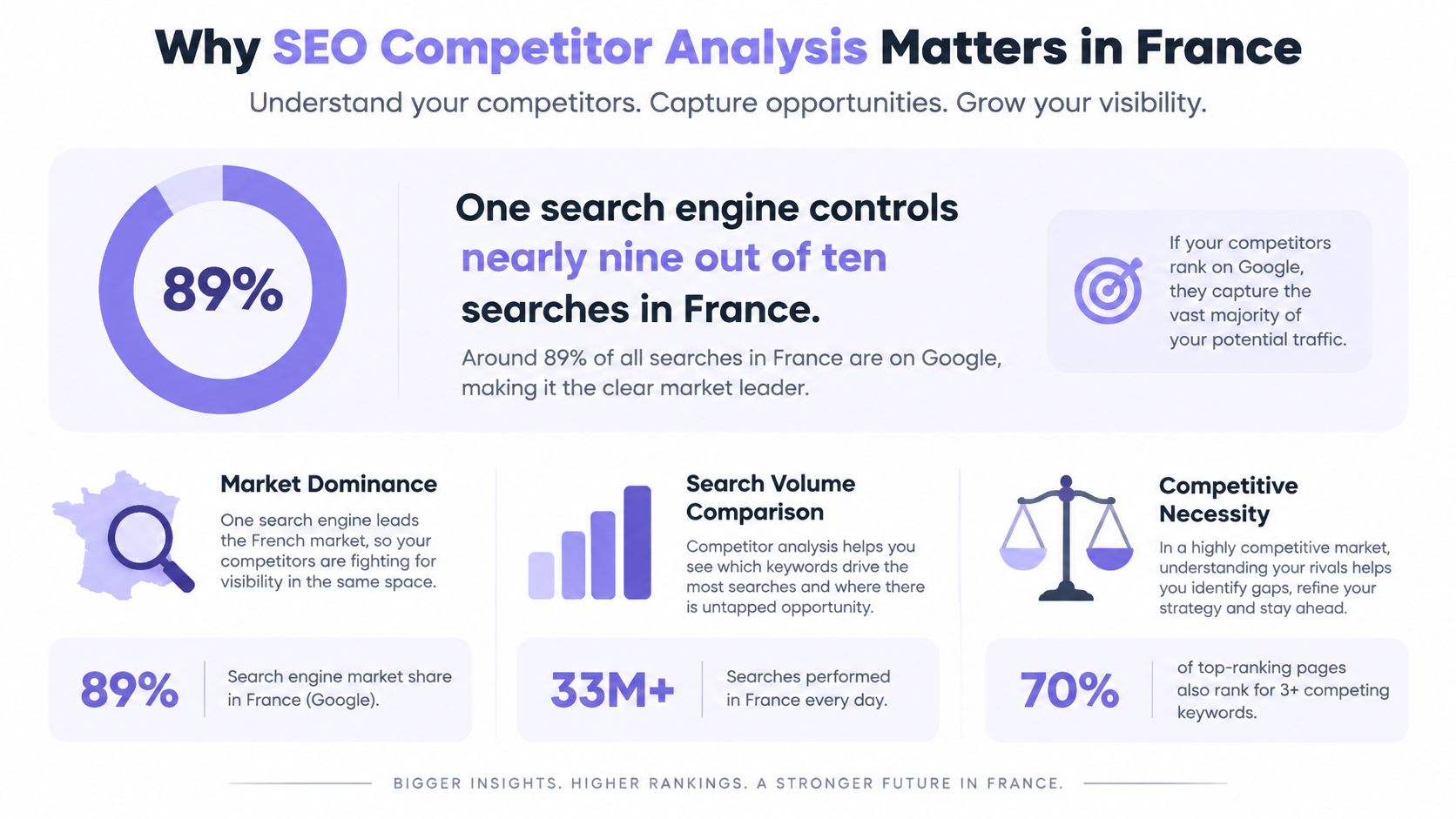
Useful analysis treats a rival's position as evidence about the result page. Does the ranking page answer in French faster, price more clearly, show proof closer to the query, or match a town-level intent your homepage ignores? For many local businesses, the contest has two fronts: classic organic results and map discovery. The ARCOM online-platform observatory reported 46.7 million daily internet users aged 12 and over in France for the first half of 2024, with Google Search and Google Maps each reaching more than 40 million monthly internet users.
The 2026 twist is that visibility no longer ends at blue links. When an AI summary cites two suppliers and skips yours, or a zero-click result answers the question before your page is seen, a competitor can gain trust without winning a visit. I've seen audits miss this because they stopped at position tracking; the fix is to record which brands are named, cited or shown when the search engine completes the job itself.
Practical rule: Treat competitor rankings as evidence about the search result, not a template for your strategy.
Agencies and consultants can fold the same process into client work without exposing the machinery behind it. For background on packaging that service, see this resource on white label SEO under your brand.
Identifying Your Real Competitors
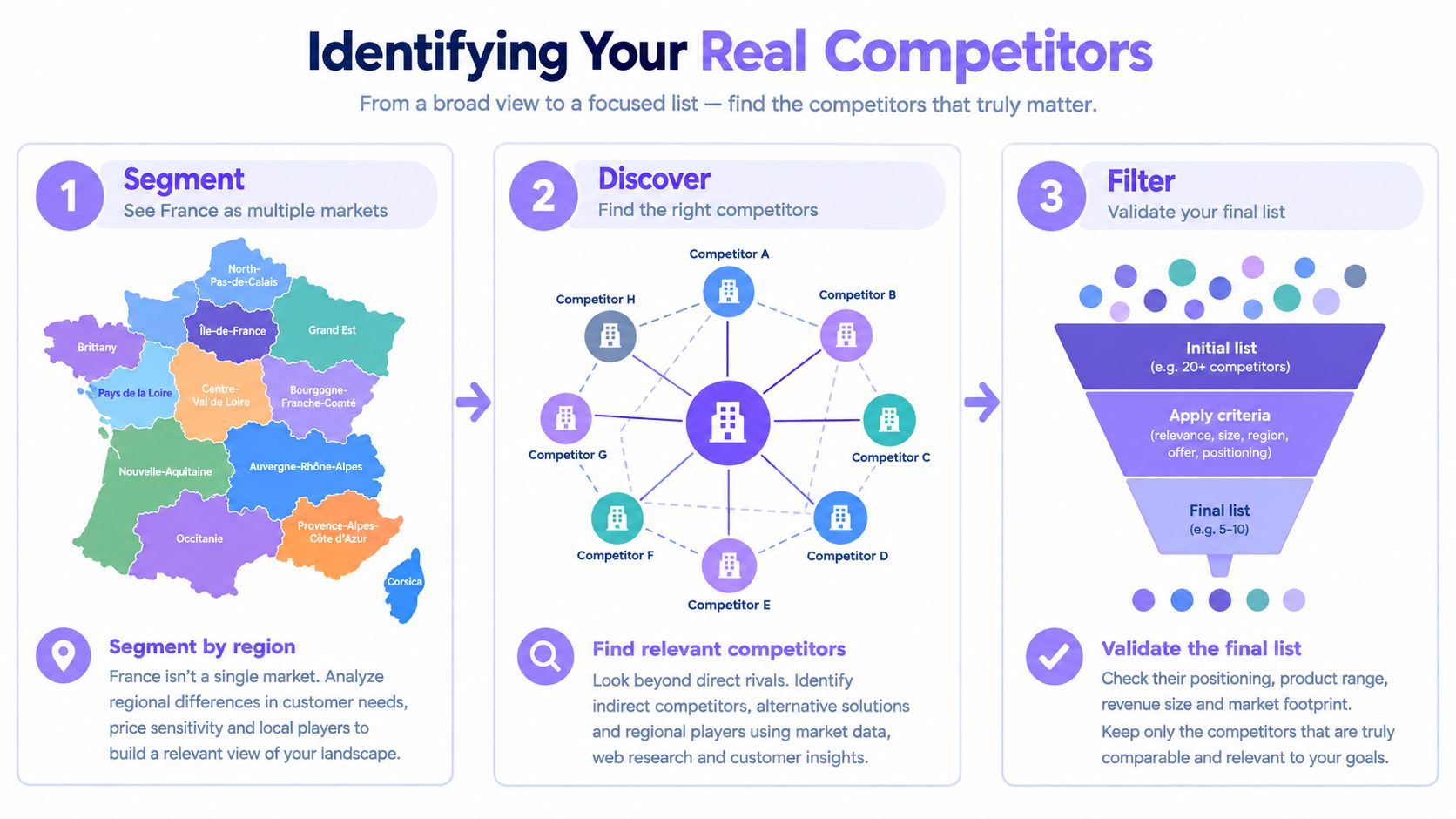
Your business rivals and your search rivals aren't always the same. A French estate agent might compete commercially with other agencies in the same city, but search results for a neighbourhood property query could also feature a listing portal, a national brand or a local guide. Build the competitor set from the results themselves.
Segment the queries before comparing domains
Start with a keyword universe grouped by intent:
- Transactional: searches that suggest a customer is ready to buy, book or request a quote.
- Local: searches tied to a city, area or nearby service.
- Informational: questions people ask while learning about a product, service or problem.
- Branded: searches for your business, a competitor or a product name.
Then separate the results by geography and device. A national French query and a local search in Lyon may return very different businesses. Likewise, a page that performs on desktop may not be the competitor a customer sees on a phone.
That mobile distinction matters in France. Google represented 94.27% of French mobile search share in the cited 2025 benchmark, compared with 75.20% on desktop and 89.95% across devices, according to the French search-engine market benchmark. Make mobile checks part of the initial research, not a later quality-control task.
Build a repeatable search sample
For each query group, search French-language variants and note the top organic results. Record the domain and the ranking URL, then mark the intent, geography and device context. Look for domains that appear across several relevant queries; a single appearance may be incidental, while repeated visibility points to a competitor worth studying.
Don't count a directory and its individual listing pages as separate business competitors. Keep the domain-level view, but preserve the page-level detail so you can see which content is earning visibility. Remove results that don't serve the same audience or intent, even if they rank prominently.
A shared worksheet is often enough to make this useful. For teams building a broader research process, this SubmitMySaas competitor analysis guide offers another reference point for organising competitor observations. The important thing is consistency: compare like with like, and don't use a national desktop result to draw conclusions about a local mobile search.
Auditing Competitor Content and Keywords
Once you've identified the domains that matter, shift from “who ranks?” to “which page ranks, and why might it fit the query?” One domain can have a strong service page and a weak article. Comparing brands alone hides that distinction.
For each target query, record the ranking URL, its apparent intent, title structure, content coverage, internal links and structured data. Note whether the page uses French terminology that customers use, answers the core question early, and provides commercial proof such as clear service details or product information. A page's length alone doesn't tell you whether it satisfies the search.
Score visibility by intent
A simple position-weighted score can help compare competitors without pretending every result is equally valuable. Give positions 1–3 considerably more weight than positions 8–10, then compare scores within each intent cluster. Keep mobile visibility prominent, and don't merge a local query with a national informational one just because they share a keyword.
| Intent Cluster | Mobile Weight | Position 1–3 Value | Position 8–10 Value |
|---|---|---|---|
| Transactional | High | Highest | Low |
| Local | Highest | Highest | Low |
| Informational | High | High | Low |
| Branded | High | High | Low |
The table is a decision aid, not an industry standard. Choose a scoring scale, apply it consistently and use the result to find which competitor is strongest for a particular type of search. A domain that ranks broadly for low-intent questions may be less commercially threatening than a local business that owns the results customers use to book.
Track visibility and traffic separately, too. One cited benchmark reported that French stores received 72.7% of total traffic from SEO. Another reported that French Shopify stores saw a 38.5% year-over-year decline in SERP visibility alongside a 16.3% decline in organic traffic. Those figures illustrate why sessions alone can conceal a deterioration in rankings. The French ecommerce industry report is the source for both benchmarks.
When assessing a content shortfall, look for missing subtopics, confusing page structure, thin internal pathways or weak localization. A guide for home service businesses can help frame keyword comparisons for that sector. For your own pages, use a structured content audit to decide whether the right move is to improve, consolidate or create content.
Comparing Backlinks and Technical Health
A competitor with more visible links isn't automatically stronger in every way. A single authority score can't tell you whether relevant sites link to the right page, whether the site is technically accessible or whether the page matches the query. Compare evidence across the backlink profile and the site's technical foundations.
Use the same checklist for every site
Review the following areas for your own pages and the competitors you've selected:
- Indexability: Can search engines discover and index the pages that should appear?
- Canonicalisation: Do canonical tags point to the intended version, rather than splitting signals across duplicates?
- Hreflang: Where a site serves multiple languages or regional versions, are language alternatives signalled appropriately?
- Mobile rendering: Can a customer use the page comfortably on a phone, including key navigation and forms?
- Structured data: Is the markup valid and relevant to the page?
- Performance: Does the page load and respond well enough to support a usable experience?
For links, look beyond a headline count. Inspect referring domains, the linking pages, topic relevance and which competitor URLs attract links. A list of domains that link to several competitors can help identify relevant associations, local publications or industry resources to investigate. It doesn't mean you should pursue every link you find; judge each opportunity for relevance and editorial legitimacy.
The useful question isn't “Who has the biggest score?” It's “What evidence makes this competitor easier to discover and trust for this query?”
Keep the comparison clean. Don't mix a national SERP with local results, and don't treat duplicate URLs as separate competitors. For a deeper look at the link side of an audit, use this competitor backlink analysis resource.
A technical review can also help explain why apparently similar pages perform differently. If a competitor's page is indexable and well structured while yours has a rendering or canonical issue, publishing more content won't fix the underlying obstacle. This technical benchmarking walkthrough can support a consistent review process.
Mapping Gaps to an Action Plan
An audit becomes useful when it changes what the team does next. Start with searches where at least two relevant French competitors appear in the top results. That pattern suggests a topic or need worth examining, but it doesn't automatically mean you should create another page. First work out what kind of gap you have found.
Classify each opportunity as content, authority, technical or local relevance. A content gap may mean the current page fails to answer an important customer question. An authority gap may mean relevant publishers or organisations link to competitors but not to you. A technical gap could be an indexability problem. A local gap might involve incomplete business information or weaker coverage of a service area.
Compare effort with business value
For each priority query, inspect the pages that rank. Check their topical coverage, French phrasing, author or entity signals, internal-link paths, commercial proof and page experience. Then write down what a better answer would add. That might be clearer service details, a stronger explanation of a local process or more useful navigation, not more copy.
Score the work by expected business value and effort. A high-value opportunity with a clear fix belongs ahead of a costly project whose relevance to leads or sales is uncertain. Keep the assessment grounded in your own customer journey: a search that attracts curious readers may be less valuable than a local query that leads to a booking. In my audits, the fastest wins tend to sit in the content and local categories, where a focused change can ship in days rather than a quarter.
As noted earlier, a large share of local discovery in France runs through Maps, so include map-pack presence as a scored line item rather than an afterthought. A competitor can hold a modest website and still win customers if their listing is complete, reviewed and well placed.
Turn the shortlist into an execution plan with an owner, a specific change and a measurement method. For content work, measure non-branded impressions, position, click-through rate and qualified actions by intent. For technical fixes, confirm that the issue is resolved and that the intended URL can be crawled. For local improvements, check whether the business information and customer-facing details are accurate and complete.
Re-score the list every quarter. Gaps shift as competitors publish.
Copying a rival's page rarely wins. A more useful answer, with better French localization, stronger evidence and a clearer path to action, usually does.
Including AI Citations in Your Analysis
A Google ranking audit can miss competitors who appear in AI answers. That's a serious blind spot if customers ask conversational tools for recommendations, comparisons or local options before visiting a website.
A 2026 report focused on French SMEs claims that the overlap between Google's top-ranking pages and sources cited by large language models is below 20%. In other words, the sites that earn conventional rankings and the sources that AI tools cite may be quite different. That finding comes from the French SME digital observatory report. Treat it as a reason to test citation visibility directly, not as proof that rankings no longer matter.
Look for the recommendation competitors
Build a set of French-language prompts around customer questions, product categories and relevant locations. Include informational prompts, such as asking what to consider when choosing a service, and commercially oriented prompts that request recommendations. Run comparable prompts across the AI search products your customers may use, then record which businesses and domains appear.
The cited source may be a directory, review platform, comparison article, marketplace listing or local publication rather than a direct rival. Record the cited domain, the brand mentioned, the context of the recommendation and the evidence the answer appears to rely on. Note whether the source presents accurate, current information and whether the company's details are consistent across pages.
Don't confuse being cited for a general explanation with being recommended for a purchase. Those appearances serve different stages of the customer journey. A directory mention may introduce a business, while a detailed comparison may shape a shortlist.
A prompt log gives the team something concrete to review over time. Keep the wording stable enough to compare results, and note changes in cited sources rather than relying on a single anecdotal answer. Businesses wanting to explore monitoring options can consult this guide to AI citation tracking tools.
This changes the definition of a competitor. The site that ranks above you in Google may not be the source shaping an AI recommendation. Find both sets, then work out what customers are being told and which sources support that answer.
Measuring Zero-Click Visibility and AI Value
A click isn't the only useful outcome of search visibility. A person may see a business named in an AI summary, remember it and search for the brand later. That path is harder to attribute than a direct organic session, but ignoring it can make a competitor's visibility look less valuable than it is.
Industry coverage of Ahrefs data reported that the click-through rate for the first organic result fell by about 58% when an AI Overview appeared, comparing December 2023 with December 2025 across roughly 300,000 informational keywords. The same coverage reports Seer Interactive's finding that organic CTR was 0.70% when a brand was cited in an AI Overview, compared with 0.52% when it wasn't cited; queries without an AI Overview had a 1.45% CTR. These figures come from coverage of AI Overviews and search behaviour in France. They underline a practical trade-off: a citation may help a brand be seen, while an AI summary can also satisfy a searcher without a click.
Measure competitors across more than sessions. Track AI citation frequency and context alongside branded queries, organic clicks, qualified leads, calls, direction requests or product discovery where those actions can be observed. Compare informational and transactional searches separately. A mention in a broad explanation shouldn't count as equivalent to a recommendation that directly addresses a customer's buying need.
Make the audit actionable: choose a small set of valuable queries, track the Google results and AI answers, and review which competitor sources keep appearing. Then improve the pages and business information that can credibly earn stronger visibility.
A mature competitor analysis connects rankings to commercial outcomes without assuming every impression becomes a visit. It helps the team decide where a better page, stronger local presence or clearer third-party evidence could make the business easier to find and trust.
Wispra offers AI visibility and competitor tracking alongside tools for businesses to manage AI-facing business information and content. If you're extending your SEO competitor analysis to AI citations, explore Wispra and assess whether its monitoring fits your workflow.