You're not confused about retirement because you're careless. You're confused because French freelance retirement is built to look simple from the outside, then punish sloppy income planning, weak quarter validation, and late decisions.
That's why a lot of independents keep paying Urssaf for years and still end up with a pension that feels disconnected from the life they built. The mistake is treating freelance retirement as a single date on a calendar. It's really a 5 to 10 year optimisation window. If you use that window properly, you can still change the outcome.
Why Freelance Retirement Is a Planning Problem, Not a Pension Problem
A consultant earning €45,000 net who has paid monthly social contributions through Urssaf for seven years often assumes the pension side is handled. It isn't. The system doesn't reward “being active” in the abstract, it rewards declared income patterns, validated quarters, and the right mix of base and complementary rights.

A good public explanation of what a pension plan does is the pension plan explainer, but freelancers need to go further than the generic definition. In France, the key question is not “Am I contributing?” It's “Am I contributing enough, consistently enough, and in the right way to build a usable pension?”
The trap most freelancers fall into
Quarter validation is tied to declared income thresholds, not to the fact that you've been busy. That means a year of activity can still produce weak retirement rights if the declared base is too low or too irregular. For micro-entrepreneurs, this is the brutal part, because a business can look healthy operationally while still failing the pension test.
Practical rule: judge your retirement by what gets recorded, not by what gets invoiced.
A second problem is that complementary rights don't magically fill the gap. They accumulate through the rules of the system, and those rules are much less forgiving than most freelancers expect. That's why a full freelance career can leave a gap between gross earning power and actual retirement income.
The useful shift is to stop thinking in terms of one retirement decision. Think in terms of three levers over the next five to ten working years, base contribution level, quarter validation, and supplementary savings. If you move those levers early enough, the final pension picture changes. If you leave them untouched, the system does exactly what it's designed to do, and nothing more.
How the French Freelance Pension System Is Built
Freelance retirement in France works like a split cash flow. One stream feeds the mandatory base pension, the other feeds the complementary pension. For most independents, Urssaf collects the contributions, then the system routes them into the right layer depending on your profession and status.
Base layer versus complementary layer
The base layer is the floor. It protects the core pension right, and for independent workers it follows the rules set by the relevant regime, whether that's SSI for most independents or CNAVPL for regulated professions. The complementary layer is where points matter. It turns contribution history into lifetime income, and it's the part people usually underplan.
The cap that matters most is the PASS, the annual social security ceiling, because it limits how much of your income feeds parts of the system. In practice, that means high income doesn't automatically translate into proportionally higher pension rights. The structure matters more than the headline revenue.
The basic pension also uses the 25 best years rule for the income reference. That means the system does not average your whole career. It rewards the years that were strongest, which is useful if your freelance income has climbed over time, but painful if your early or middle years were thin.
| Layer | Regime for Freelancers | How Rights Are Expressed | Key 2025 Change |
|---|---|---|---|
| Base pension | SSI or CNAVPL depending on status | Core pension rights tied to validated quarters and reference income | PASS continues to shape the contribution base, with PASS at €48,060 in 2026 according to Service-Public |
| Complementary pension | Complementary scheme linked to the profession | Points converted into lifetime income | Ongoing reform context matters, especially for phased exit choices |
That structure explains why freelance retirement is never just about paying in. You need to know which layer you're feeding, how the income is being recorded, and which years will count most when the pension is calculated. The rules are separate, but your planning has to be joined up.
How Your Freelance Pension Is Actually Calculated
Take a mid-career freelancer declaring €38,000 annual net BNC and expecting 150 validated quarters by the end of the career. The pension formula is not mysterious, but it is unforgiving. First, the system looks at the average income from the 25 best years. Then it applies the 50% base rate where the full-rate conditions are met. After that, the complementary pension is added on top through points.
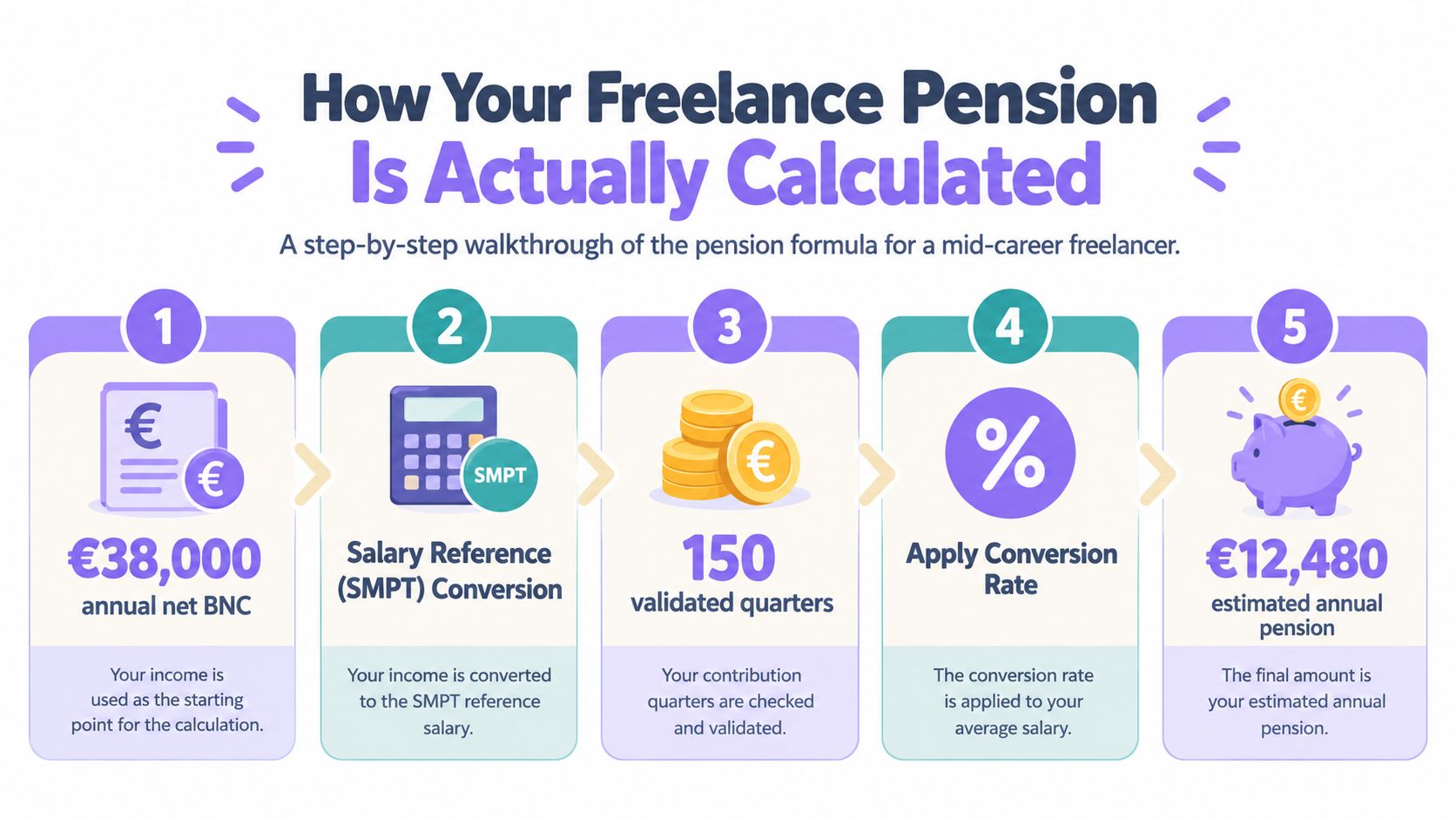
Where the quarter-validation trap appears
The silent killer is not the formula, it's the quarter count. A freelancer declaring €12,000 in a weak year may validate only two quarters instead of four, which slows the build-up of rights without looking dramatic on a monthly cash-flow chart. That's why many independents discover too late that the pension system has been tracking a different story from the one they thought they were writing.
A weak declared year doesn't just lower income, it can also shorten the career base the pension is built on.
Here's the practical result for a well-managed but still typical freelance career, the replacement rate often lands in the roughly 40% to 45% range of pre-retirement income when income has been irregular. That is not a disaster if you've planned for it. It is a problem if you assumed “years worked” automatically meant “retirement secured”.
The conclusion is simple. If your declared income is low or lumpy for long periods, the system doesn't forgive it. Over a 30-year freelance career, the harm builds through fewer validated quarters, a weaker reference income, and a thinner complementary layer. That's why freelance retirement is really a cash-flow design problem with pension consequences.
Building Supplementary Savings on Top of the Mandatory Regime
The mandatory regime should be treated as the floor, never the full plan. Once the base and complementary rights are set, you need a second layer that behaves the way a freelancer actually lives, with uneven income, periods of strong cash flow, and occasional dry spells.
The three tools that matter
PER, life insurance, and complementary schemes such as Madelin each solve a different problem. The right choice depends on three criteria only, tax timing, liquidity, and pension complementarity. Nothing else should distract you.
| Criteria | PER | Life Insurance | Complementary (Madelin) |
|---|---|---|---|
| Tax timing | Strongest pension-style tax lever, because deductions reduce taxable base now | No pension-style deduction advantage at retirement | Useful when you want structured long-term locking |
| Liquidity | Locked for retirement logic, so discipline is built in | Flexible, good for access and transmission | Less liquid, designed for commitment |
| Pension complementarity | Directly aligned with retirement planning | Indirect, useful as a reserve, not the main pension engine | A niche fit for specific high-income profiles |
For most freelancers with a stable income and a meaningful tax rate, PER is the first lever to pull. For irregular earners, or people who may need money before retirement, life insurance is the better parking place because it keeps flexibility. Complementary schemes only make sense when income is high enough and the freelancer is willing to lock capital for the long term.
If you want a practical external benchmark for broader income protection alongside retirement planning, the coast FIRE calculator is useful as a thinking tool, because it forces you to compare savings pace with a target lifestyle. It doesn't replace French pension planning, but it does sharpen the question of how much capital you need to stop leaning on the mandatory system.
For freelancers, I'd be direct. PER is the core optimisation tool, life insurance is the liquidity cushion, and Madelin-type structures are for specific cases, not the default. If you mix them badly, you either trap too much capital or leave too much tax relief on the table.
The 2025 Progressive Retirement Reform and What It Changes
The 2025 reform changes the timing logic for independents who still have a five to ten year runway. From 1 September 2025, the minimum age to enter progressive retirement dropped from 62 to 60 for pensions taking effect from that date, provided the freelancer still meets the 150-quarter condition. That is a real planning shift, not a cosmetic one.
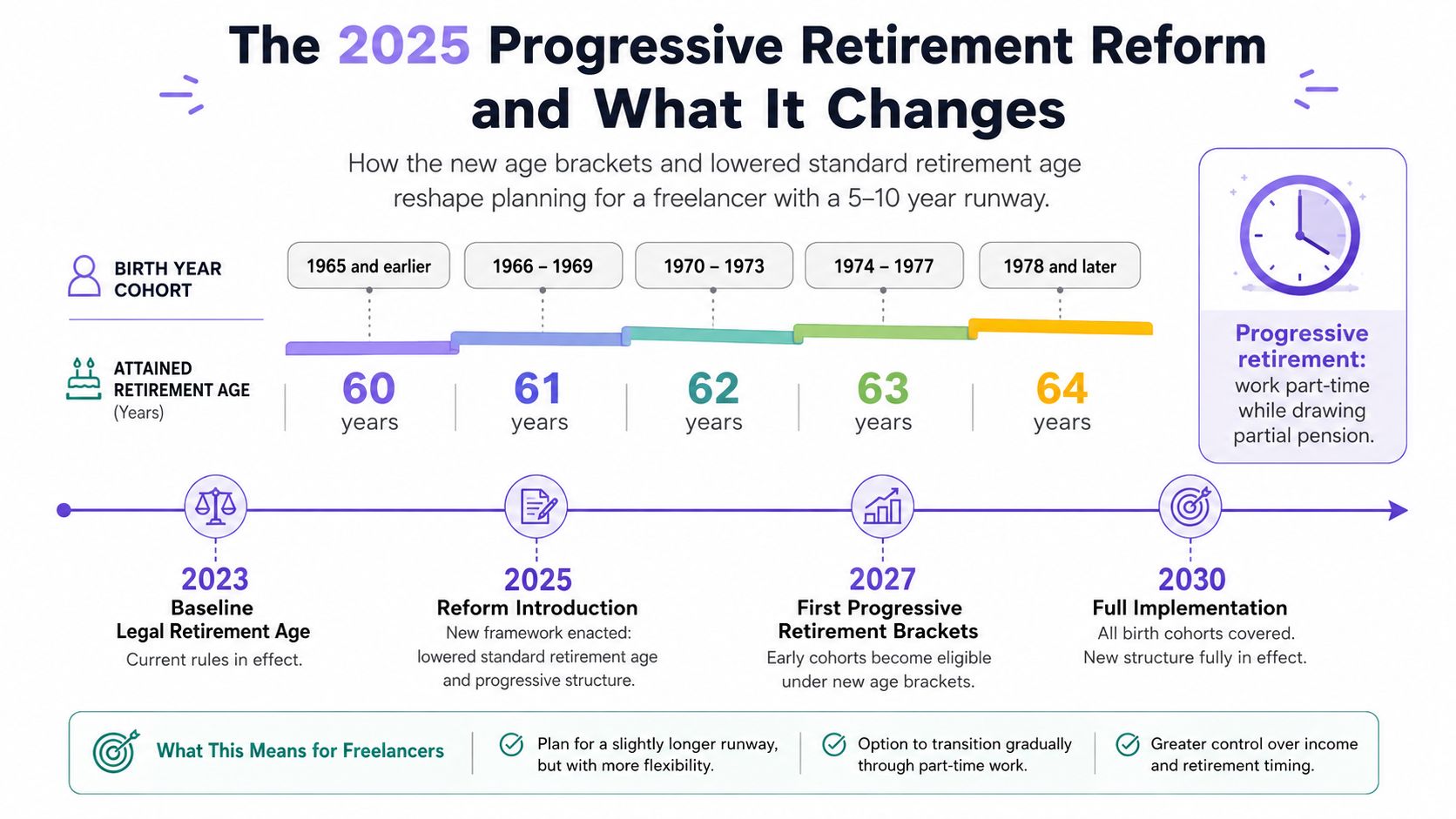
Three timing scenarios freelancers should map now
A 55-year-old who wants an earlier exit should look first at whether progressive retirement can reduce workload without collapsing income. A 50-year-old should think harder about deferring and aiming for a later departure with a better final pension profile. A 45-year-old should be focused on contribution design, because that's the age where the wrong declared-income pattern slowly undermines the end result.
The useful levers here are surcote versus décote, Trimestres de Majoration, and the effect of continued contributions after the legal age. If you work beyond the minimum age with a proper strategy, you can improve the shape of the final pension instead of just pushing the date further out. Since 1 January 2025, some people can even continue accumulating complementary rights in a full cumul emploi-retraite arrangement, which makes the post-retirement phase more strategic than it used to be.
Don't treat the reform as a theoretical headline. Treat it as a planning window that opens or closes based on your last ten working years.
My recommendation is simple. Recheck the thresholds in 2026, because revaluation and parametric changes are part of how this system works. Any plan built today is a 12-month commitment, not a forever forecast.
Estimating Your Future Pension With a Simple Model
You do not need a fancy calculator to get a realistic view of your pension. You need a spreadsheet with four lines, and you need to be honest with the inputs. Start with your average annual income from the 25 best years, then apply the contribution base, then test the quarter count, then add the decote or surcote adjustment.
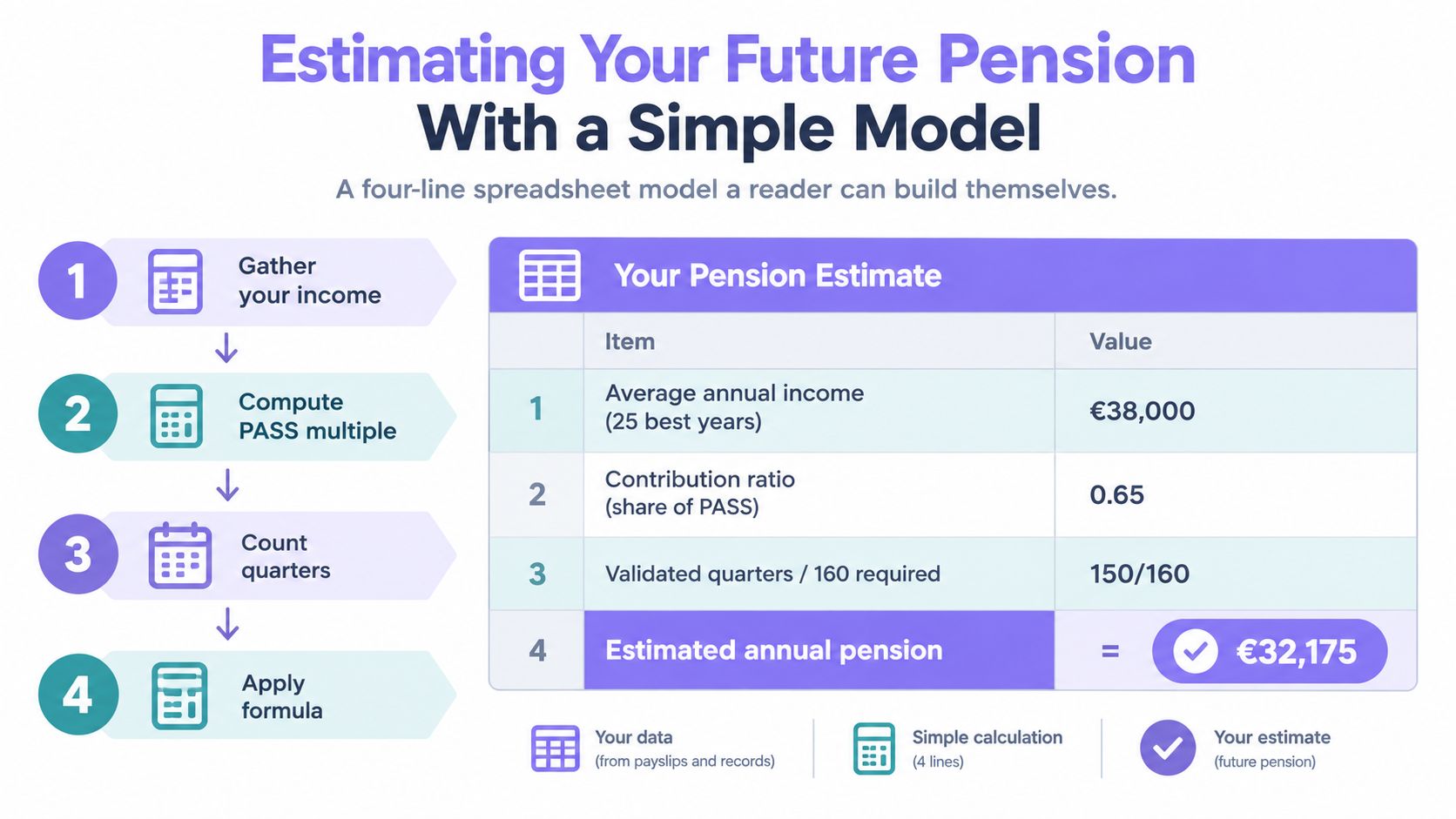
The spreadsheet model I'd use
| Row | Input | Why it matters |
|---|---|---|
| 1 | Average annual income, 25 best years | This anchors the base pension reference |
| 2 | Contribution ratio, share of PASS | This shows how much of your income is actually feeding rights |
| 3 | Validated quarters versus required quarters | This reveals whether you're losing pension years |
| 4 | Estimated annual pension | This is the number you plan against |
A freelancer around €55,000 declared income can still come up short if the income is structured badly. Lowering income to reduce short-term tax can feel clever in the moment, but it often damages quarter validation and weakens the reference base that the pension uses later. That's the trade-off people miss when they focus only on current tax.
If your model shows a gap, fix it with one lever at a time. Raise the contribution base through voluntary PER payments, buy missing quarters where the rules allow it, defer retirement by 18 to 36 months if that improves the final rate, or add a complementary layer such as Madelin if the income level justifies it. A useful way to sanity-check the broader retirement story is the plan for debt-free retirement, because debt service and pension cash flow need to be planned together.
If the pension estimate only works when your income stays high forever, the model is too optimistic.
Common Mistakes That Quietly Shrink a Freelance Pension
The first mistake is assuming that being registered as an auto-entrepreneur automatically means you're building meaningful rights. It doesn't. A quarter still needs the right declared income threshold, and for some activities the quarter only validates when annual revenue clears the level tied to the applicable contribution rate, which makes low-revenue years dangerous for retirement.
Five errors that keep showing up
- Assuming registration equals rights. Fix it by checking quarter validation every year, not every decade.
- Switching from réel to micro without modelling the impact. Fix it before the switch, not after the tax year closes.
- Ignoring the contribution track when revenue is volatile. Fix it by choosing the regime that matches your revenue shape, not your mood.
- Treating the PER like a normal savings account. Fix it by using it as a retirement lever, not an emergency wallet.
- Delaying declarations during sickness or parental leave. Fix it by checking what free quarters or protective rules apply before the year ends.
The second mistake is moving status without pricing the long-term pension effect. Many independents focus only on short-term simplicity, then discover later that the pension profile has been flattened. That's a tax-planning error dressed up as admin convenience.
The third mistake is leaving the complementary side on autopilot when turnover is volatile. The contribution track matters more than people think, because a weak year can send you onto the lowest pension path. For a general operational overview of protection choices, the RC pro freelance guide is useful, but don't confuse business cover with retirement planning.
Finally, don't assume the system will rescue a bad year later. It won't. If the declarations weren't made correctly, the quarters weren't earned, and the pension won't pretend otherwise.
Your 12-Month Freelance Retirement Action Plan
Start with your records. In month one, request your Relevé Individuel de Situation from CNAV and your independent-worker statement from Urssaf. If the statement is messy, fix that first, because every later decision depends on clean data.
The monthly sequence I'd use
- Month 1: Pull the retirement record and the Urssaf statement.
- Month 2: Model your validated quarters and the 25-best-years average.
- Month 3: Choose your contribution track based on revenue stability.
- Months 4 to 5: Open or top up a PER before the year-end deduction window, if the tax profile justifies it.
- Month 6: Add life insurance only as a liquidity bridge, not as a pension substitute.
- Months 7 to 9: Close any pension gap with a voluntary top-up where it makes sense.
- Month 10: Check the 2025 progressive retirement impact on your departure age.
- Months 11 to 12: Put next year's review on the calendar before the new thresholds land.
If you also want a practical way to think about how retirement planning fits into the rest of your financial life, the mutual vs health insurance difference guide is useful because it reminds you that healthcare costs and retirement cash flow need to be planned together. Pension planning fails fastest when it's handled in isolation.
One more point. 2026 thresholds will move, so this plan is not something you file once and forget. Re-run it every year, and treat the review as part of the business, not a side quest.
Wispra helps independents and small businesses get structured visibility across AI search and content channels, and that same clarity is useful when you're making long-term financial decisions. If you want a cleaner way to organise your planning, visit Wispra and see how its visibility tools can support your next decisions.